


Geneos Wealth Management, a full-service broker-dealer headquartered in Centennial, Colorado, has faced regulatory action from both FINRA and the SEC for alleged supervisory failures tied specifically to complex alternative investments, including high-risk options funds and illiquid private placements. A March 2022 FINRA enforcement action resulted in approximately $400,000 in total sanctions, including a $150,000 fine and over $250,000 in restitution to investors harmed by allegedly unsuitable recommendations of the LJM Preservation and Growth Fund and GPB Capital Holdings private placements.
That action followed a prior FINRA sanction in 2015 and a separate SEC administrative proceeding, together reflecting a pattern of compliance and oversight failures documented across multiple product categories and enforcement bodies. Investors who suffered losses through these products may have recovery options with the help of alternative investment loss attorneys.
FINRA and SEC Regulatory Actions Against Geneos Wealth Management
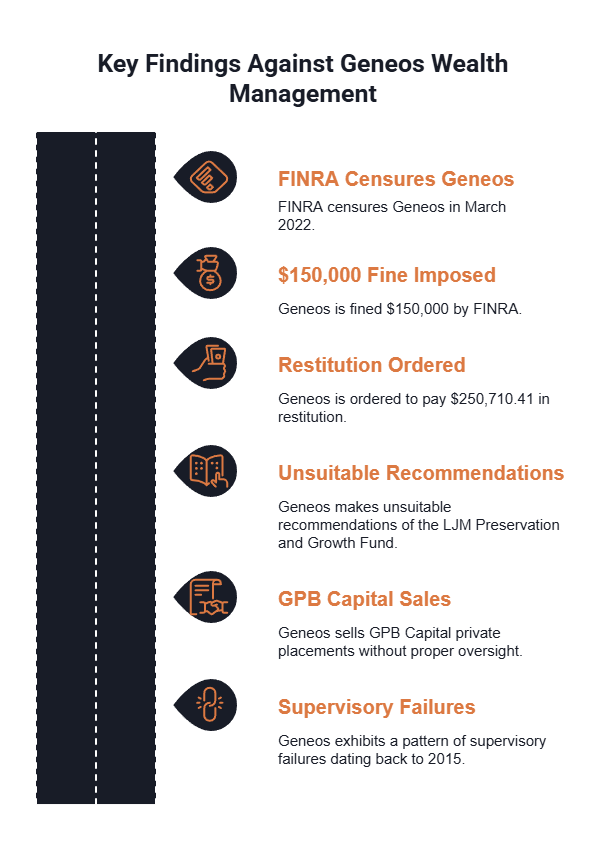
The regulatory record against Geneos Wealth Management’s BrokerCheck profile (CRD #120894) reveals a pattern of supervisory breakdowns and compliance failures spanning multiple years and product categories.
On March 18, 2022, FINRA issued a Letter of Acceptance, Waiver and Consent (AWC) that censured Geneos Wealth Management, fined the firm $150,000, and ordered restitution of $250,710.41 to affected investors. According to FINRA’s findings, Geneos brokers allegedly made unsuitable recommendations of the LJM Preservation and Growth Fund, a high-risk product employing an uncovered options strategy, without adequately disclosing the significant downside risks to customers. The same AWC addressed Geneos’s role in selling private placements issued by GPB Capital Holdings in a manner that allegedly contributed to customer harm, bringing total sanctions to approximately $400,000.
Prior to the 2022 enforcement action, FINRA had already sanctioned the firm. In December 2015, a separate AWC resulted in a $12,500 fine against Geneos Wealth Management for failing to supervise registered representatives who sold limited partnership interests to customers through outside business activities, without recording those transactions on the firm’s books and records.
Additionally, an SEC administrative order (Exchange Act Release No. 83003; Advisers Act Release No. 4877) details a series of compliance and supervisory failures by Geneos Wealth Management under the Securities Exchange Act of 1934 and the Investment Advisers Act of 1940. The SEC’s findings further underscore the firm’s alleged inability to maintain adequate compliance systems and oversight protocols.
Key regulatory milestones include:
- March 2022: FINRA censure, $150,000 fine, and $250,710.41 restitution for unsuitable LJM Preservation and Growth Fund recommendations and GPB Capital sales
- 2018: SEC administrative proceeding (Release No. 83003) documenting compliance and supervisory failures under federal securities laws
- December 2015: FINRA AWC imposing a $12,500 fine for failure to supervise limited partnership sales conducted through outside business activities

We Have Recovered Over
$350 Million for Our Clients Nationwide.
How Geneos Wealth Management’s Supervisory Failures Harmed Investors
The regulatory findings against Geneos Wealth Management go far beyond administrative technicalities. They describe alleged failures that caused real, measurable harm to individual investors, many of them retirement-age clients who had no business being placed in volatile, complex products.
The LJM Preservation and Growth Fund used an uncovered options strategy that carried catastrophic downside risk. When a spike in market volatility triggered the fund’s collapse in February 2018, some investors lost nearly their entire principal within days. FINRA’s AWC found that Geneos brokers allegedly made those recommendations without establishing product suitability or ensuring customers understood what they were being sold.
GPB Capital Holdings private placements presented a separate and equally serious problem. These illiquid, high-fee products were allegedly sold without adequate due diligence or supervisory oversight, and GPB Capital itself later became the subject of both an SEC enforcement action and FBI investigation, leaving investors locked into positions with no clear path out. MWW has previously pursued and recovered full investment losses for a GPB Capital investor, demonstrating what accountability in these cases can look like.
The 2015 AWC adds historical context, showing that Geneos’s supervisory failures were not new. Representatives were already conducting securities transactions outside the firm’s oversight years before these products were ever recommended.
Investors who held LJM or GPB Capital products through Geneos, or whose accounts show signs of overconcentration, undisclosed risk, or transactions they didn’t fully authorize, may have viable claims for recovery through arbitration.
How Meyer Wilson Werning Can Help
Meyer Wilson Werning represents investors nationwide who have suffered losses from unsuitable recommendations, supervisory failures, and brokerage firm misconduct, including the types of alleged violations documented in the regulatory record against Geneos Wealth Management. Since 1999, our attorneys have recovered over $350 million for clients through FINRA arbitration and securities litigation, and we handle every case on a pure contingency fee basis. You pay nothing unless we recover for you.
If your losses involve LJM Preservation and Growth Fund recommendations, GPB Capital private placements, or other products sold through Geneos Wealth Management, contact us today for a free and confidential consultation to discuss your options.
Our lawyers are nationwide leaders in investment fraud cases.
Frequently Asked Questions
What regulatory actions have been taken against Geneos Wealth Management for alleged fraud or misconduct?
Geneos Wealth Management (CRD #120894) has faced multiple FINRA and SEC actions. In March 2022, FINRA censured the firm and imposed approximately $400,000 in total sanctions, including a $150,000 fine and $250,710.41 in restitution, for allegedly failing to supervise unsuitable recommendations of the LJM Preservation and Growth Fund. A 2015 FINRA AWC fined the firm $12,500 for failing to supervise representatives who sold limited partnership interests without recording transactions on the firm’s books.
What does Geneos Wealth Management’s BrokerCheck record under CRD 120894 show for investors?
Geneos Wealth Management’s BrokerCheck profile under CRD #120894 reflects FINRA sanctions involving allegedly unsuitable recommendations of the LJM Preservation and Growth Fund and GPB Capital private placements, as well as supervisory failures tied to outside business activities and limited partnership sales. Investors should focus on the nature of the supervisory violations, the product types involved, and any firm-level disclosures indicating broader compliance weaknesses.
How can investors recover losses related to Geneos Wealth Management’s LJM or GPB Capital recommendations?
Investors who suffered losses from Geneos’s alleged LJM or GPB Capital recommendations may be able to pursue recovery through FINRA arbitration. FINRA’s 2022 AWC found that brokers allegedly made unsuitable recommendations and failed to properly disclose risks, supporting claims that the firm breached its suitability and supervisory obligations. Claims can be brought against the firm itself even if the recommending broker is no longer employed there.
What types of misconduct are commonly alleged against Geneos Wealth Management?
Allegations against Geneos have focused on supervisory failures, unsuitable recommendations of complex and high-risk products, and inadequate risk disclosure related to alternative investments like LJM and GPB Capital. When a firm fails to supervise its brokers or allows unsuitable concentration in volatile products, investors can face losses inconsistent with their risk tolerance and investment objectives.
Recovering Losses Caused by Investment Misconduct.