


In 2025, Regulation Best Interest enforcement reached record levels, with FINRA filing 44 formal enforcement actions against brokers and broker-dealers for failing to meet the best interest standard when recommending investments to retail customers.
That figure represents more than double the 21 cases filed in 2023 and a meaningful increase from the 38 cases filed in 2024. For investors who suffered losses from recommendations that did not align with their financial situation, risk tolerance, or stated objectives, this enforcement trend signals that the conduct they experienced may be actionable.
If you or a family member experienced significant investment losses because a broker failed to act in your best interest, Meyer Wilson Werning can help. Our team of experienced broker misconduct attorneys focus on representing investors who have been misled by financial professionals. Contact us for a free and confidential consultation.
FINRA Enforcement Numbers Tell the Story
Regulation Best Interest has been on the books since 2020, but for the first several years after its compliance deadline, enforcement activity was relatively measured. That changed meaningfully in 2023 and has continued to accelerate. FINRA has made clear through its public statements and enforcement calendar that Reg BI compliance is no longer a grace period issue, it is an active supervisory priority, and firms and brokers who have not adjusted their practices are now facing formal consequences.
- 2023: 21 formal enforcement actions tied to Reg BI violations
- 2024: 38 formal enforcement actions, nearly doubling the prior year
- 2025: 44 formal enforcement actions, setting a new high
Beyond those formal filings, FINRA also issued approximately 40 settlement letters or complaints through late November 2025, with 25 of those actions brought directly against individual brokers rather than firms. That breakdown matters because it suggests regulators are not limiting scrutiny to firm-level compliance programs. Individual brokers who made recommendations that prioritized commissions or proprietary products over client needs are being held accountable.
Reg BI became effective on September 10, 2019, with a compliance deadline of June 30, 2020. Every broker-dealer recommendation made after that date is measured against the best interest standard rather than the earlier suitability standard under FINRA Rule 2111.

We Have Recovered Over
$350 Million for Our Clients Nationwide.
What Regulation Best Interest Requires of Brokers
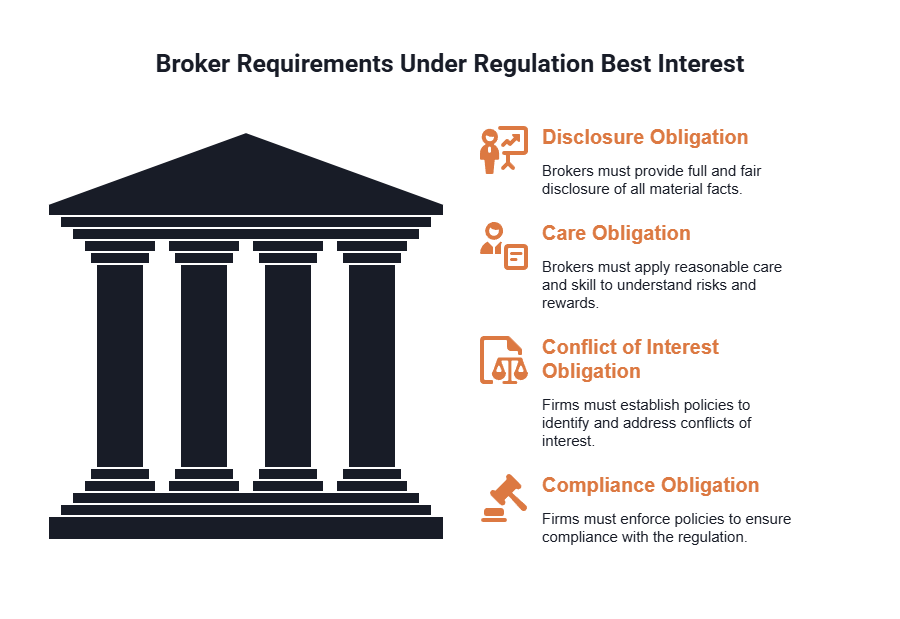
Under Reg BI, a broker-dealer must satisfy four distinct obligations before recommending any securities transaction or investment strategy to a retail customer:
- Disclosure Obligation: The broker must provide, before or at the time of the recommendation, full and fair disclosure of all material facts about the scope and terms of the relationship, including fees, costs, and conflicts of interest.
- Care Obligation: The broker must apply reasonable care, thoroughness, and skill to understand the risks, rewards, and costs of the recommendation and must have a reasonable basis to believe the recommendation is in the customer’s best interest based on that customer’s investment profile.
- Conflict of Interest Obligation: The firm must establish, maintain, and enforce written policies and procedures designed to identify and address conflicts of interest associated with recommendations.
- Compliance Obligation: The firm must establish, maintain, and enforce written policies and procedures reasonably designed to achieve compliance with the entire regulation.
These obligations apply to recommendations of securities transactions or investment strategies involving securities, including account type recommendations. Self-directed trades and unsolicited transactions fall outside Reg BI’s scope, but any recommendation a broker initiates is covered. When a broker steers a client toward a higher-cost product, an unnecessarily risky strategy, or a transaction that generates commissions without a corresponding benefit to the client, that recommendation may fall short of the best interest standard.
How Reg BI Violations Harm Investors
Reg BI violations can take many forms, but they frequently involve one or more of the following patterns:
- Unsuitable investment recommendations: A broker recommends products that do not match the client’s age, income, net worth, investment objectives, or risk tolerance.
- Churning and excessive trading: A broker executes frequent trades in a client’s account primarily to generate commissions, driving up costs without a corresponding benefit.
- Undisclosed conflicts of interest: A broker recommends proprietary products or revenue-sharing arrangements without explaining how those products benefit the broker or firm rather than the client.
- Account-type steering: A broker recommends a commission-based brokerage account over a fee-based advisory account (or vice versa) based on the broker’s compensation rather than the client’s needs.
Investors affected by these practices often see their account values decline while transaction costs and fees accumulate. The losses may appear gradually across monthly statements, making them easy to overlook until the cumulative damage is substantial.
For conduct occurring after June 30, 2020, the SEC’s Regulation Best Interest established an obligation that goes beyond the earlier suitability standard. Under FINRA Rule 2111 (Suitability), brokers were required to have a reasonable basis to believe a recommended investment was suitable for the client’s unique financial situation, age, and risk tolerance. Reg BI raised that bar by requiring brokers to act in the customer’s best interest and to address conflicts of interest rather than merely disclosing them.
Our lawyers are nationwide leaders in investment fraud cases.
Warning Signs That a Broker May Have Violated Reg BI
Investors should watch for the following indicators that a broker’s recommendations may not have met the best interest standard:
- Account statements showing frequent buying and selling of the same or similar securities over short periods
- High commission charges or fee ratios relative to the account’s overall value
- Recommendations concentrated in complex, illiquid, or high-risk products that do not match the investor’s stated objectives
- A broker who discourages questions about fees, product alternatives, or the reasons behind a specific recommendation
- Account performance that consistently lags the investor’s stated benchmark or objective despite active management
- Communications from the firm about new account types or product changes that are difficult to understand
These warning signs do not automatically establish a violation, but they may indicate that the broker’s conduct warrants closer review. According to FINRA Regulation Best Interest guidance, broker-dealers bear the burden of demonstrating compliance with each of the four obligations when a recommendation is challenged.
We Are The firm other lawyers
call for support.
How Meyer Wilson Werning Can Help
The surge in Regulation Best Interest enforcement confirms what many investors have experienced firsthand: brokers across the industry have failed to meet the obligations Reg BI imposes. When those failures produce real financial harm, investors have the right to pursue recovery through FINRA arbitration or other legal channels.
Meyer Wilson Werning represents investors nationwide who have been harmed by Reg BI violations, broker misconduct, churning, and unsuitable recommendations. With more than 75 years of combined experience and over $350 million recovered for our clients, our team is dedicated to holding negligent firms accountable. Contact us today for a free and confidential consultation to discuss your path to recovery.
Frequently Asked Questions

What is Regulation Best Interest enforcement?
Regulation Best Interest enforcement refers to SEC actions against broker-dealers or brokers that fail to act in a retail customer’s best interest when making recommendations. Reg BI became effective on September 10, 2019, and broker-dealers had to comply by June 30, 2020. Enforcement can involve allegations such as unsuitable investment recommendations, conflicts of interest, or other sales-practice violations.
Why has FINRA Reg BI enforcement increased in 2025?
FINRA Reg BI enforcement increased in 2025 because regulators have intensified scrutiny of broker recommendations that generate higher fees or expose investors to unnecessary risk. Public reports indicate 44 formal enforcement actions in 2025, compared with 21 in 2023 and 38 in 2024. That trend suggests regulators are treating broker best interest standard violations as a higher priority.
What evidence is useful in a Regulation Best Interest complaint?
Account statements, trade confirmations, emails with the broker, and new account forms are among the most useful records in a Regulation Best Interest complaint. Those documents can help show unsuitable investment recommendations, churning broker misconduct, or whether the broker ignored the customer’s investment objectives and risk tolerance. A clear timeline of the recommendation and the losses that followed can also strengthen the claim.
How does a Reg BI violation affect investors?
A Reg BI violation can lead to higher fees, unnecessary risk, or losses from recommendations that were not in the investor’s best interest. SEC guidance states that Reg BI applies to broker-dealer recommendations, not unsolicited trades or self-directed transactions. Investors who were steered into costlier accounts or products may have a potential claim based on the broker best interest standard.
Recovering Losses Caused by Investment Misconduct.