


Your broker may have shown you an impressive projected return. What FINRA just did makes it significantly harder for you to hold them accountable for it.
FINRA has amended its proposed update to Rule 2210, the rule governing what broker-dealers are allowed to tell you about performance, and the revised version strips out several of the specific protections that were designed to keep those projections honest. The story was first reported by Financial Advisor IQ (FA-IQ), the financial trade publication covering the advisory industry, where Courtney Werning of Meyer Wilson Werning, who sits on FINRA’s own regulatory committee, called “a significant step backward for investor protection.”
If a financial professional recommended an investment to you based on projected returns or targeted performance figures that proved unrealistic, the securities fraud attorneys at Meyer Wilson Werning can evaluate whether your losses are the result of actionable misconduct. Contact us today for a free and confidential consultation, and you pay nothing unless we recover for you.
What FINRA’s Rule 2210 Originally Said and Why Performance Projections Were Prohibited
FINRA Rule 2210 governs how broker-dealers communicate with the public. For decades, it has broadly prohibited broker-dealer communications from predicting or projecting performance, implying that past results will repeat, or making exaggerated or unwarranted claims. The rationale was straightforward: forward-looking return claims can mislead investors, particularly retail investors without the financial background to distinguish an assumption-based estimate from a promise.
The rule allowed only narrow exceptions, including mathematical hypothetical illustrations, investment analysis tools meeting specific FINRA standards, and price targets in research reports accompanied by required disclosures. Projected performance for individual securities or investment strategies in general marketing communications was simply not permitted.

We Have Recovered Over
$350 Million for Our Clients Nationwide.
What FINRA Originally Required and Why It Mattered for Investors
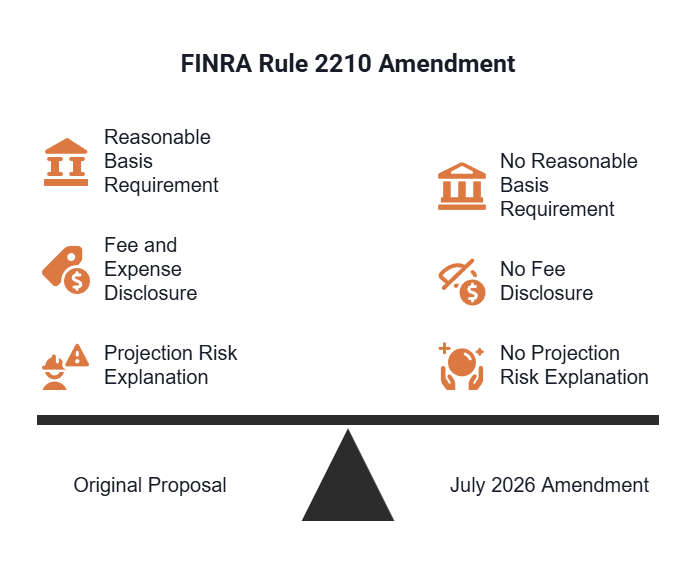
Until recently, FINRA’s proposal to allow performance projections came with a set of conditions that would have given investors a meaningful layer of protection. The rule, as originally written, would not have simply opened the door and walked away. It would have required broker-dealers to meet specific, enforceable standards before showing a projected return to any client.
Under the original proposal, a firm could only present projected performance or targeted returns if it:
- Adopted and maintained written policies and procedures ensuring the communication was appropriate for the intended audience’s financial situation and investment objectives
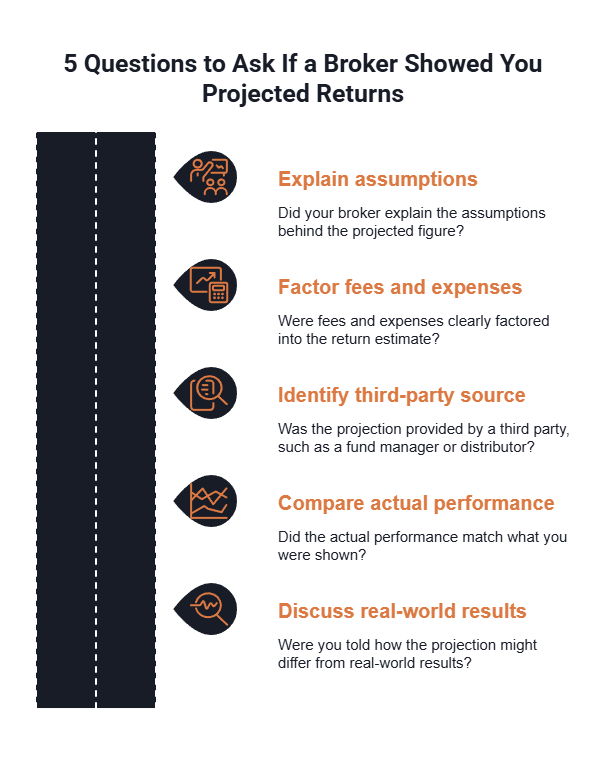
- Provided sufficient information for the audience to understand the projection’s underlying criteria and assumptions, including whether anticipated fees and expenses were factored in
- Disclosed the risks and limitations of the projection and explained why estimated returns might differ from actual results
- Established a “reasonable basis” for the underlying criteria and assumptions used to produce the projection
- Retained written records supporting that methodology
These were not bureaucratic formalities. Together, they meant that a broker-dealer could not simply pass along a fund manager’s projection and call it a day. The firm would need to independently verify the basis for that number, document its work, and stand behind it. That is the kind of accountability that protects investors when projected returns and actual results do not match.
Can your broker now pitch you performance projections without actually verifying them?
byu/MeyerWilsonCo ininvestorclaims
FINRA Then Amended the Proposal and Removed the Safeguards
When the SEC’s comment window closed, broker-dealers had made themselves heard. FINRA Vice President and Associate General Counsel Joseph Savage submitted a revised version of the rule that removed several of its most investor-protective provisions. The industry argued the original conditions were too burdensome. FINRA agreed.
The most significant removal was the “reasonable basis” requirement, which had obligated broker-dealers to independently verify the assumptions behind any projected return before presenting it to clients. Gone too was the requirement to disclose whether a projection accounts for anticipated fees and expenses, and the requirement to explain why projected returns might differ from actual performance.
Savage’s letter to the SEC cited Rule 2210’s existing general content standards as a sufficient substitute for all three. “FINRA believes that, in retrospect, these disclosure requirements may be too narrow,” he wrote.
In other words, FINRA replaced specific, auditable obligations with principles that already existed before this rule was ever proposed. The amended proposal was published in the Federal Register on July 8, 2026, opening a 21-day public comment period.
Our lawyers are nationwide leaders in investment fraud cases.
Why Investor Advocates Are Calling This a Step Backward
The investor protection community’s response has been pointed.
Courtney Werning, Principal at Meyer Wilson Werning, incoming PIABA President in 2027, chair of PIABA’s arbitration committee, and an appointee to FINRA’s own National Arbitration and Mediation Committee, was direct. “Specific rules exist because general ones are not enough,” Werning told FA-IQ. “This is a significant step backward for investor protection.”
Her concern goes to the core of what the reasonable basis requirement was designed to prevent. “The idea that a broker-dealer should be able to pass along a third-party projection without independently substantiating it is deeply troubling,” she added.
Michael Bixby, president of the Public Investors Advocate Bar Association (PIABA), had opposed the performance projection expansion even before the July amendment. His concern is about what happens at the point of sale. “Allowing members to make projections with complicated disclaimers will almost certainly result in greater investor confusion, and it is difficult to see how these changes advance FINRA’s investor protection mission,” Bixby told FA-IQ.
He added a warning about what effective oversight would require if the amended rule is adopted: “Supervision and compliance will need to watch any such communications like a hawk and FINRA will need to take real regulatory enforcement actions to curb abuses.”
We Are The firm other lawyers
call for support.
What Stays and What It Actually Covers
The amended proposal retains some requirements. Firms must still maintain written policies and procedures, and they must keep written records supporting the methodology behind any projection they present. Rule 2210’s baseline content standards, requiring communications to be fair, balanced, and not misleading, continue to apply.
FINRA has argued that the amended rule more closely aligns with the SEC’s Marketing Rule, which governs how investment advisers present performance projections, satisfying concerns raised by industry commenters about compliance complexity.
But alignment with the SEC Marketing Rule does not resolve the investor protection concern at the heart of the debate. The reasonable basis requirement would have obligated broker-dealers to independently verify what they present to clients. Without it, a broker can relay a third-party projection from a fund sponsor, a product distributor, or an outside manager without performing any independent analysis of the assumptions behind it. General fairness standards are not the same thing as a specific, auditable obligation to independently substantiate a projection.
What This Means If You Were Sold an Investment Based on Projected Returns
A projected return figure is persuasive. It is designed to be. When a broker shows you a number tied to an investment they are recommending, that number carries weight regardless of the disclosures surrounding it. If those projections proved unrealistic, if the fees were never clearly explained, or if the investment turned out to be unsuitable for your situation, the fact that FINRA has now loosened the rules going forward does not erase what your broker was required to do when they made that recommendation to you.
With more than $350 million recovered for investors nationwide, Meyer Wilson Werning has spent over 25 years holding broker-dealers accountable for exactly this kind of misconduct. If a broker’s use of projected performance claims contributed to your losses, contact us today for a free and confidential consultation. You pay nothing unless we recover for you.
Frequently Asked Questions

What did FINRA’s Rule 2210 originally say about performance projections?
FINRA Rule 2210 has long prohibited broker-dealer communications from predicting or projecting performance, implying past results will recur, or making exaggerated claims. Narrow exceptions existed for mathematical hypothetical illustrations and price targets in research reports with required disclosures.
What did FINRA propose to change, and what did the July 2026 amendment remove?
FINRA’s original proposal would have allowed broker-dealers to present projected returns if they met four conditions: written policies and procedures, a reasonable basis for the assumptions used, written records supporting that methodology, and disclosures about fees and the risk that projections might differ from actual results. The July 2026 amendment removed the reasonable basis requirement, the fee disclosure requirement, and the requirement to explain why projections might differ from actual performance.
Why is removing the “reasonable basis” requirement a problem for investors?
Without this requirement, a broker can relay a third-party projection from a fund manager or distributor without performing any independent analysis of its validity. Courtney Werning has argued that Rule 2210’s general content standards are not an adequate substitute for this specific, enforceable obligation.
Does Regulation Best Interest still apply if a broker presents projected returns?
Yes. If a broker-dealer presents projected performance as part of a recommendation to a retail customer, that recommendation must still satisfy Regulation Best Interest, requiring the broker to act in the customer’s best interest and consider their risk tolerance and financial profile. A projection used to support an unsuitable recommendation could still form the basis of an investor claim.
How long is the SEC comment period on the amended FINRA proposal?
The amended proposal was published in the Federal Register on July 8, 2026, beginning a 21-day public comment period. Investors, legal practitioners, and market participants may submit comments to the SEC during that window.
Recovering Losses Caused by Investment Misconduct.