


FINRA has censured and fined Merrill Lynch, Pierce, Fenner & Smith Incorporated $175,000 for a near three-year failure to give self-directed clients the information they were owed before buying municipal bonds at a market discount.
Between January 2021 and September 2023, the firm executed 4,181 municipal securities purchases totaling approximately $87 million in principal across 1,072 accounts without disclosing that the accreted market discount on those bonds would be taxed as ordinary income rather than at the more favorable capital gains rate. FINRA treats that tax consequence as information investors are entitled to receive at or before the time of trade. Merrill Lynch had no written procedures to ensure those disclosures were made, and no process to test whether they were being made at all.
If you or a family member purchased municipal bonds through Merrill Lynch’s self-directed platform during this period and experienced unexpected tax consequences, Meyer Wilson Werning can help. Our team of experienced broker misconduct attorneys focuses on representing investors who have been harmed by disclosure failures and supervisory breakdowns at major brokerage firms. Contact us for a free and confidential consultation.
What Happened: The Merrill Lynch FINRA Fine for Municipal Bond Violations
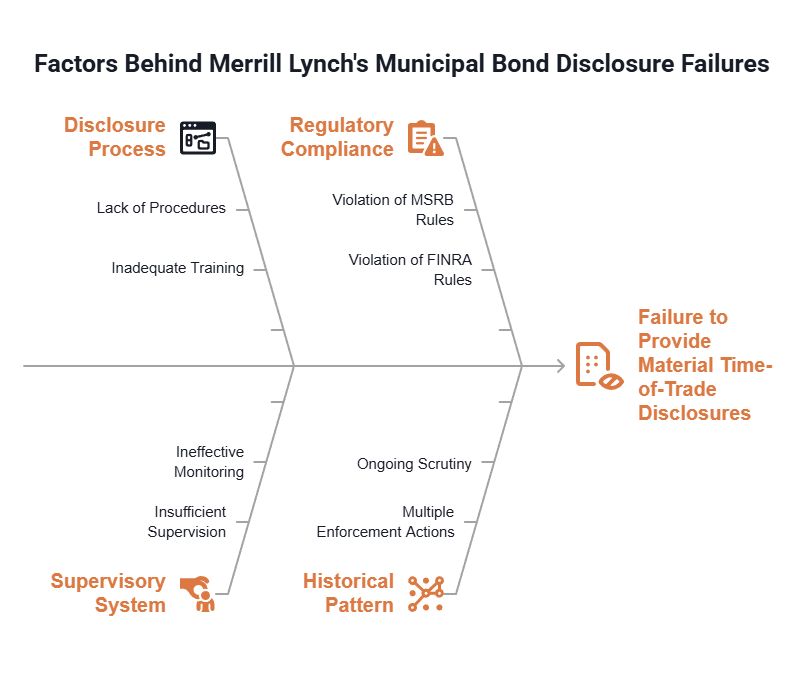
FINRA determined that Merrill Lynch failed to provide material time-of-trade disclosures on municipal bond purchases made through its self-directed platform over a nearly three-year period. The key facts of the enforcement action include:
- 4,181 municipal securities purchases totaling approximately $87 million in principal value were executed without required market discount disclosures
- 1,072 self-directed customer accounts were affected between January 2021 and September 2023
- Merrill Lynch did not disclose that non-de minimis market discounts on the purchased municipal bonds could cause part of investors’ returns to be taxed as ordinary income rather than at the lower capital gains rate
- FINRA found that the firm did not establish or maintain a supervisory system and written procedures reasonably designed to ensure market discount disclosures were delivered on its self-directed platform
- Merrill Lynch updated its procedures and added market discount disclosures for applicable transactions on its self-directed platform in September 2023
FINRA concluded that Merrill Lynch violated MSRB Rule G-47 (time-of-trade disclosure), MSRB Rule G-27 (supervision of municipal securities activities), and FINRA Rule 2010 (standards of commercial honor and just and equitable principles of trade).
This is not an isolated incident. Merrill Lynch has faced multiple FINRA enforcement actions over the years involving supervisory failures, reporting deficiencies, and municipal securities violations, reinforcing a pattern that investors and regulators continue to scrutinize.


We Have Recovered Over
$350 Million for Our Clients Nationwide.
How Market Discount Disclosure Failures Harm Municipal Bond Investors
Municipal bonds are often purchased specifically for their tax advantages. Interest income from most municipal bonds is exempt from federal income tax, and in many cases, from state and local taxes as well. Investors who rely on this favorable tax treatment to plan their retirement income or portfolio strategy are entitled to know when that tax advantage may not apply as expected.
When a municipal bond is purchased at a “market discount,” meaning the purchase price is below the bond’s adjusted issue price by more than a de minimis amount, part or all of the gain realized at maturity or upon sale may be reclassified as ordinary income. This distinction matters significantly:
- Ordinary income tax rates can be as high as 37% for federal purposes, compared to a maximum long-term capital gains rate of 20%
- An investor who believed their municipal bond gains would be taxed at capital gains rates could face a substantially higher tax bill than anticipated
- For retirees and income-focused investors, these unexpected tax liabilities can erode the very returns that made municipal bonds attractive in the first place
By failing to disclose these market discount tax implications at the time of trade, Merrill Lynch allegedly deprived investors of the information necessary to make fully informed decisions about whether those particular municipal bonds aligned with their financial goals and tax situations.
MSRB Rule G-47, Supervisory Obligations, and the Rules Merrill Lynch Violated
The regulatory framework governing municipal securities transactions imposes clear disclosure and supervisory duties on broker-dealers like Merrill Lynch. Understanding these rules helps illustrate why FINRA treated this matter as a serious compliance failure.
MSRB Rule G-47: Time-of-Trade Disclosure
MSRB Rule G-47 requires broker-dealers to disclose all material information about a municipal securities transaction to the customer at or before the time of trade. Municipal bond investors frequently purchase these securities for their favorable tax treatment, which makes the tax consequence of a market discount directly material. When a bond carries a non-de minimis market discount, the potential for ordinary income tax treatment on a portion of the gain must be communicated before the trade is executed.
MSRB Rule G-27: Supervision of Municipal Securities Activities
MSRB Rule G-27 requires firms engaged in municipal securities activities to establish and maintain a system of supervision, including written supervisory procedures, reasonably designed to ensure compliance with applicable rules. FINRA found that Merrill Lynch’s supervisory system and written procedures were not reasonably designed to ensure that time-of-trade market discount disclosures were provided to customers on its self-directed platform.
FINRA Rule 2010: Standards of Commercial Honor
FINRA Rule 2010 requires member firms to observe high standards of commercial honor and just and equitable principles of trade. Violations of MSRB rules in connection with municipal securities transactions also constitute violations of this foundational standard.
Investors who purchased municipal bonds through Merrill Lynch during the affected period and who were not provided with required market discount disclosures may have grounds to pursue recovery through arbitration. Claims may include breach of the duty of fair dealing and failure to supervise.
Our lawyers are nationwide leaders in investment fraud cases.
How Meyer Wilson Werning Can Help
Merrill Lynch’s $175,000 FINRA fine confirms that the firm failed in its obligation to provide material disclosures to municipal bond investors for nearly three years. While the regulatory fine addresses the firm’s compliance failures, it does not compensate individual investors who may have suffered real financial harm, including unexpected tax liabilities and diminished returns, as a result of these disclosure failures.
Meyer Wilson Werning represents investors nationwide who have been harmed by broker misconduct and disclosure failures at major brokerage firms. With more than 75 years of combined experience and over $350 million recovered for our clients, our team is dedicated to holding negligent firms accountable. Led by founding partner David P. Meyer, our attorneys understand the complexities of municipal securities regulations and have extensive experience pursuing FINRA arbitration claims on behalf of investors who were denied critical information about their investments.
Contact us today for a free and confidential consultation to discuss whether you have a path to recovery.
We Are The firm other lawyers
call for support.
Frequently Asked Questions

Why did FINRA fine Merrill Lynch $175,000 over municipal bond disclosures?
FINRA fined and censured Merrill Lynch for failing to provide required time-of-trade disclosures on 4,181 municipal securities purchases totaling approximately $87 million across 1,072 self-directed accounts between January 2021 and September 2023. The firm did not inform investors that market discounts on those bonds could result in ordinary income tax treatment rather than the lower capital gains rate, and lacked adequate supervisory procedures to ensure those disclosures were made.
What is MSRB Rule G-47 and how did Merrill Lynch violate it?
MSRB Rule G-47 requires broker-dealers to provide customers with all material information about a municipal bond transaction, including market discount and tax treatment, at or before the time of trade. FINRA found Merrill Lynch violated this rule by systematically failing to disclose that returns from market discount bonds could be taxed as ordinary income across thousands of transactions on its self-directed platform.
How can Merrill Lynch’s municipal bond disclosure failures harm investors?
Without proper market discount disclosures, investors may face unexpectedly higher ordinary income taxes rather than the lower capital gains rates they anticipated, reducing net returns. Investors who were not warned may have claims against the firm for disclosure failures and supervisory violations through FINRA arbitration.
Recovering Losses Caused by Investment Misconduct.