


Congress is moving to fix one of the most counterintuitive problems in the federal tax code, a rule that allows the IRS to treat stolen money as taxable income. The Tax Relief for Fraud Victims Act, introduced as H.R. 9500, would restore and expand federal tax deductions for Americans who have lost money to scams, investment fraud, and other forms of theft involving deceit or misrepresentation.
With consumers reporting $15.9 billion in fraud losses to the FTC in 2025, a 27 percent increase from the prior year, and current tax law leaving most private-sector fraud victims without meaningful deductions, this bipartisan bill addresses a gap that has affected investors, retirees, and everyday consumers since 2018. The House Ways and Means Committee unanimously approved H.R. 9500 on July 1, 2026, by a vote of 39 to 0, sending the bill toward the full House for consideration.
Courtney Werning was featured in Inc. Magazine’s August 2026 coverage of this issue and cited by WSB-TV and Totally The Bomb for speaking out on the urgency of H.R. 9500. Having represented fraud victims who faced tax liability on top of a total financial loss, the firm’s attorneys understand exactly why this bill matters beyond the policy level.
Investors affected by fraud or misconduct may also want to explore their investment loss recovery options beyond the tax code.
What H.R. 9500 Would Change for Fraud Victims

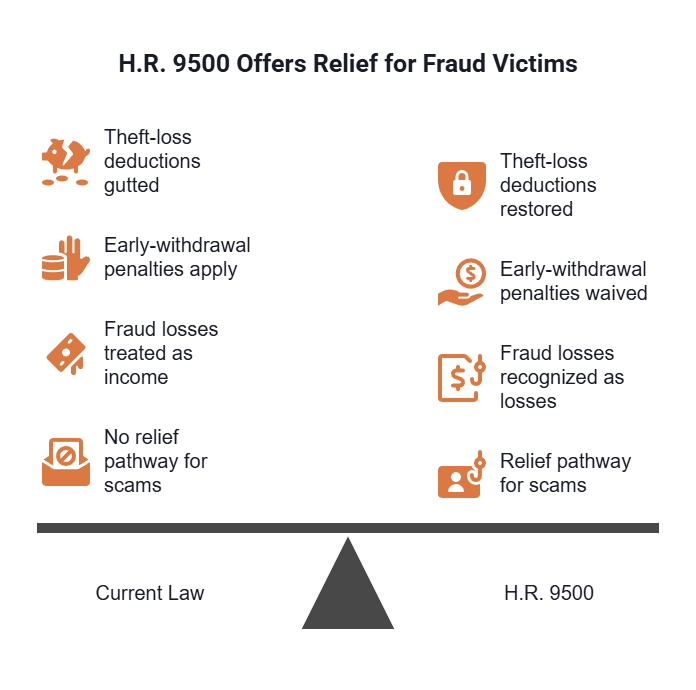
Under current law, personal casualty and theft loss deductions are largely suspended unless the loss is tied to a federally or state declared disaster. That restriction was put in place by the Tax Cuts and Jobs Act of 2017 and was originally set to expire after the 2025 tax year, which would have automatically restored the deduction. Instead, the One Big Beautiful Bill Act made the limitation permanent, expanding the exemption only to include state-declared disasters. H.R. 9500 is a direct legislative response to that change, effectively eliminated deductions for victims of Ponzi scheme fraud, identity theft, romance scams, business email compromise, cryptocurrency schemes, and other private-sector fraud. The bill was introduced by Representative Max Miller (R-OH) and Representative Tom Suozzi (D-NY).
H.R. 9500, the Tax Relief for Fraud Victims Act, would make several targeted changes to restore and improve relief for these investors.

We Have Recovered Over
$350 Million for Our Clients Nationwide.
The Four Key Provisions of the Bill
- Repeal of the disaster-only limitation. The bill would remove the requirement that personal casualty and theft losses be linked to a declared disaster, allowing qualifying losses to be deducted subject to a 10 percent of adjusted gross income threshold.
- Modified timing rules for theft losses. Victims of theft involving fraud, deceit, or misrepresentation could elect to treat their loss as sustained in the taxable year when the loss actually occurred, rather than the year the theft was discovered. This change would allow taxpayers to file amended returns for earlier years.
- Extended refund claim periods. The bill would give victims at least one year after discovering a theft loss to file claims for credits or refunds and would remove certain limits that currently reduce refund amounts.
- Retirement account relief. H.R. 9500 adds an exception to the 10 percent additional tax on early retirement-plan distributions when those distributions are connected to fraudulent theft losses. Victims could also repay those distributions to an eligible account and seek refunds for taxes already paid on them.
According to the Joint Committee on Taxation description of H.R. 9500, the repeal of the casualty loss limitation, modified timing rules, and extended refund periods would apply to losses sustained in taxable years beginning after December 31, 2025. The retirement-plan exception would apply to distributions made after that date.
The bill also includes a separate retroactive provision for pyrrhotite-related personal casualty losses involving damage to principal residences in Connecticut and surrounding areas caused by deteriorating concrete foundations, applying to losses sustained in taxable years ending after December 31, 2020.
Where the Bill Stands and What Comes Next
Following the Ways and Means Committee’s unanimous approval, H.R. 9500 must still be reported to the full House, placed on the legislative calendar, approved by the House, considered by the Senate Finance Committee, and passed by the Senate before it can be signed into law. Ways and Means Committee Chairman Jason Smith (R-MO) stated at the July 1 markup that “victims of fraud deserve tax relief when rebuilding their financial lives.” The unanimous 39-0 vote reflects the rare bipartisan consensus the bill has generated.
Our lawyers are nationwide leaders in investment fraud cases.
What This Means for Investors Right Now
Since 2018, investors defrauded through Ponzi schemes, broker misconduct, or financial advisor negligence have generally been unable to deduct theft losses on their federal return, and those who liquidated retirement accounts to cover fraud-related losses have faced a 10 percent early-withdrawal penalty on top of ordinary income tax. Inc. Magazine covered this exact dynamic in an August 2026 feature, documenting how AI-powered scam victims who withdrew retirement funds under false pretenses were then hit with tax bills on money they never truly kept.
As Courtney Werning of Meyer Wilson Werning told Inc.: “The financial loss is devastating. But many victims don’t realize the tax consequences can make the damage even worse.” If enacted, H.R. 9500 would restore theft-loss deductions, waive that penalty for qualifying distributions, and allow amended returns for years when taxes were paid on money that was ultimately stolen.
H.R. 9500 has not yet become law. Any tax planning based on its provisions should account for the possibility that the bill may be amended or may not advance further. Investment fraud also creates recovery options outside the tax system, including arbitration claims for breach of fiduciary duty and other forms of misconduct against brokers and financial advisors.
We Are The firm other lawyers
call for support.
How Meyer Wilson Werning Can Help
While the Tax Relief for Fraud Victims Act addresses the tax side of fraud losses, investors who have been harmed by misconduct, negligence, or deception may also be able to recover their losses through legal claims.
Meyer Wilson Werning represents investors nationwide who have suffered losses due to investment fraud, Ponzi schemes, broker misconduct, and other forms of financial wrongdoing. With over 25 years of experience and over $350 million recovered for clients, the firm’s attorneys understand both the financial and legal challenges that fraud victims face.
Contact us today for a free and confidential consultation to discuss your options.
Frequently Asked Questions

What is the Tax Relief for Fraud Victims Act (H.R. 9500)?
H.R. 9500 is a bipartisan bill that would amend the Internal Revenue Code to repeal current limitations on personal casualty loss deductions and provide expanded tax relief for theft losses involving fraud, deceit, or misrepresentation. The bill is intended to restore the ability of scam and investment fraud victims to claim meaningful tax deductions and refunds for their losses.
How would H.R. 9500 change theft loss deductions for scam victims?
The bill would remove the current requirement that personal casualty and theft losses be tied to a declared disaster, would let victims elect to treat the loss as sustained in the year it occurred rather than the year of discovery, and would extend the time to file refund claims. These changes would allow victims to amend prior tax returns and recover taxes paid on income generated by the fraud.
Will the Tax Relief for Fraud Victims Act waive IRS penalties on retirement account withdrawals used after fraud?
Yes. H.R. 9500 creates an exception to the 10 percent early distribution tax for retirement-plan withdrawals connected to fraudulent theft losses. Victims could also repay those distributions to an eligible retirement account and seek refunds for taxes already paid on the withdrawn amounts.
Does the Tax Relief for Fraud Victims Act help victims of investment scams and Ponzi schemes with their taxes?
The bill is aimed at victims of a wide range of private-sector fraud, including Ponzi schemes, investment scams, romance scams, business email compromise, cryptocurrency schemes, and identity theft. These victims would gain access to theft loss deductions, extended refund claim periods, and, in some cases, relief from early withdrawal penalties on retirement accounts.
Recovering Losses Caused by Investment Misconduct.