


Investors who purchased EcoVest Capital syndicated conservation easement interests are now facing a deadline. The IRS has opened a time-limited settlement window for eligible partnerships, and the Department of Justice previously alleged that EcoVest organized and promoted an abusive conservation easement tax scheme that generated more than $3 billion in federal tax deductions through inflated appraisals and misleading representations about tax benefits. EcoVest is now permanently barred from promoting these deals following a 2023 DOJ settlement.
An IRS settlement resolves the government’s tax claims. It does not address whether the broker or advisor who recommended EcoVest investments acted improperly. If a licensed financial professional, broker, or advisor recommended or facilitated your investment in a syndicated conservation easement, an alternative investment loss attorney may be able to help.
The DOJ’s Case Against EcoVest Capital
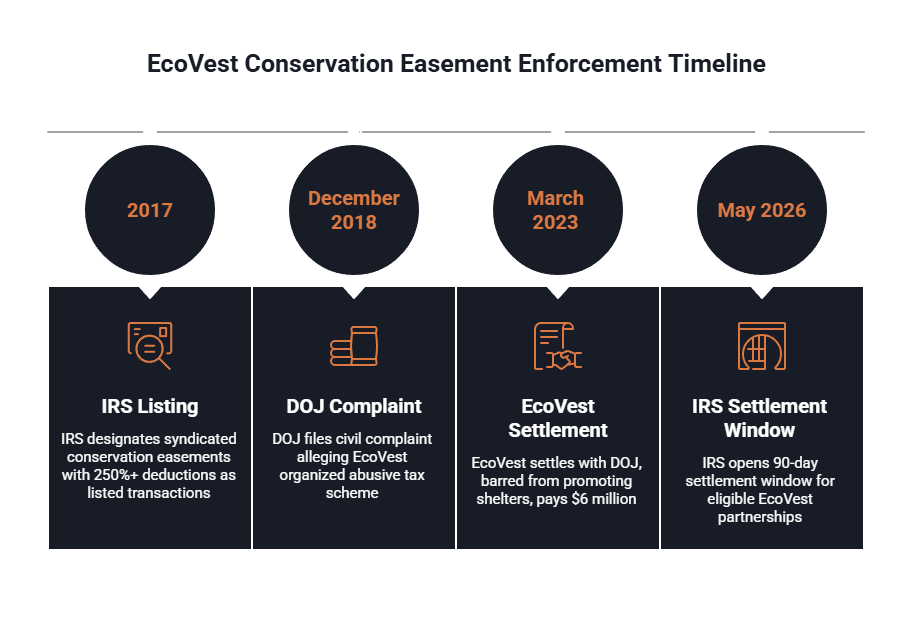
The federal government’s enforcement action against EcoVest began in December 2018, when the DOJ filed a civil complaint alleging that EcoVest Capital, certain principals, and related parties organized, promoted, and sold interests in an abusive syndicated conservation easement tax scheme. The Justice Department sought a permanent injunction and significant disgorgement of fees the defendants allegedly collected from investors.
The DOJ’s allegations centered on claims that EcoVest used inflated land appraisals and misleading representations about tax benefits to sell partnership interests in entities that donated conservation easements to charities. Investors received large charitable contribution deductions based on those inflated valuations. Media reports indicate the program generated more than $3 billion in total federal tax deductions before enforcement action began.
In March 2023, EcoVest and the DOJ reached a settlement in United States v. EcoVest Capital Inc. et al. The terms included a permanent injunction barring EcoVest and its co-defendants from promoting, selling, or facilitating federal tax benefits for syndicated conservation easement shelters going forward. Reports indicate the settlement required a $6 million payment rather than the $130 million in disgorgement the DOJ originally sought. The defendants also agreed not to seek any refund or reimbursement of the settlement amount from the United States.

We Have Recovered Over
$350 Million for Our Clients Nationwide.
Where IRS Enforcement Stands Today
Separately from the DOJ action, the IRS has pursued both civil and criminal enforcement against abusive syndicated conservation easement transactions. Key milestones in that enforcement history include:
- IRS Notice 2017-10, which identified certain syndicated conservation easement transactions generating charitable deductions of 250% or more of an investor’s investment as listed transactions subject to heightened IRS scrutiny
- IR-2020-130 and IR-2020-228, which offered resolution paths for partnerships and individual taxpayers with pending easement disputes
- Chief Counsel Notice 2021-001, which allowed certain docketed Tax Court cases to participate in a settlement initiative requiring full disallowance of claimed charitable contribution deductions and the imposition of penalties
- A new time-limited settlement announced on May 13, 2026, giving eligible partnerships with syndicated conservation easement or historic preservation easement disputes 90 days from the settlement letter’s postmark to accept a standardized offer that disallows the easement deductions and imposes specified penalties
Analyses of the May 2026 settlement window indicate that partnerships declining the initial offer within 90 days may face a 45-day grace period at a higher penalty rate before the IRS pursues full 40% penalties at trial. EcoVest investors are currently receiving IRS settlement letters and must decide whether to accept disallowance of their deductions along with related penalties.
What an IRS Settlement Does and Does Not Resolve
The IRS settlement initiatives and the DOJ’s case against EcoVest address government enforcement and tax liability. They do not compensate investors for their financial losses or address misconduct by the brokers and brokerage firms that sold EcoVest conservation easement interests.
This distinction matters. An investor who accepts the IRS settlement resolves the dispute over disallowed deductions and associated penalties and interest. That settlement does not reimburse the money the investor paid for the partnership interest, does not recover additional costs imposed by the enforcement process, and does not address whether the broker who recommended the investment acted improperly.
The financial consequences of IRS disallowance can be severe. When the IRS determines that a syndicated conservation easement deduction is invalid, the investor owes back taxes on the disallowed amount plus interest. Penalties can reach as high as 40% of the underpayment. Even investors who accept a settlement offer face the elimination of the claimed deduction and significant additional tax liability.
Our lawyers are nationwide leaders in investment fraud cases.
How Meyer Wilson Werning Can Help
When a brokerage firm or financial advisor recommends a complex, tax-driven private placement like a syndicated conservation easement, investors have every reason to expect that recommendation was sound. The EcoVest enforcement history makes clear those expectations were not always justified. For investors now facing IRS penalties, back taxes, and disallowed deductions on top of their original investment, the losses belong to more than one party.
With more than $350 million recovered for investors nationwide, Meyer Wilson Werning has spent over 25 years holding broker-dealers and financial advisors accountable for exactly this kind of misconduct. If you invested in an EcoVest syndicated conservation easement through a brokerage firm or financial advisor and are now facing IRS penalties, disallowed deductions, or investment losses, contact us today for a free and confidential consultation. You pay nothing unless we recover for you.
We Are The firm other lawyers
call for support.
Frequently Asked Questions
What did the Department of Justice allege against EcoVest Capital?
The DOJ’s December 2018 civil complaint alleged that EcoVest Capital, certain principals, and related parties organized, promoted, and sold an abusive syndicated conservation easement tax scheme. The government alleged that the scheme used inflated appraisals and misleading claims about tax benefits to generate more than $3 billion in federal tax deductions for investors. In March 2023, EcoVest agreed to a permanent injunction barring further promotion of these transactions.
Can investors still pursue claims against brokers after accepting an IRS settlement?
IRS settlements resolve tax disputes by disallowing deductions and imposing penalties, but they do not compensate investors for investment losses or address broker misconduct. Investors who purchased EcoVest syndicated conservation easement interests through brokerage firms can generally pursue separate FINRA arbitration claims alleging unsuitable recommendations, inadequate investigation of the offerings, or misrepresentations, regardless of whether they participated in an IRS settlement.
What penalties do investors face when the IRS disallows conservation easement deductions?
When the IRS audits a syndicated conservation easement transaction and determines the deductions are invalid, investors may owe back taxes on the disallowed amount plus substantial interest. Penalties can reach up to 40% of the underpayment. The IRS’s current settlement offer requires investors to concede the full deduction, and penalty amounts can vary depending on when partnerships accept the offer.
How can EcoVest investors evaluate whether they have a claim against their broker?
Investors should review account statements, trade confirmations, offering documents, and communications from their brokers to assess whether the recommendation was appropriate for their risk profile and financial objectives. Claims typically focus on suitability failures, inadequate investigation of the offerings, and misrepresentations about material risks under FINRA Rule 2111, FINRA Rule 2010, and Regulation Best Interest. Consulting experienced securities arbitration counsel can help determine whether an arbitration claim is viable.
How does the May 2026 IRS settlement window work for EcoVest partnerships?
The IRS announced a time-limited settlement on May 13, 2026, for eligible partnerships with syndicated conservation easement disputes. Partnerships have 90 days from the settlement letter’s postmark to accept a standardized offer that disallows easement deductions and imposes specified penalties. Declining the initial window may lead to a higher penalty rate during a 45-day grace period before the IRS pursues full 40% penalties at trial.
Recovering Losses Caused by Investment Misconduct.