

A federal jury in San Antonio convicted Joshua Allen and Michael Cox on August 18, 2026, for their roles in the Ferrum Capital Ponzi scheme, a multimillion-dollar fraud that, according to the FBI, involved more than 400 investors and over $100 million.
The two Lubbock men now face up to 70 years in federal prison. The case, which also involves former financial advisor Brooklynn Chandler Willy, marks a significant milestone for hundreds of investors who lost money through what prosecutors described as a sprawling promissory investment fraud.
Because Ferrum Capital and Brooklynn Willy were unregistered in the securities industry at the time of this scheme, MWW cannot directly pursue claims against them. However, If you your investment was facilitated by a licensed broker or another registered professional, a Ponzi scheme attorney can help determine if your losses were casued by actionable misconduct.
What Happened in the Ferrum Capital Case
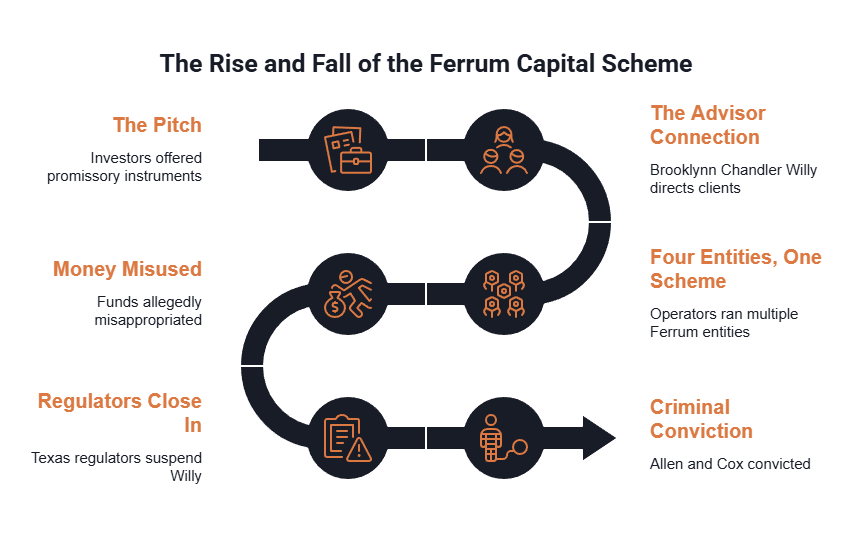
According to the U.S. Department of Justice, Allen and Cox operated a network of at least four investment entities:
- Ferrum Capital LLC
- Ferrum II LLC
- Ferrum III LLC
- Ferrum IV LLC
Prosecutors alleged that the defendants used these companies to solicit funds from investors through promissory instruments, a type of debt product in which investors lend money in exchange for promised returns.
The DOJ press release on the Ferrum Capital verdict states that a federal jury found Allen and Cox guilty following a trial in San Antonio. Earlier DOJ reporting indicated that both men were indicted alongside Brooklynn Chandler Willy for allegedly defrauding hundreds of victims. Willy, a former Texas financial advisor, previously pleaded guilty to 10 counts related to her role in the investment fraud scheme.
The Ferrum Capital trial drew widespread attention because the case illustrated how alleged broker misconduct and financial advisor negligence can work together to cause widespread investor harm. According to prosecutors, the scheme relied on trust and personal relationships to keep money flowing, even as the underlying investments allegedly failed to generate legitimate returns.

We Have Recovered Over
$350 Million for Our Clients Nationwide.
What The Alleged Ponzi Scheme Means for Investors
The guilty verdicts against Allen and Cox, alongside Willy’s plea, show how promissory instruments can be used to run a Ponzi-style investment scheme that looks credible on paper. Because promissory notes often fall outside the oversight structures governing publicly traded securities, investors may have fewer protections when things go wrong.
The faith and community trust angle in this case is also a textbook example of affinity fraud. Promises of consistent returns, lack of transparency about how funds were used, and pressure rooted in personal relationships rather than verifiable disclosures are warning signs that appear across nearly every investment fraud scenario.
A criminal conviction does not automatically return money to investors. Restitution may be ordered at sentencing, but that process is lengthy and uncertain. Investors who lost money through the Ferrum Capital promissory instruments may have independent civil recovery options that operate on a separate track from the criminal case entirely. Consulting with an investment fraud attorney is the most direct way to evaluate what those options look like for a specific situation.
How Meyer Wilson Werning Can Help
The Ferrum Capital case moved from indictment to conviction in just over a year, but the speed of the criminal process does not translate into quick recovery for the investors who lost money.
Brooklynn Chandler Willy had already been suspended by Texas regulators and fired by a prior firm before she recommended these investments to clients who trusted her. Allen and Cox concealed the commissions they collected and lied about how the money was being used. For investors who relied on personal relationships and a financial adviser’s recommendation, the loss is not just financial.
With more than $350 million recovered for investors nationwide, Meyer Wilson Werning has spent over 25 years holding advisers, firms, and scheme operators accountable. If you worked with a licensed financial professional and lost money through the Ferrum Capital scheme or a similar promissory investment fraud, contact us today for a free and confidential consultation. You pay nothing unless we recover for you.
Our lawyers are nationwide leaders in investment fraud cases.
Frequently Asked Questions
What happened in the Ferrum Capital case?
A federal jury in San Antonio convicted Joshua Allen and Michael Cox on August 18, 2026, for their roles in a Ponzi fraud scheme tied to Brooklynn Chandler Willy. The two men face up to 70 years in federal prison, according to the DOJ.
What are promissory instruments, and why are they used in fraud?
Promissory instruments are debt products where an investor lends money in exchange for promised returns. Fraudulent schemes often use these instruments because they can be structured to avoid the regulatory oversight that applies to publicly traded securities, making them harder for investors to verify independently.
Recovering Losses Caused by Investment Misconduct.