

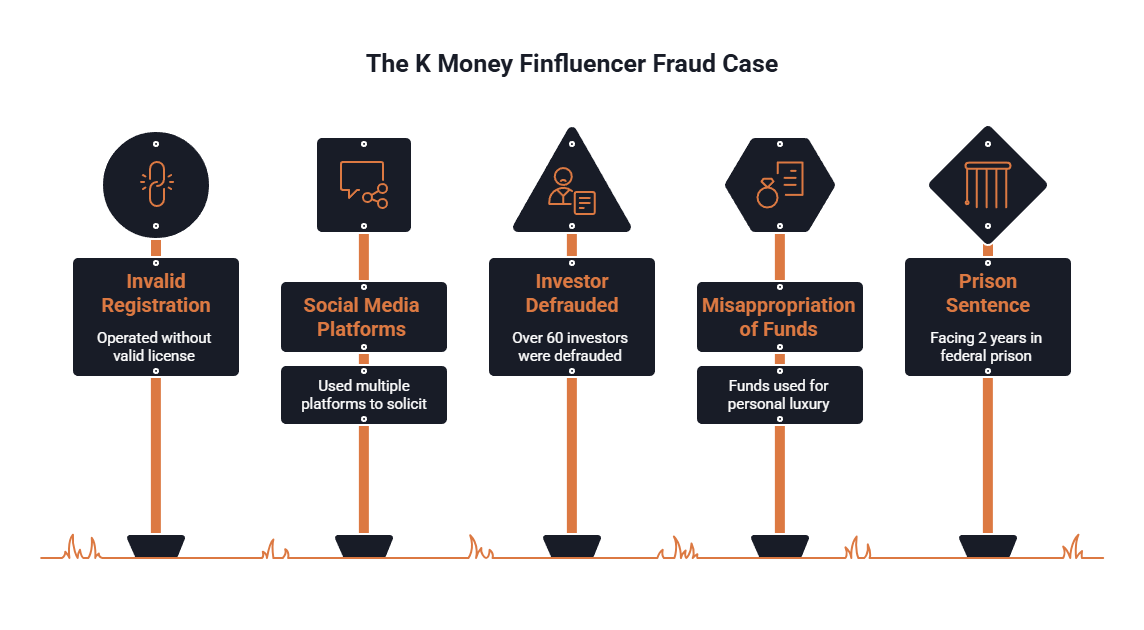
A suspended broker who spent more than a decade marketing himself as a trading authority on social media has been sentenced to two years in federal prison. Kenneth Thom, a New Jersey resident who built a following on Facebook, Twitch, and Instagram under the name “K Money,” pleaded guilty to investment adviser fraud after federal prosecutors and the SEC alleged he used that platform to solicit investment funds he was not legally authorized to manage.
According to the U.S. Department of Justice and the SEC, Thom’s broker license had been suspended by FINRA since 2011, a fact he allegedly concealed from the more than 60 investors who sent him money. Prosecutors allege that between roughly 2023 and 2025, Thom raised approximately $800,000, diverted a significant share for personal expenses, and lost a substantial portion of the remainder through options trading.
The Thom case sits within a broader category of broker misconduct involving suspended or unregistered individuals who solicit investment funds while concealing their regulatory history. It also raises questions about whether any brokerage firms or licensed professionals connected to his operation may bear independent responsibility for investor losses.
What Do Current Disclosures Report About Kenneth Thom?
According to the FINRA BrokerCheck report for Kenneth Thom (CRD# 5098147), his broker license was suspended in 2011 and that suspension remains in effect. Despite being out of the industry for more than 15 years, Thom allegedly marketed himself to social media audiences as a “former Wall Street market maker,” omitting his suspended status entirely.
The SEC litigation release alleges Thom raised over $600,000 from more than 50 investors and misappropriated approximately $235,000 for personal use, including luxury goods and a vacation rental. Criminal prosecutors described a broader scheme raising approximately $800,000 between 2023 and 2025, with only about $350,000 deposited into brokerage accounts and more than $250,000 lost through options trading.
In March 2026, Thom pleaded guilty to one count of investment adviser fraud before a U.S. District Judge. He was sentenced in August 2026 to two years in federal prison. The SEC’s civil enforcement action remains pending and seeks disgorgement, penalties, and a permanent bar from advisory and brokerage roles. He was sentenced in August 2026 to two years in federal prison.


We Have Recovered Over
$350 Million for Our Clients Nationwide.
What Do Past Settlements/Regulatory Actions Indicate for Investors?
The Kenneth Thom case is unusual because Thom was not associated with a brokerage firm during the period of alleged fraud. His FINRA registration had been suspended since 2011, meaning he operated entirely outside the traditional broker-dealer supervision framework during the conduct at issue. That makes conventional firm-level liability claims under FINRA Rule 3110, which requires member firms to reasonably supervise their associated persons, harder to pursue through the usual channels.
However, the regulatory record and media coverage raise broader questions about institutional oversight. Reports indicate that Thom’s social media activity and solicitation of investor funds continued for roughly two years before enforcement agencies intervened. Investor-protection advocates have questioned how social media platforms, payment processors, and any financial firms that held the brokerage accounts evaluated Thom’s regulatory background before allowing him to promote investment loss recovery options to the public.
For investors who sent money to Thom, the criminal prosecution and SEC enforcement action may eventually provide some form of restitution or disgorgement. But criminal proceedings are not designed to make individual investors whole, and civil recovery through those channels can take years.
How Meyer Wilson Werning Can Help
Kenneth Thom was suspended by FINRA in 2011 and spent the following decade rebuilding a fraudulent persona online, one that collected roughly $800,000 from investors who had no way to know he had been suspended from the industry. A two-year prison sentence and an SEC civil action do not automatically return what those investors lost.
For some, civil claims may be available against brokerage firms that opened or maintained accounts for a suspended broker without conducting reasonable due diligence, or against any financial professional who directed clients toward Thom’s scheme.
For over 25 years, Meyer Wilson Werning has recovered more than $350 million for investors harmed by broker misconduct, firm negligence, and the failures of institutions that should have caught it sooner. If a brokerage firm that opened or maintained accounts connected to Thom’s scheme failed to conduct reasonable due diligence, or if a licensed financial professional referred or directed you toward his operation, contact us today for a free and confidential consultation. You pay nothing unless we recover for you.
Our lawyers are nationwide leaders in investment fraud cases.
Frequently Asked Questions
Who is Kenneth Thom, also known as K Money?
Kenneth Thom is a New Jersey resident and former FINRA-registered broker (CRD# 5098147) whose license was suspended in 2011. According to the SEC and DOJ, he later rebranded himself on social media as “K Money” and “K$,” marketing himself as a successful trader and finfluencer despite his suspended status. He pled guilty to investment adviser fraud in March 2026 and was sentenced to two years in federal prison in August 2026.
How much money did investors reportedly lose in the Kenneth Thom K Money scheme?
The SEC alleges that Thom raised over $600,000 from more than fifty investors and misappropriated approximately $235,000 for personal use. Criminal and news reports describe a broader scheme that allegedly raised about $800,000 between 2023 and 2025, with only about $350,000 deposited into brokerage accounts and more than $250,000 lost through options trading.
Was Kenneth Thom a registered broker when he promoted investments on social media?
No. According to the SEC’s litigation release and his FINRA BrokerCheck profile, Thom’s broker license was suspended by FINRA in 2011, and that suspension remained in effect during the entire period of alleged fraud. He was not authorized to act as a broker or solicit investments when he marketed himself online as K Money.
Recovering Losses Caused by Investment Misconduct.