


Thousands of investors who purchased syndicated conservation easement deals through brokers or financial advisers are now facing a more uncertain and potentially more costly enforcement landscape. On August 19, 2026, the IRS established a new Office of Conservation Easements, centralizing all enforcement, policy, and case resolution for these matters under one roof. At the same time, the agency ended the automatic issuance of uniform settlement letters, replacing a predictable resolution process with individualized, case-by-case scrutiny.
For investors already dealing with disallowed deductions, back taxes, and IRS penalties that can reach 40% of the underpayment, the shift makes an already difficult situation harder to navigate. The tax consequences, however, are only part of the problem.
When a broker or financial adviser recommends one of these deals without adequately disclosing the regulatory risks, that recommendation may give rise to a separate and independent legal claim. If you were placed in a syndicated conservation easement or other complex alternative investments and are now facing losses, contact us today for a free and confidential consultation.
The IRS Creates a Dedicated Conservation Easement Office
On August 19, 2026, the IRS issued IR-2026-95 announcing the formation of the IRS Office of Conservation Easements. This new office is designed to centralize technical knowledge and coordinate policy, enforcement strategy, and case resolution for conservation and historic preservation easement matters. The office works across IRS divisions and with the Office of Chief Counsel.
The announcement also marked the end of the agency’s uniform settlement letter program, which had been in place since May 2026. The IRS stated that standardized, unsolicited settlement offers with fixed response periods were not well suited to the full range of conservation easement cases.
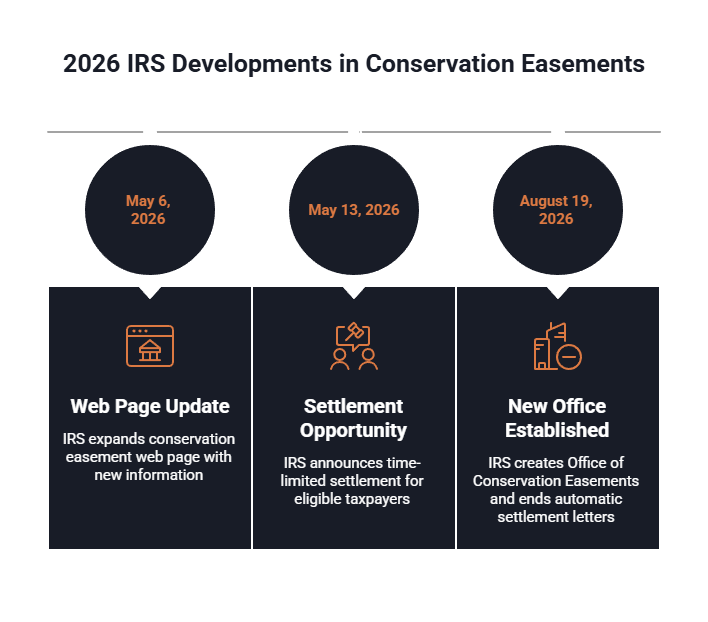
Timeline of the key 2026 developments:
- August 19, 2026: The IRS established the Office of Conservation Easements and ended the automatic issuance of uniform settlement letters, transitioning to case-specific resolution through the new office.
- May 13, 2026: The IRS announced a time-limited settlement opportunity for eligible taxpayers involved in conservation easement or historic preservation easement disputes, with individualized letters giving partnerships 90 days to accept specific terms.
- May 6, 2026: The IRS expanded its conservation easement web page with updated information on abusive transactions, recent court decisions, and warning signs for investors.
The IRS has targeted syndicated conservation easement transactions described in Notice 2017-10 through multiple enforcement actions, court cases, and settlement initiatives over recent years. The creation of a dedicated office signals that the agency views these matters as a long-term enforcement priority, not a short-lived initiative.


We Have Recovered Over
$350 Million for Our Clients Nationwide.
How the 2026 Settlement Initiative Worked and Why It Ended
Under the May 13, 2026 settlement program, eligible partnerships involved in conservation easement disputes received individualized letters outlining specific settlement terms. Partnerships had a 90-day window to accept terms that generally disallowed the charitable contribution deduction, permitted an “other deduction” roughly equal to the partnership’s actual out-of-pocket costs, and imposed a 10% gross valuation misstatement penalty.
Partnerships that did not accept within the initial 90 days faced a subsequent 45-day window during which the penalty increased to 20%. After the combined 135-day period, the IRS indicated it would seek to resolve remaining cases based on hazards of litigation, typically permitting only approximately 5% to 7% of the claimed deduction and pursuing a 40% penalty.
The escalating penalty structure made early settlement considerably less expensive for most taxpayers. However, the IRS concluded that the standardized format did not fit the full variety of conservation easement cases. Going forward, the new Office of Conservation Easements will coordinate a more centralized and case-specific approach to resolving disputes. For investors and partnerships that did not settle during the window, the path forward may involve more uncertainty and potentially steeper penalties.
What This Means for Investors
When the IRS disallows those deductions, investors face back taxes, interest, and penalties that may reach 40% of the tax underpayment. With the uniform settlement program now replaced by case-by-case enforcement through the Office of Conservation Easements, there are no longer standardized offers with predictable terms. Each investor’s exposure now depends entirely on the specifics of their partnership’s case.
For investors whose broker or financial adviser recommended one of these deals, the IRS outcome is only part of the picture. These products are illiquid, carry substantial regulatory risk, and depend on aggressive appraisals that may not survive scrutiny. A recommendation made without adequately disclosing those risks may constitute broker misconduct or a breach of fiduciary duty. That claim is entirely separate from whatever happens in the IRS process. Investors placed in unsuitable conservation easement deals should gather their offering documents, subscription agreements, K-1 forms, and any IRS correspondence to preserve a record that can support potential claims.
Our lawyers are nationwide leaders in investment fraud cases.
How Meyer Wilson Werning Can Help
Meyer Wilson Werning represents investors nationwide who have been harmed by unsuitable investment recommendations, including losses tied to syndicated conservation easement transactions. With more than 75 years of combined experience and over $350 million recovered for clients, the experienced attorneys at Meyer Wilson Werning understand the financial and regulatory issues these cases present and can evaluate whether an investor has a viable claim against the broker or adviser who recommended the transaction.
If you invested in a syndicated conservation easement and are facing tax liability, penalties, or financial losses because of a recommendation you believe was inappropriate, contact us today for a free and confidential consultation to discuss your options.
We Are The firm other lawyers
call for support.
Frequently Asked Questions

What is a conservation easement?
A conservation easement is a legal agreement, typically granted by deed and recorded in public land records, that permanently restricts how a property can be used to protect conservation values such as open space, wildlife habitat, outdoor recreation, or historically important land or buildings. Under section 170(h) of the federal tax code, donors may claim a charitable deduction for qualified conservation easement donations granted in perpetuity and exclusively for conservation purposes.
What is the IRS Office of Conservation Easements?
The IRS Office of Conservation Easements is a specialized unit announced on August 19, 2026, to centralize enforcement, policy coordination, and case resolution for conservation and historic preservation easement matters. The office works across IRS divisions and with the Office of Chief Counsel, and it replaces the prior approach of issuing standardized settlement letters with a more individualized case-management process.
What happened to the IRS settlement initiative for syndicated conservation easements?
The IRS ended the automatic issuance of uniform settlement letters on August 19, 2026, when it launched the Office of Conservation Easements. The agency explained that the standardized format was not well suited to the full range of conservation easement cases. Future resolutions will be coordinated through the new office on a case-by-case basis rather than through rolling uniform offers.
Recovering Losses Caused by Investment Misconduct.