

Brent C. Kovar, the owner of Las Vegas-based Profit Connect Wealth Services, was found guilty by a federal jury of running a cryptocurrency Ponzi scheme that defrauded at least 400 investors out of approximately $24 million.
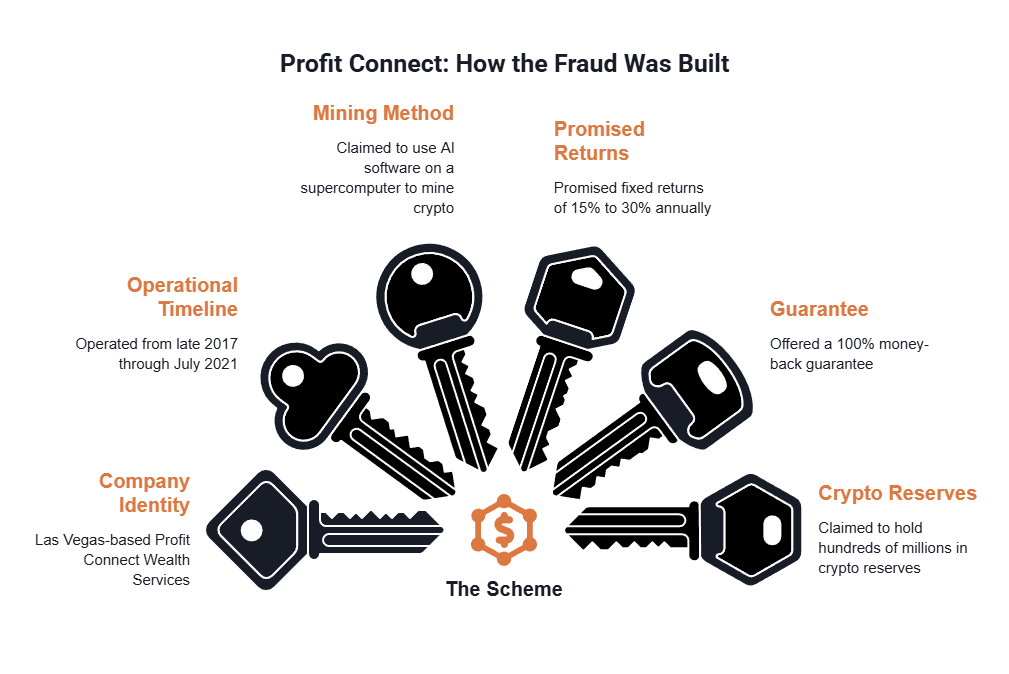
According to the U.S. Attorney’s Office for the District of Nevada, Kovar falsely represented that Profit Connect used artificial intelligence software running on a supercomputer to mine cryptocurrency and verify transactions, promising investors fixed annual returns of 15% to 30% and a 100% money-back guarantee. Prosecutors state that Kovar instead used incoming investor funds to pay earlier investors, buy himself a house, purchase gifts for employees, and cover business expenses. Kovar now faces a statutory maximum penalty of 280 years in prison, with sentencing scheduled for November 30, 2026.
Because Profit Connect and Brent Kovar were not registered broker-dealers or licensed financial advisors, Meyer Wilson Werning is generally unable to pursue claims directly against them through securities arbitration. However, if a licensed financial professional, broker, or advisor recommended or facilitated your investment in Profit Connect or a similar cryptocurrency scheme, a Ponzi scheme attorney may be able to help.
What Do Federal Records Reveal About Brent Kovar and the Profit Connect Scheme?
Following a nine-day federal trial, a jury found Brent C. Kovar guilty of 11 counts of wire fraud, two counts of mail fraud, and two counts of money laundering in connection with the Profit Connect cryptocurrency Ponzi scheme, according to the DOJ conviction announcement for Brent C. Kovar and Profit Connect.
The Department of Justice describes the scheme as operating from late 2017 through July 2021. During that period, Kovar solicited investors by claiming that Profit Connect was a profitable company backed by hundreds of millions of dollars in cryptocurrency reserves. Prosecutors state that these representations were false and that Profit Connect had no such reserves and was not genuinely profitable.
The DOJ’s indictment and conviction materials identify several ways that investor funds were misused:
- Using incoming investor money to pay returns to earlier investors, a hallmark of a Ponzi structure
- Purchasing a home for Kovar personally
- Buying gifts for Profit Connect employees
- Funding general business operations as though the company were generating legitimate revenue

We Have Recovered Over
$350 Million for Our Clients Nationwide.
What Did the SEC Allege About Profit Connect’s AI Supercomputer Claims?
Before Kovar’s criminal conviction, the SEC had already moved against Profit Connect. In July 2021, the agency filed an emergency action against Profit Connect Wealth Services, Inc., Joy I. Kovar, and Brent Kovar, alleging they raised more than $12 million from at least 277 retail investors through a fraudulent offering built around a purported “artificial intelligence supercomputer.” The SEC alleged the Kovars promised investor funds would be deployed into securities trading and cryptocurrencies guided by that AI system, and that the company held between $500 million and $1 billion in cryptocurrency reserves.
Neither claim held up. Blockchain analytics cited in receiver filings showed Profit Connect mined only $352.93 in cryptocurrency across its entire operation. The SEC characterized the program as a Ponzi-like structure, obtained a temporary restraining order and asset freeze, and appointed a receiver to marshal remaining assets. The agency also described Brent Kovar as a recidivist and flagged false claims about guaranteed returns of up to 30% and FDIC-style protections as part of the fraudulent solicitation.
How Meyer Wilson Werning Can Help
Criminal convictions and SEC enforcement actions do not automatically return money to individual investors. While the Profit Connect receivership may eventually distribute recovered assets, those proceedings can take years, and distributions often represent only a fraction of total investor losses. Affected investors may have separate civil claims that can be pursued independently.
Meyer Wilson Werning represents investors nationwide who have lost money to Ponzi schemes, cryptocurrency fraud, and other forms of investment misconduct. With more than 75 years of combined experience and over $350 million recovered for clients across the country over the last 26 years, the firm’s Courtney M. Werning and the broader legal team work to identify all potentially responsible parties, including intermediaries, custodians, or advisers who may have facilitated investor losses.
Meyer Wilson Werning works on a contingency fee basis, meaning if the firm is not able to recover your losses, its services are at no cost to you. Contact us today for a free and confidential consultation to discuss your options if you lost money in the Profit Connect scheme or a similar cryptocurrency investment fraud.
Our lawyers are nationwide leaders in investment fraud cases.
Frequently Asked Questions
What was the Brent Kovar Profit Connect crypto Ponzi scheme, and how did it operate?
According to the U.S. Attorney’s Office for the District of Nevada, Brent C. Kovar owned Profit Connect, a Las Vegas-based company that claimed to use artificial intelligence software on a supercomputer to mine cryptocurrency and verify transactions. Kovar allegedly promised investors fixed annual returns of 15% to 30% and a 100% money-back guarantee. DOJ and SEC records indicate that, instead of using investor funds for legitimate trading or mining, Kovar largely used incoming money to pay earlier investors and to cover personal and business expenses in a manner characteristic of a Ponzi scheme.
How many investors and how much money were involved in the Profit Connect cryptocurrency fraud?
The DOJ conviction announcement states that Kovar fraudulently obtained approximately $24 million from at least 400 investors through Profit Connect between late 2017 and July 2021. Earlier SEC enforcement materials describe an emergency action alleging that Profit Connect Wealth Services, Joy I. Kovar, and Brent Kovar raised more than $12 million from at least 277 retail investors in an offering fraud centered on a purported artificial intelligence supercomputer.
What criminal charges did Brent Kovar face, and what sentence could he receive?
A federal jury found Brent C. Kovar guilty of 11 counts of wire fraud, two counts of mail fraud, and two counts of money laundering. He is scheduled to be sentenced on November 30, 2026, and faces a statutory maximum penalty of 280 years in prison, although the actual sentence will be determined by the federal judge under the U.S. Sentencing Guidelines.
What did the SEC allege about Profit Connect’s claimed AI supercomputer and cryptocurrency reserves?
The SEC’s July 2021 complaint alleged that the Kovars raised investor funds while assuring investors their money would be invested according to recommendations from an “artificial intelligence supercomputer” that would generate high, guaranteed returns. Blockchain analysis cited in receiver filings showed that Profit Connect actually mined only about $352.93 in cryptocurrency over several years, supporting the SEC’s characterization of the operation as fraudulent rather than a genuine AI-driven trading platform.
Recovering Losses Caused by Investment Misconduct.