
Leor Moshe, the founder of Capital Funding ASAP LLC, has pleaded guilty to federal wire fraud after admitting he defrauded more than 97 investors out of approximately $47 million between June 2019 and June 2023, according to the U.S. Attorney’s Office for the District of New Jersey. Sentencing is scheduled for December 16, 2026.
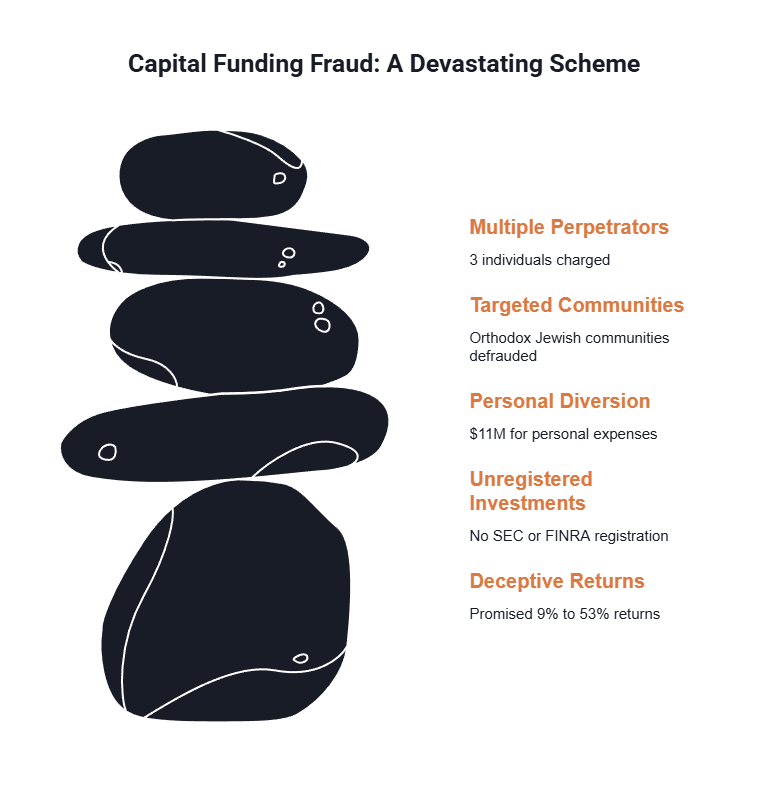
Moshe exploited trust within Orthodox Jewish communities in New Jersey and New York, promising investors their money would fund short-term business loans generating fixed returns of 9% to 53%. Federal prosecutors and the SEC allege those promises were false from the start. Rather than making business loans, Moshe allegedly diverted more than $11 million for personal expenses including gambling debts and home renovations, while using additional funds to make Ponzi scheme payments to earlier investors. The structure and targeting of the fraud follow a pattern common in affinity-based investment fraud cases.
What Happened With Capital Funding ASAP LLC
The Department of Justice and the Securities and Exchange Commission have outlined a scheme that operated for roughly four years across close-knit religious communities. Below is a timeline of the key events based on publicly available enforcement records.
- 2018: Leor Moshe formed Capital Funding ASAP LLC in New Jersey, according to the SEC’s civil complaint.
- June 2019 through June 2023: Moshe, along with associates Jacob Goldman and Isaac Odes, allegedly raised approximately $47 million from more than 97 investors, primarily members of Orthodox Jewish communities in New Jersey and New York.
- 2026: The DOJ announced Moshe’s guilty plea to one count of wire fraud, which carries a maximum penalty of 20 years in prison and a fine of $250,000 or twice the gross gain or loss.
- 2026: The SEC filed civil charges against Moshe, Goldman, and Odes, alleging violations of federal securities laws, including selling unregistered securities and acting as unregistered broker-dealers.
The SEC’s complaint alleges that investors collectively lost more than $25 million, even though roughly $47 million was raised in total. The gap reflects partial repayments and Ponzi-like distributions to earlier participants. Federal prosecutors stated that Moshe personally diverted approximately $11 million to cover personal expenses, while at least $850,000 was allegedly used to make payments to earlier investors in the classic pattern of a Ponzi scheme.
Goldman and Odes, who the SEC alleges acted as unregistered broker-dealers by recruiting investors and receiving transaction-based compensation, face parallel civil charges. Neither was registered with the SEC or FINRA to sell securities or act as brokers, according to the SEC’s litigation release.

We Have Recovered Over
$350 Million for Our Clients Nationwide.
What This Means for Investors
The Capital Funding ASAP case is a textbook example of affinity fraud, a tactic in which scammers exploit shared cultural, religious, or social ties to gain trust and bypass independent scrutiny. The SEC alleges the offering spread through personal networks rather than advertising, making the warning signs of investment fraud harder for individual investors to catch. Those warning signs were present throughout:
- Promised returns of 9% to 53% were described as “fixed,” which is inconsistent with legitimate short-term business lending.
- Investor funds were allegedly pooled and used for purposes other than the stated loans.
- Early investor returns came from new investor deposits, not actual business profits.
- None of the promoters were registered with the SEC or FINRA.
How Meyer Wilson Werning Can Help
Leor Moshe raised nearly $47 million from members of his own community on promises that no legitimate short-term lending operation could have kept, then spent millions on personal expenses while using new investor funds to pay earlier ones. Jacob Goldman and Isaac Odes collected recruiting fees for a scheme that was never registered and never what it claimed to be. A guilty plea does not return what investors lost, and criminal restitution is a lengthy, uncertain process.
With more than $350 million recovered for investors nationwide, Meyer Wilson Werning has spent over 25 years holding the advisers and registered professionals who directed clients into fraudulent investments accountable. Because Moshe, Goldman, Odes, and Capital Funding ASAP LLC were not registered with FINRA or the SEC as broker-dealers, direct claims against them fall outside the scope of securities arbitration. However, if a licensed broker, financial adviser, or registered firm recommended Capital Funding ASAP to you, introduced you to the offering, or played any role in directing your investment, you may have independent civil claims against that party.
Contact us today for a free and confidential consultation.
Our lawyers are nationwide leaders in investment fraud cases.
Frequently Asked Questions
What is the Capital Funding ASAP Ponzi scheme and who was involved?
According to the U.S. Attorney’s Office for the District of New Jersey and the SEC, the Capital Funding ASAP Ponzi scheme was an affinity investment fraud operated through Capital Funding ASAP LLC, a New Jersey company formed by Leor Moshe in 2018. Between approximately June 2019 and June 2023, Moshe and two associates, Jacob Goldman and Isaac Odes, allegedly raised around $47 million from more than 97 investors, most of whom were members of Orthodox Jewish communities in New Jersey and New York. Regulators allege Moshe misappropriated more than $11 million for personal expenses and used at least $850,000 to make Ponzi-like payments to earlier investors.
How did the scheme target Orthodox Jewish communities?
Regulators describe the Capital Funding ASAP scheme as an affinity fraud because it relied on shared religious and social ties within close-knit Orthodox Jewish communities to build investor trust. The SEC alleges that most investors were active community members and that the offering spread primarily through personal networks rather than public advertising. For more information, see this FAQ on affinity fraud targeting religious and close-knit communities.
What charges did Leor Moshe face and what is his current legal status?
The DOJ reports that Leor Moshe pleaded guilty in federal court in Trenton, New Jersey to a single count of wire fraud. The charge carries a maximum penalty of 20 years in prison and a fine of $250,000 or twice the gross loss to victims. At the time of the 2026 enforcement announcements, sentencing had not yet occurred, and the SEC’s parallel civil case against Moshe, Goldman, and Odes remained pending.
How much money did investors lose in the Capital Funding ASAP fraud?
The SEC’s civil complaint alleges that investors collectively lost more than $25 million, even though approximately $47 million was raised overall. The difference reflects partial Ponzi-like repayments and limited distributions. DOJ charging documents confirm that Moshe obtained roughly $47 million from victim investors and used about $11 million for personal expenses.
Recovering Losses Caused by Investment Misconduct.