
A federal guilty plea entered in the Middle District of Florida has brought new attention to a cryptocurrency investment platform that prosecutors say raised at least $400 million from investors while deploying only a fraction of those funds into the strategies it advertised. Christopher Alexander Delgado of Apopka, Florida, has admitted to conspiracy to commit wire fraud, wire fraud, and money laundering in connection with his operation of Goliath Ventures, formerly known as Gen-Z Venture Firm. The DOJ says the scheme caused approximately $250 million in investor losses. Delgado’s sentencing is scheduled for October 8, 2026.
If you or a family member experienced significant investment losses involving Goliath Ventures, Christopher Delgado, or a similar cryptocurrency scheme, and a licensed financial professional, broker, or advisor facilitated your investment, Meyer Wilson Werning can help. Our experienced crypto fraud attorneys are reviewing claims now. Contact us today for a free and confidential consultation, and you pay nothing unless we recover for you.
How the Goliath Ventures Scheme Operated
Federal prosecutors allege that Christopher Delgado operated Goliath Ventures from approximately January 2023 through January 2026. Goliath Ventures was formerly known as Gen-Z Venture Firm. The DOJ says the company marketed itself as a crypto investment platform that deployed investor funds into liquidity pools and decentralized finance (DeFi) strategies, promising monthly returns of 3% to 8%.
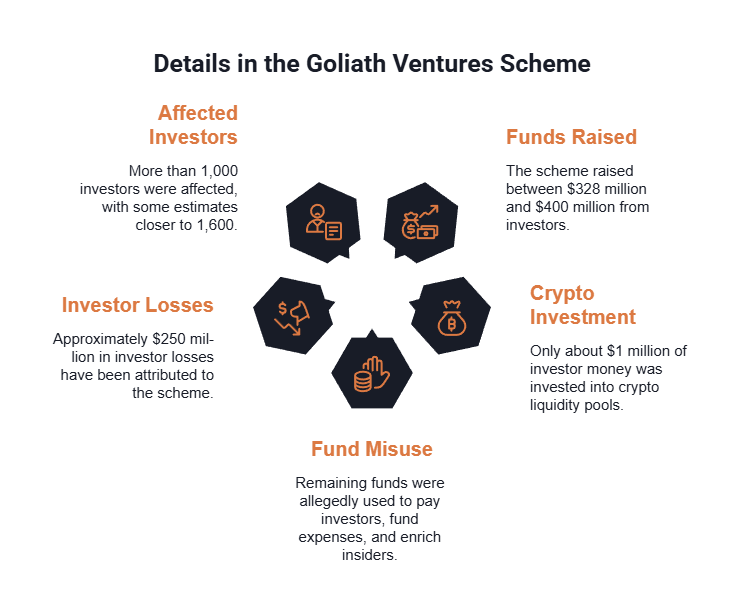
According to the government, those promises did not match reality. Key facts from the federal case include:
- The scheme raised between $328 million and $400 million from investors during its operating period.
- Only about $1 million of all investor money was actually invested into crypto liquidity pools.
- The remaining funds were allegedly used to pay earlier investors, fund personal expenses, and enrich insiders.
- Approximately $250 million in investor losses have been attributed to the scheme.
- Public reports indicate that more than 1,000 investors were affected, with some estimates placing the figure closer to 1,600.
In his plea agreement, Delgado admitted to using investor funds to purchase at least six residential properties worth between $1.15 million and $8.5 million each, along with Lamborghinis, Rolls-Royces, Rolex watches, dozens of Louis Vuitton bags, and custom Tiffany jewelry.
The gap between the money raised and the money actually deployed into any legitimate investment strategy is a hallmark of a Ponzi scheme. When a promoter uses new investor money to pay returns to earlier participants rather than generating real profits, the operation is unsustainable and collapses once new money stops flowing in.

We Have Recovered Over
$350 Million for Our Clients Nationwide.
What This Means for Investors Who Lost Money
Christopher Delgado’s guilty plea confirms that federal authorities have built a case strong enough to obtain a criminal conviction. For affected investors, the guilty plea is an important development, but it does not automatically return lost money. Criminal proceedings focus on punishment and potential restitution orders, while civil claims and regulatory actions are often the most direct paths to financial recovery.
Investors who lost money through Goliath Ventures or Gen-Z Venture Firm should be aware of several steps they can take:
- Review all account records and communications. Emails, wire transfer confirmations, offering documents, and text messages can support a civil recovery claim.
- Identify all parties involved. In addition to Christopher Delgado, there may be other individuals, entities, banks, or platforms that facilitated the scheme and bear legal responsibility.
- Evaluate the role of any licensed broker or adviser. If a registered broker or investment adviser recommended Goliath Ventures to clients, that professional and their firm may face investment fraud claims for failing to conduct adequate due diligence.
- Act promptly. Statutes of limitations apply to civil claims, and delay can reduce available recovery.
A crypto fund promised big returns, raised $400M, and only invested $1M. How does that happen?
byu/MeyerWilsonCo ininvestorclaims
Cryptocurrency liquidity pool fraud is a growing category of investment misconduct. Promoters use the technical language of DeFi, yield farming, and automated market makers to create a veneer of legitimacy. In many cases, investors have no way to verify whether their funds are actually being deployed into the pools described. That information asymmetry is what makes these schemes effective and why they can grow to the scale seen in the Goliath Ventures case.
How Meyer Wilson Werning Can Help
Investors who trusted Goliath Ventures or Gen-Z Venture Firm with their money deserve to know whether any licensed financial professional who steered them toward the scheme can be held accountable. A guilty plea confirms wrongdoing occurred. It does not automatically return what was lost.
With more than $350 million recovered for investors nationwide, Meyer Wilson Werning has spent over 25 years holding bad actors in the financial industry accountable for exactly this kind of misconduct. If a licensed financial professional, broker, or advisor facilitated your investment in Goliath Ventures or a similar cryptocurrency scheme, contact us today for a free and confidential consultation. You pay nothing unless we recover for you.
Our lawyers are nationwide leaders in investment fraud cases.
Frequently Asked Questions
What did Christopher Delgado plead guilty to in the Goliath Ventures case?
Christopher Alexander Delgado pleaded guilty to conspiracy to commit wire fraud, wire fraud, and money laundering in the Goliath Ventures cryptocurrency fraud case. The U.S. Department of Justice said the case is captioned United States v. Christopher Alexander Delgado, Case No. 6:26-cr-158-GAP-NWH. Prosecutors said the scheme promised crypto liquidity pool returns but allegedly operated as a fraud that caused substantial investor losses.
What does the DOJ say about the Goliath Ventures Ponzi scheme?
The DOJ says Goliath Ventures, formerly Gen-Z Venture Firm, raised at least $400 million from investors while promising monthly returns of 3% to 8% through crypto liquidity pools and DeFi strategies. Prosecutors allege only about $1 million was actually invested into liquidity pools, while investor money was used for other purposes. The case is a federal criminal prosecution in the Middle District of Florida.
How many investors were affected by the Christopher Delgado guilty plea?
Public reports tied to the case say more than 1,000 investors were affected, and some reports state the number may have been closer to 1,600. The DOJ press release confirms that Christopher Delgado pleaded guilty and that sentencing is scheduled for October 8, 2026. Investors who contributed to Goliath Ventures should review account records, offering materials, and transfer history to evaluate losses.
What is cryptocurrency liquidity pool fraud and why can it resemble a Ponzi scheme?
Cryptocurrency liquidity pool fraud occurs when a promoter claims investor funds are being deployed into digital asset pools, but the money is instead used to pay earlier investors or enrich insiders. In the Goliath Ventures case, prosecutors said the firm promised monthly returns through liquidity pools while only a small fraction of funds was actually deployed. That kind of mismatch between marketing claims and actual use of money is a common warning sign in Ponzi-style schemes.
Recovering Losses Caused by Investment Misconduct.