

Thousands of investors who placed their trust, and their money, into HyperFund and its related platforms are now confronting staggering losses after the U.S. Department of Justice charged three individuals in connection with an alleged $1.89 billion cryptocurrency fraud and pyramid scheme.
According to federal prosecutors, the scheme operated under multiple brand names including HyperTech, HyperCapital, HyperVerse, and HyperNation, and allegedly used fabricated crypto mining operations to justify daily returns of 0.5% to 1% that were never sustainable. With one key promoter now having pleaded guilty and sentencing on the horizon, HyperFund victims have a narrowing window to explore their legal options for recovery.
If you or a family member experienced significant investment losses involving the HyperFund crypto fraud or a similar cryptocurrency scheme, Meyer Wilson Werning can help. Our team of experienced cryptocurrency investment fraud lawyers focuses on representing investors who have been misled by financial professionals and crypto promoters. Contact us for a free and confidential consultation.
The $1.89 Billion HyperFund Scheme: How Investors Were Allegedly Defrauded
According to the DOJ press release on the $1.89 billion HyperFund cryptocurrency fraud scheme, HyperFund was a global cryptocurrency fraud operation that allegedly raised approximately $1.89 billion from investors worldwide. The Department of Justice charged Sam Lee, an Australian citizen reportedly residing in Dubai, as a co-founder, along with promoters Rodney Burton (known as “Bitcoin Rodney“) and Brenda Chunga.
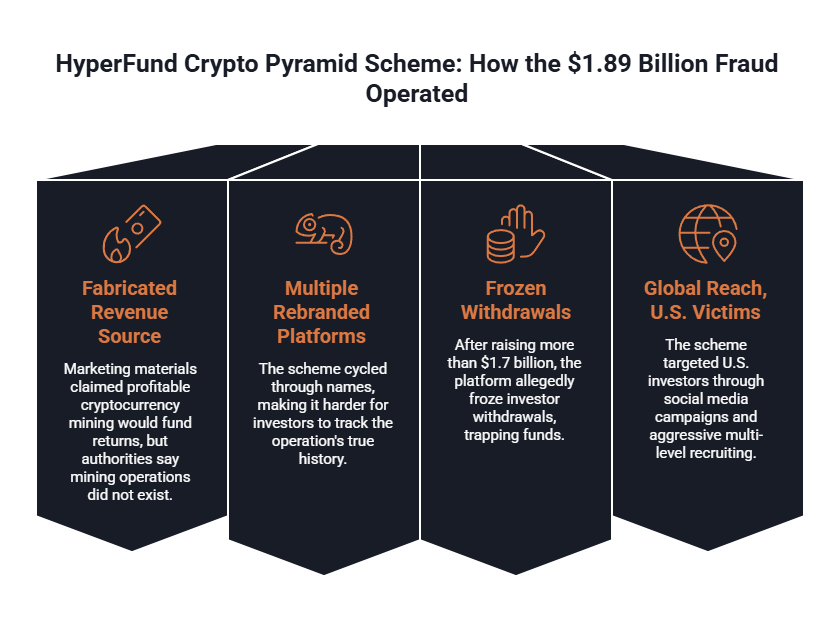
Prosecutors allege that HyperFund falsely represented that investor returns would come from large-scale crypto mining operations. In reality, authorities say those mining operations did not exist. Instead, the scheme allegedly operated as a classic Ponzi structure:
- Fabricated revenue source: Marketing materials allegedly claimed that profitable cryptocurrency mining would fund daily passive returns of 0.5% to 1%, returns that prosecutors say were paid with new investor money, not legitimate business profits.
- Multiple rebranded platforms: As scrutiny grew, the scheme allegedly cycled through names (HyperFund, HyperTech, HyperCapital, HyperVerse, and HyperNation) making it harder for investors to track the operation’s true history.
- Frozen withdrawals: After raising more than $1.7 billion, the platform allegedly froze investor withdrawals, trapping funds and leaving participants unable to access their money.
- Global reach, U.S. victims: Although operated internationally, the scheme allegedly targeted U.S. investors through social media campaigns, webinars, and aggressive multi-level recruiting.
The criminal charges include conspiracy to commit wire fraud, substantive wire fraud counts, and money laundering, underscoring the severity of the alleged misconduct.
SEC wins final judgment in the NanoBit pig butchering case
byu/Crypto_Court inCryptoCourtLaw

We Have Recovered Over
$350 Million for Our Clients Nationwide.
Bitcoin Rodney’s Guilty Plea and What It Means for HyperFund Victims
Rodney “Bitcoin Rodney” Burton, a Florida-based crypto promoter, pleaded guilty in federal court to conspiracy to operate an unlicensed money transmitting business in connection with the HyperFund platform. According to prosecutors, Burton helped facilitate the movement of investor funds into HyperFund through unlicensed money-transmitting services and used proceeds to further promote the scheme.
Prosecutors allege that Burton controlled multiple companies that presented themselves as consulting entities and personally received at least $7.8 million in proceeds tied to the HyperFund operation. His plea agreement follows earlier charges that included conspiracy to commit wire fraud, substantive wire fraud counts, and money laundering, charges that reflect the broader scope of the alleged scheme. Burton faces a maximum sentence of five years in federal prison, with sentencing currently scheduled for July 23. The DOJ’s Fraud Section Victim Witness Unit is directing potential HyperFund victims to contact them for case-related updates, restitution issues, and procedural information.
Burton’s guilty plea is significant for victims because it confirms that the federal government has secured cooperation from at least one participant in the scheme. This development can strengthen harmed investors’ parallel civil recovery efforts and may unlock additional evidence about where investor funds were directed.
What the HyperFund Crypto Fraud Means for Affected Investors
The criminal case addresses the conduct of the scheme’s operators, but it does not automatically return money to investors. Victims of the HyperFund crypto fraud should understand the distinction between criminal prosecution and civil recovery, and why pursuing both tracks may be necessary.
Criminal restitution, if ordered, can take years to materialize and may only cover a fraction of total losses. Meanwhile, investors may have independent civil claims against:
- Promoters and recruiters who earned commissions by bringing new investors into the scheme
- Licensed intermediaries, including brokers or investment advisers, who recommended or facilitated investments in HyperFund-related products
- Payment processors and exchanges that allegedly failed to implement adequate anti-money-laundering controls
For investors whose funds were directed into HyperFund through a licensed broker or investment adviser, additional recovery channels may be available, including securities fraud and Ponzi scheme cases pursued through arbitration or civil litigation. Where a registered representative was involved, investors may also have claims for broker misconduct, including failure to conduct reasonable due diligence before recommending a crypto-related investment.
Our lawyers are nationwide leaders in investment fraud cases.
How Meyer Wilson Werning Can Help
The fallout from the HyperFund crypto fraud is far from over. While federal prosecutors pursue criminal accountability, investors who lost money in HyperFund, HyperVerse, or related platforms need their own legal advocate, someone focused entirely on recovering their losses.
Attorney Courtney M. Werning and the team at Meyer Wilson Werning have extensive experience representing investors harmed by cryptocurrency fraud, digital asset scams, and Ponzi-style schemes. The firm can analyze how you were recruited into the scheme, identify all potentially liable parties (including promoters, influencers, and any licensed intermediaries), and coordinate your civil recovery rights alongside the criminal restitution process.
Meyer Wilson Werning represents investors nationwide who have been harmed by cryptocurrency fraud and Ponzi schemes. With over 25 years of experience and over $350 million recovered, our team is dedicated to holding negligent promoters, firms, and intermediaries accountable. Contact us today for a free and confidential consultation to discuss your path to recovery.
We Are The firm other lawyers
call for support.
Frequently Asked Questions
What is the HyperFund crypto fraud scheme?
HyperFund is described by the U.S. Department of Justice as a $1.89 billion cryptocurrency fraud and pyramid scheme that raised money from investors worldwide using false promises of guaranteed daily returns. Prosecutors allege the platform claimed payouts would be funded by profitable crypto mining operations that did not exist. After raising more than $1.7 billion, the scheme allegedly froze withdrawals, leaving investors unable to access their funds.
Who is Bitcoin Rodney and what is his role in the HyperFund case?
Rodney “Bitcoin Rodney” Burton is a Florida-based crypto promoter who pleaded guilty in federal court to conspiracy to operate an unlicensed money transmitting business in connection with HyperFund. Prosecutors allege he personally received at least $7.8 million from the operation. He faces a maximum sentence of five years in federal prison, with sentencing currently scheduled for July 23.
How can HyperFund and HyperVerse investors try to recover their losses?
Investors may have several options, including participating in any court-ordered restitution process, filing civil lawsuits or class actions, and exploring arbitration or regulatory complaints where a licensed intermediary was involved. An attorney experienced in cryptocurrency fraud can evaluate whether claims exist under federal and state securities laws, consumer-protection statutes, or other legal theories.
How does the HyperFund case fit into broader crypto fraud trends?
HyperFund bears the hallmarks of crypto Ponzi schemes: unrealistic daily return promises, non-existent underlying operations, aggressive social-media recruiting, and an eventual collapse. The case confirms that federal prosecutors can bring securities-fraud and wire-fraud charges against crypto platforms when investors are misled, regardless of whether traditional securities are involved.
Recovering Losses Caused by Investment Misconduct.