


The U.S. Securities and Exchange Commission has fined Bank of America’s Merrill Lynch unit $7.5 million for allegedly failing to file numerous Suspicious Activity Reports (SARs) between April 2020 and September 2024. According to the SEC, Merrill Lynch breached its reporting and recordkeeping obligations under federal anti-money laundering rules by not properly investigating certain suspicious transactions and by failing to submit required reports meant to flag potential money laundering and other suspicious client activity.
Merrill Lynch accepted the civil penalty without admitting or denying the SEC’s findings. For investors who held accounts at Merrill Lynch during this period, the firm’s alleged compliance breakdowns raise serious questions about whether suspicious or unauthorized activity in their accounts went unreported and whether they may have a path to recovery.
If you or a family member experienced significant investment losses involving Merrill Lynch during the period covered by this enforcement action, Meyer Wilson Werning can help. Our team of experienced broker misconduct and securities fraud lawyers focuses on representing investors who have been misled by financial professionals. Contact us for a free and confidential consultation.
The SEC’s $7.5 Million Penalty Against Merrill Lynch
The SEC’s enforcement action against Merrill Lynch centers on the firm’s alleged failure to meet its obligations under the Bank Secrecy Act (BSA) and related SEC rules governing suspicious activity reporting at broker-dealers. Between April 2020 and September 2024, regulators allege that Merrill Lynch failed to file a significant number of SARs, the mandatory filings that financial institutions must submit when they detect transactions that may involve money laundering, fraud, or other illicit conduct.
Key facts from the enforcement action include:
- $7.5 million civil penalty imposed by the SEC to settle the allegations
- Covered period: April 2020 through September 2024
- Alleged violations: Failure to file required Suspicious Activity Reports, along with recordkeeping deficiencies
- Settlement terms: Merrill Lynch neither admitted nor denied the SEC’s finding.
- Overlap with Reg BI adoption: The covered period coincides with the securities industry’s transition to the SEC’s Regulation Best Interest standard, which took effect June 30, 2020.
Under the Bank Secrecy Act, broker-dealers like Merrill Lynch are required to monitor customer accounts for signs of suspicious activity and to submit SARs to the Financial Crimes Enforcement Network (FinCEN) when red flags are identified. These reports are a front-line defense against money laundering, Ponzi schemes, and other fraudulent activity flowing through securities accounts. When a firm fails to file SARs, regulators and law enforcement lose visibility into potentially harmful transactions, and investors may be left exposed to risks the firm was supposed to catch.

We Have Recovered Over
$350 Million for Our Clients Nationwide.
A Pattern of SAR Failures: Prior SEC and FINRA Actions Against Merrill Lynch
The $7.5 million penalty is not the first time Merrill Lynch has faced regulatory consequences for SAR filing breakdowns. A prior SEC action imposed a $6 million penalty on the firm for allegedly failing to file hundreds of Suspicious Activity Reports between 2009 and late 2019. FINRA brought a parallel enforcement case covering that same period, resulting in a separate $6 million fine. The most recent action now extends the alleged compliance failures into a second consecutive time window, covering April 2020 through September 2024.
Taken together, these three enforcement actions span more than a decade and suggest that Merrill Lynch’s internal anti-money laundering controls may have remained inadequate even after prior regulatory scrutiny. Under FINRA Rule 3110, brokerage firms are required to maintain adequate supervisory systems to identify potential red flags of misconduct. When a firm’s compliance infrastructure repeatedly fails to catch suspicious transactions and unauthorized activity across multiple time periods, investors may have grounds to pursue claims through arbitration.
Meyer Wilson Werning also shared this news on X:
Regulators fined Merrill Lynch $7.5 million for allegedly failing to report suspicious customer activity for over four years. This penalty marks the firm's third enforcement action for similar reporting failures.#InvestorProtection #BrokerMisconduct
— Meyer Wilson Werning (@Investor_Claims) July 22, 2026
What This Means for Investors With Merrill Lynch Accounts
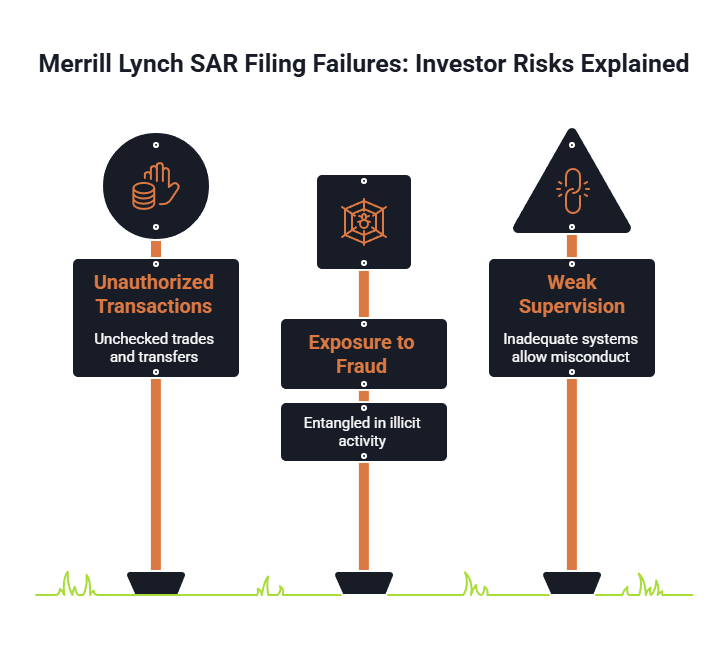
Investors who maintained accounts at Merrill Lynch between April 2020 and September 2024 should pay close attention to this enforcement action. SAR filing failures do not occur in isolation, they often signal broader weaknesses in a firm’s compliance and supervisory framework. When a brokerage firm is not properly monitoring for suspicious activity, other forms of misconduct may also go undetected.
Specific investor concerns raised by this action include:
- Unauthorized or unexplained transactions: If suspicious activity in your account was not reported, it may also not have been flagged for internal review, meaning unauthorized trades or unusual transfers could have gone unchecked
- Exposure to fraudulent schemes: SAR obligations exist to protect investors and the financial system from money laundering, Ponzi schemes, and other fraud; when a firm fails to file, investors may unknowingly become entangled in illicit activity
- Weak supervisory oversight: Repeated SAR failures may indicate that the firm’s broader supervisory systems were inadequate, potentially allowing unsuitable recommendations or other broker misconduct to persist
- Potential recovery through FINRA arbitration: Investors who suffered losses tied to suspicious or inadequately supervised activity in their Merrill Lynch accounts may be eligible to file claims through the FINRA arbitration process.
If you received unexpected account statements, observed transactions you did not authorize, or suffered unexplained losses during the covered period, those events may be connected to the same compliance gaps that led to this SEC penalty.
Our lawyers are nationwide leaders in investment fraud cases.
How Meyer Wilson Werning Can Help
When a firm of Merrill Lynch’s size faces its third SAR-related enforcement action in under a decade, the pattern matters. Compliance failures of this scale can leave individual investors without the protections they were entitled to, and the consequences of unreported suspicious activity in an account are rarely limited to regulatory paperwork.
With more than $350 million recovered for investors nationwide, Meyer Wilson Werning has spent over 25 years holding broker-dealers accountable for exactly this kind of misconduct. If you held a Merrill Lynch account between April 2020 and September 2024 and believe suspicious activity in your account may have gone undetected or unaddressed, contact us today for a free and confidential consultation. You pay nothing unless we recover for you.
We Are The firm other lawyers
call for support.
Frequently Asked Questions
Why did the SEC fine Merrill Lynch $7.5 million over suspicious activity reports?
The SEC fined Merrill Lynch $7.5 million for allegedly failing to file required Suspicious Activity Reports between April 2020 and September 2024, in violation of federal anti-money laundering rules. Merrill accepted the civil penalty without admitting or denying the findings.
What are Suspicious Activity Reports and why are they required for broker-dealers like Merrill Lynch?
SARs are mandatory filings under the Bank Secrecy Act that broker-dealers must submit when they detect potential money laundering, fraud, or other suspicious transactions. Timely SAR reporting is a core compliance obligation, and failures to file can indicate broader breakdowns in a firm’s oversight systems.
How does the SEC’s recent Merrill Lynch SEC fine relate to earlier enforcement actions against the firm?
The $7.5 million fine follows a prior SEC action that penalized Merrill Lynch $6 million for SAR filing failures between 2009 and 2019, alongside a separate $6 million FINRA penalty in that same matter. Regulators have now identified a recurring pattern of anti-money laundering compliance failures at the firm across multiple time periods.
Can investors be harmed when a brokerage firm fails to file suspicious activity reports?
Yes. SAR failures can allow fraudulent or unauthorized activity to go undetected in client accounts. Weak compliance oversight of this kind may coincide with broker misconduct that causes financial losses, and affected investors may have grounds for a private claim through arbitration.
Recovering Losses Caused by Investment Misconduct.