


When a single stock, sector, or asset class makes up a disproportionate share of an investment portfolio, the result is overconcentration. It can expose investors to devastating losses when that position declines in value.
While financial professionals have a duty to recommend strategies appropriate for each client’s risk tolerance and financial goals, many investors discover too late that their accounts were dangerously concentrated in a single holding. For investors who received equity compensation, inherited large stock positions, or relied on a broker or advisor to manage diversification, understanding overconcentration risk is a first step toward protecting wealth.
If you or a family member experienced significant investment losses tied to an overconcentrated portfolio, Meyer Wilson Werning can help. Our team of experienced overconcentration attorneys focuses on representing investors who have been misled by financial professionals. Contact us for a free and confidential consultation.
What Is Overconcentration and Why Does It Matter?
Overconcentration means that a portfolio holds too much of one stock, one sector, or one type of asset relative to the investor’s total holdings. Financial industry guidance generally treats a single position exceeding 10% of a portfolio as a potential concentration risk, and that concern grows significantly when selling is restricted by company policies, blackout periods, or lock-up agreements.
When one position dominates a portfolio, a downturn in that single stock can wipe out years of gains across the entire account. Diversification is not just a preference. Under FINRA Rule 2111 (Suitability), brokers are required to have a reasonable basis to believe that a recommended investment strategy, including the degree of concentration, is suitable for each client’s financial situation, age, and risk tolerance. For recommendations to retail customers made after June 30, 2020, the SEC’s Regulation Best Interest largely superseded the suitability standard, replacing it with a higher obligation requiring broker-dealers to act in the retail customer’s best interest rather than merely recommend a suitable investment.
When a financial professional allows or encourages a client to maintain a concentrated position without disclosing the risks, that may constitute broker misconduct.

We Have Recovered Over
$350 Million for Our Clients Nationwide.
How Equity Compensation and Company Stock Create Concentrated Positions
Equity compensation is one of the most common paths to overconcentration. RSUs (restricted stock units), stock options, employee stock purchase plans, and performance shares all tie a growing share of an employee’s wealth to a single employer. Over time, this can create a situation where one company represents both the investor’s income and the majority of their investment portfolio.
Several factors make this especially dangerous:
- Automatic accumulation: Equity awards vest on a schedule, often building a larger position than the employee realizes.
- Tax challenges: Selling company stock triggers capital gains taxes, which can discourage diversification. Many investors hold longer than they should because of unfavorable tax treatment on short-term gains.
- Trading restrictions: Blackout periods, insider-trading policies, and Rule 144 limitations can prevent employees from selling even when they want to reduce exposure.
- Emotional attachment: Employees may feel loyalty to their company or believe the stock will continue to appreciate, overriding sound risk-management principles.
Warning Signs That Your Portfolio May Be Overconcentrated
Investors should watch for these red flags:
- A single stock represents more than 10% of total portfolio value.
- Equity compensation awards have pushed company stock above 20% of holdings.
- A broker or advisor has not raised the topic of diversification during reviews.
- The portfolio is heavily weighted in one sector (for example, technology or energy) even if spread across multiple stocks.
- Unrealized gains in a single position have grown so large that selling feels “too expensive” from a tax standpoint.
- A financial professional has discouraged selling a concentrated position without providing a written rationale tied to the investor’s stated goals and risk tolerance.
If any of these situations sound familiar, a review of the account may reveal that financial advisor misconduct contributed to the concentration.
Our lawyers are nationwide leaders in investment fraud cases.
Strategies to Reduce Overconcentration Risk
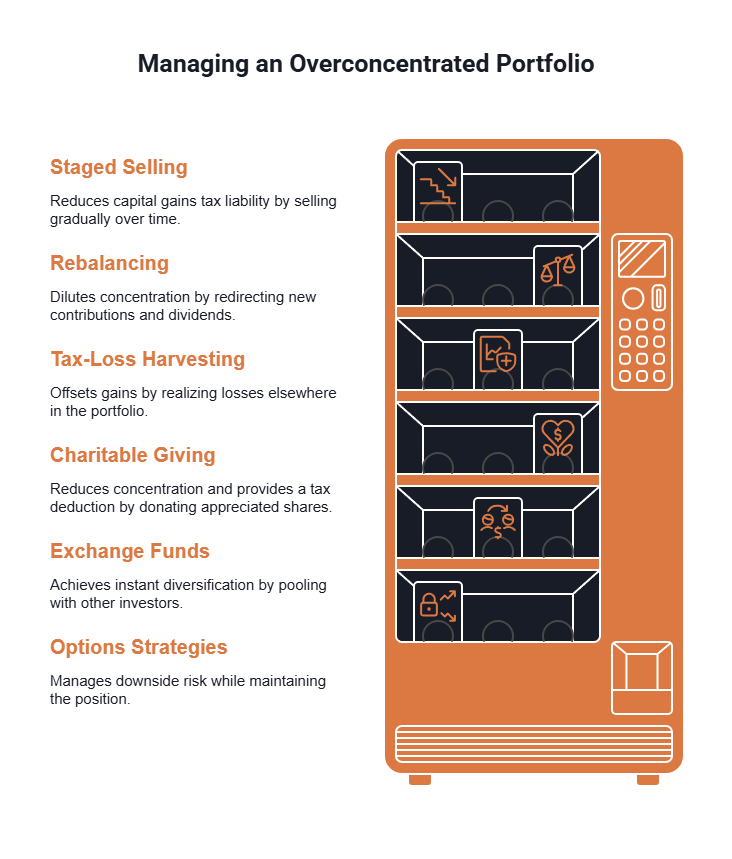
Addressing a concentrated stock position does not require selling everything at once. Common approaches include:
- Staged selling: Reducing the position gradually over months or years to spread out capital gains tax liability.
- Rebalancing: Redirecting new contributions and dividends into other asset classes to dilute the concentration over time.
- Tax-loss harvesting: Offsetting gains from selling a concentrated position by realizing losses elsewhere in the portfolio.
- Charitable giving: Donating appreciated shares to a donor-advised fund or charity can reduce concentration while providing a tax deduction.
- Exchange funds: Pooling concentrated stock with other investors to achieve instant diversification (available primarily to accredited investors).
- Covered calls and protective puts: Using options strategies to manage downside risk while maintaining the position.
The right approach depends on an investor’s risk tolerance, retirement timeline, income needs, and any trading restrictions that apply to the position. A broker or advisor who fails to discuss these options, or who recommends holding an unsuitable concentration, may be in violation of FINRA Rule 3110 (Supervision), which requires firms to maintain adequate systems to oversee their brokers’ recommendations and identify potential red flags of misconduct.
We Are The firm other lawyers
call for support.
When Overconcentration Becomes a Legal Issue
Overconcentration is not always the investor’s fault. In many cases, a broker, financial advisor, or brokerage firm bears responsibility because they:
- Recommended purchasing or holding an excessive position in a single stock without a reasonable basis for suitability.
- Failed to explain the risks of concentration to the client in clear terms.
- Ignored or overrode the client’s stated risk tolerance or investment objectives.
- Did not recommend diversification during regular account reviews.
- Encouraged holding company stock without addressing the combined risk of employment income and investment exposure.
When a financial professional’s actions or inactions lead to losses from overconcentration, the investor may have a claim for financial fraud through arbitration. FINRA arbitration is a streamlined dispute resolution process that allows investors to pursue recovery without going to court.

Understanding Your Options When Overconcentration Causes Losses
Overconcentration does not always happen because an investor made the wrong choice. In many cases, a broker or financial advisor failed to raise the issue, recommend diversification, or explain the real risk of a concentrated position to the client. When that failure leads to significant losses, investors may have more options than they realize.
Meyer Wilson Werning represents investors nationwide who have experienced losses tied to unsuitable concentration strategies and related broker misconduct. With more than $350 million recovered for investors over 25 years, the firm offers free and confidential consultations to help people understand whether their losses may be the result of actionable misconduct.
Frequently Asked Questions

What is overconcentration in a portfolio?
Overconcentration means holding too much of one stock, sector, or issuer in a portfolio relative to the investor’s total assets and risk tolerance. Holding more than 10% of a portfolio in a single stock can create concentration risk, and the threshold may be closer to 20% if selling is restricted. That level of exposure can amplify both gains and losses far beyond what an investor intended.
How do I know if my account is overconcentrated?
A common warning sign is when one company stock becomes a large percentage of total assets, especially after equity compensation, a long holding period, or repeated automatic reinvestment. A single stock above 10% of a portfolio may be overly concentrated, and the risk is higher when the position is difficult to sell due to trading restrictions or tax consequences. Reviewing holdings at least annually can help identify the problem before it leads to significant losses.
What are some ways to reduce overconcentration risk?
Diversification, periodic rebalancing, and a staged plan for selling or reducing company stock are common approaches to managing overconcentration risk. Tax-aware strategies, including weighing capital gains consequences before selling and coordinating with a financial or tax advisor, can also help. The right approach depends on risk tolerance, retirement timing, and any trading restrictions that apply. At the end of the day, It’s your financial advisors job to understand how to reduce these risks.
Why does equity compensation create overconcentration risk?
Equity compensation can build a concentrated stock position because RSUs, stock options, and other awards often tie a growing share of wealth to a single employer over time. Investors should consider stock-trading rules, tax implications, and whether the position still aligns with their goals and time horizon. When one company dominates both income and investments, the need for diversification becomes significantly greater.
Recovering Losses Caused by Investment Misconduct.