



In back-to-back enforcement actions in late July and early August 2026, the U.S. Securities and Exchange Commission obtained default judgments against two purported investment advisers, Adamant Stone Limited and Wisdom Capital Management Group Ltd., after regulators determined that both firms filed materially false and unsubstantiated Form ADV disclosures with the Commission. Neither company appeared in court to defend itself. Combined civil penalties exceeded $2.3 million.
This article is intended to be informational. Because no identified investor victims appear in the public record for either case, and both firms appear to be ghost entities with no recoverable assets, it is unlikely that Meyer Wilson Werning can pursue direct claims arising from these specific enforcement actions.
However, if a licensed broker, financial adviser, or registered firm referred you to, recommended, or played any role in directing your funds toward an investment adviser that misrepresented its credentials or registration status, an experienced investment loss attorney may be able to help.
What Is a Form ADV and Why Does It Matter to Investors?
A Form ADV is the standard disclosure document that investment advisers are required to file with the SEC. It contains basic but essential information: who runs the firm, what services it provides, how much money it manages, what types of clients it serves, and whether the firm or its principals carry a disciplinary history.
The SEC makes Form ADV filings publicly available through its Investment Adviser Public Disclosure database at adviserinfo.sec.gov. Investors rely on it to research advisers before committing funds. Regulators rely on it to monitor the industry. When a firm files a Form ADV with fabricated information, it corrupts both functions simultaneously, creating a false regulatory record designed to withstand a surface-level review.
Both Adamant Stone and Wisdom Capital allegedly did exactly that.

We Have Recovered Over
$350 Million for Our Clients Nationwide.
The Adamant Stone Limited Enforcement Action
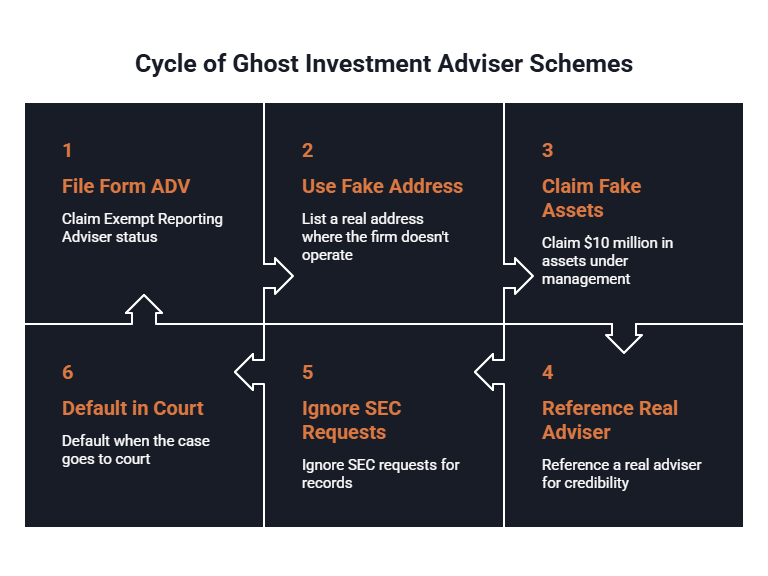
The SEC filed its complaint against Adamant Stone Limited on November 13, 2025, in the U.S. District Court for the District of Colorado. Regulators alleged that in its September 2024 Form ADV, Adamant Stone made material misrepresentations and unsubstantiated statements to the Commission.
According to the SEC’s complaint, Adamant Stone claimed to be an Exempt Reporting Adviser operating from office space in Denver, managing $10 million in U.S. assets and advising a private fund. The filing also identified a separate registered investment adviser as reporting information about that fund on its own Form ADV.
Investigators found no evidence supporting any of these representations. The business occupant of the listed Denver address allegedly had no knowledge of Adamant Stone or its purported Chief Executive Officer. The separate registered investment adviser referenced in the filing had not reported any information about the private fund Adamant Stone claimed to advise. Commission staff found no record of the fund in other SEC filings and no information about Adamant Stone in the SEC’s public company database. The firm also failed to respond to requests from Commission attorneys to produce supporting records.
On July 30, 2026, the court entered a final judgment by default against Adamant Stone. The judgment permanently enjoins the firm from future violations of Sections 204(a) and 207 of the Investment Advisers Act of 1940, and permanently bars Adamant Stone, its owners, and its executive officers from filing a Form ADV as an Exempt Reporting Adviser. The court ordered a civil penalty of $1,182,254.

The Wisdom Capital Management Group Enforcement Action
Four days later, a nearly identical set of facts produced a nearly identical outcome in Washington, D.C.
The SEC filed its complaint against Wisdom Capital Management Group Ltd. on August 30, 2024, in the U.S. District Court for the District of Columbia. The complaint alleged that in its December 2023 Form ADV, Wisdom Capital made material misrepresentations and unsubstantiated statements to the Commission.
Specifically, the SEC alleged that Wisdom Capital claimed to be an Exempt Reporting Adviser and a public company operating from office space on Wall Street in New York City, managing $10 million in private funds and advising two private funds. Its filing identified a separate registered investment adviser as reporting information about those funds.
According to the complaint, the current occupant of the listed Wall Street address had no knowledge of Wisdom Capital or its purported management. The referenced registered investment adviser had not reported any information about the two alleged funds. No record of the funds appeared in other Commission filings, and Wisdom Capital also failed to respond to SEC requests for records.
On August 3, 2026, the court entered a final judgment by default against Wisdom Capital. The judgment permanently enjoins the firm from future violations of Sections 204(a) and 207 of the Investment Advisers Act of 1940 and permanently bars its owners and executive officers from filing a Form ADV as an Exempt Reporting Adviser. The court ordered a civil penalty of $1,152,316. The SEC noted that the investigation remains ongoing.
Our lawyers are nationwide leaders in investment fraud cases.
If You Lost Money With a Fraudulent Investment Adviser, You May Have Legal Options
The public record in the Adamant Stone and Wisdom Capital cases does not identify investor victims by name. Both appear to be ghost entities that regulators caught at the filing stage. The civil penalties ordered in these cases go to the Commission, not to investors.
That said, fraudulent investment adviser registration schemes are not always confined to paper. In many cases, a firm that falsifies its regulatory record does so to appear legitimate while actively soliciting investor capital
If a licensed broker, financial adviser, or registered firm referred you to, recommended, or facilitated your investment with an adviser that turned out to misrepresent its registration status, the assets it managed, or the funds it operated, you may have independent legal claims against that party. The ghost firm itself may be unreachable, but the licensed intermediary who placed you there may not be.
Meyer Wilson Werning has recovered more than $350 million for investors harmed by financial adviser misconduct, misrepresentation, and fraud over more than 25 years. Our attorneys handle every case on a contingency fee basis, meaning clients pay nothing unless the firm recovers money for them. If a licensed professional was involved in directing your investment, contact us today for a free and confidential consultation.
We Are The firm other lawyers
call for support.
Frequently Asked Questions

What Is an Exempt Reporting Adviser?
An Exempt Reporting Adviser is a category of private fund adviser that qualifies for an exemption from full registration under the Investment Advisers Act of 1940. These firms are still required to file a Form ADV with the SEC but are subject to fewer ongoing disclosure requirements than fully registered investment advisers. To understand the difference between an Exempt Reporting Adviser and a fully registered investment adviser, investors should verify a firm’s registration category before committing any funds.
What Do Sections 204(a) and 207 of the Investment Advisers Act Prohibit?
Section 204(a) requires investment advisers to maintain records and submit reports to the SEC as required by the Commission. Section 207 prohibits making false or misleading statements in any registration application or report filed with the Commission. Both Adamant Stone and Wisdom Capital were found to have violated these provisions, resulting in permanent injunctions and civil penalties totaling more than $2.3 million.
What Is a Form ADV and Where Can I Find It?
A Form ADV is the primary disclosure document that investment advisers must file with the SEC. It contains information about the firm’s ownership, services, fees, assets under management, and disciplinary history. Investors can access Form ADV filings for any registered or exempt reporting adviser through the SEC’s Investment Adviser Public Disclosure database at adviserinfo.sec.gov.
How Can I Tell If an Investment Adviser Is Legitimate Before I Invest?
Use the SEC’s IAPD database at adviserinfo.sec.gov and FINRA BrokerCheck at brokercheck.finra.org to verify registration status and review any disciplinary history. Confirm the firm’s physical address independently, cross-reference any related entities mentioned in its disclosures, and consult a securities attorney before transferring funds if anything does not match.
Recovering Losses Caused by Investment Misconduct.