


Meyer Wilson Werning is sounding the alarm on one of the fastest-moving risks in the advisory industry, the unchecked use of artificial intelligence by financial advisors. As the firm continues its nationwide mission to protect investors, the attorneys at Meyer Wilson Werning are tracking a surge in AI adoption across advisory practices and the compliance gaps that come with it.
Recent industry surveys show that a strong majority of advisors now use AI-integrated tools for day-to-day tasks, yet most of that use is concentrated in administrative support rather than the kind of individualized advice investors depend on. As the technology spreads, so does the risk that advisors or firms will lean on AI beyond its appropriate scope, potentially exposing clients to losses and compliance failures.
Investors who believe an advisor’s misuse of technology contributed to losses in their accounts may have grounds to pursue a claim for robo-advisor and AI investment losses.
SEC and FINRA AI Compliance: Rules That Already Apply
Advisors and firms wondering about SEC and FINRA AI compliance should understand a fundamental principle, regulators have not created a separate rule book for artificial intelligence. Instead, every obligation that applies to traditional advice, communications, supervision, and recordkeeping applies with equal force when AI is involved.
FINRA’s key-topics guidance on artificial intelligence in the securities industry makes this explicit. FINRA states that its rules and securities laws remain fully applicable when member firms use generative AI or similar technologies, whether those tools are developed internally or sourced from third parties. The regulatory framework is technology neutral, meaning firms cannot treat the use of an AI tool as a reason to relax their supervision or compliance standards.
FINRA’s AI applications guidance adds another layer of concern. The regulator has indicated that firms should review AI-based investment tools to determine whether the activity those tools perform could be deemed discretionary investment advice, which would implicate the Investment Advisers Act of 1940. In other words, if an AI tool is effectively selecting securities or setting allocations for individual clients, the firm and advisor may face the full range of obligations and liabilities that come with providing discretionary advice.
For investors, this means that the protections they are entitled to do not diminish simply because an advisor used software to generate a recommendation or draft a communication. Suitability requirements, fiduciary obligations, conflict-of-interest disclosures, and supervision duties all remain in place.

We Have Recovered Over
$350 Million for Our Clients Nationwide.
Investor Protection Risks in AI Wealth Management
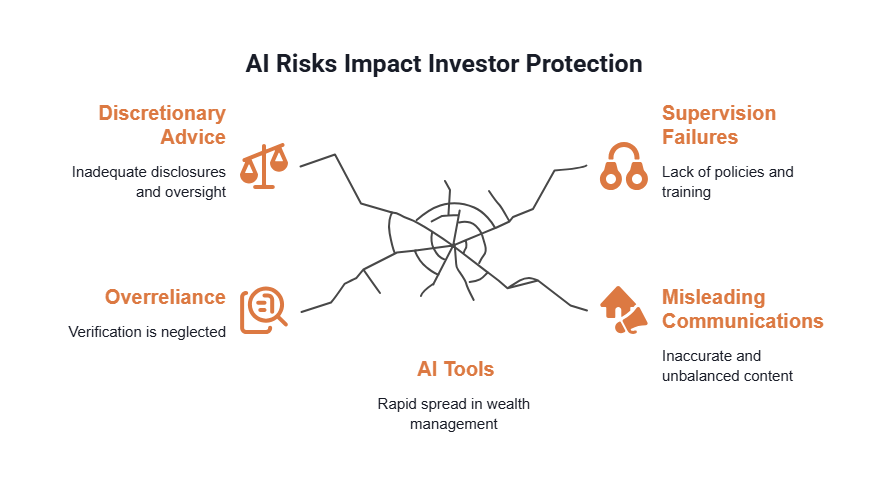
The rapid spread of AI tools in wealth management creates several distinct categories of risk for investors.
- Overreliance without verification. When advisors use AI-generated research, analysis, or portfolio suggestions without independently verifying the output, errors or biases in the technology can flow directly into client accounts. AI models can produce confident-sounding output that contains factual inaccuracies, outdated information, or recommendations that do not account for an individual client’s circumstances.
- Discretionary advice by another name. If an AI tool is recommending specific securities, setting asset allocations, or making suitability determinations for individual clients, the advisor and firm may be providing discretionary investment advice without the appropriate disclosures, authorizations, or oversight.
- Supervision failures. Firms have an obligation to supervise the activities of their advisors and the tools those advisors use. When AI is deployed without clear policies, training, and review procedures, the firm may be failing in its supervisory duties. FINRA’s guidance urges firms to address supervision at both the enterprise and individual levels and to consider accuracy and bias risks associated with any AI deployment.
- Misleading communications. AI-generated content used in client communications, marketing materials, or performance reports could introduce inaccuracies or misleading statements. Under existing securities regulations, every client-facing communication must be fair, balanced, and not misleading, regardless of whether a human or a machine drafted it.

RIA Liability for AI Investment Losses and What Firms Must Do
Registered investment advisory firms face particular exposure when adopting AI tools. RIA-focused legal and compliance guidance stresses that all existing legal obligations remain in force and that poorly governed AI deployments can increase both litigation and enforcement risk.
The safeguards for AI adoption in advisory firms that industry guidance recommends include clear written policies defining which AI use cases are approved and which are prohibited, controls governing how client data is entered into and retained by AI systems, mandatory review and supervision workflows for any AI-generated output before it reaches a client, ongoing monitoring to confirm that AI outputs are accurate and free from bias, and documentation practices that create an auditable trail of how AI was used in connection with client advice.
Firms that fail to implement these safeguards may face claims of negligence, breach of fiduciary duty, and failure to supervise. The AI fiduciary duty requirements that already govern advisory relationships do not allow firms to delegate their responsibilities to a technology vendor or an algorithm. Advisors and their firms remain accountable for every piece of advice, every record, every disclosure, and every supervisory decision, regardless of which tool drafted the first version.
Our lawyers are nationwide leaders in investment fraud cases.
How Meyer Wilson Werning Can Help
Meyer Wilson Werning has recovered over $350 million for clients nationwide and represents investors in claims involving licensed advisors and broker dealers. With more than 75 years of combined experience, the firm’s attorneys understand how new technologies create new avenues for investor harm and hold advisors and firms accountable when their use of AI or other tools falls short of their legal obligations.
If you believe your financial advisor’s use of AI contributed to losses in your account, or if you suspect that an advisory firm failed to properly supervise its use of technology, Contact us today for a free and confidential consultation to discuss your options.
We Are The firm other lawyers
call for support.
Frequently Asked Questions
Can financial advisors use AI to give personalized investment advice?
Industry and regulatory guidance indicate that advisors may use AI to support research and administrative tasks, but AI tools should not independently recommend specific securities, set allocations, or make suitability determinations for individual clients. Advisors and firms remain fully responsible for the advice they provide, and FINRA has stated that its rules and securities laws still apply when member firms use generative AI or similar technologies, whether those tools were developed in-house or obtained from third parties.
How are financial advisors currently using AI in their practices?
Recent surveys show that advisors primarily use AI for administrative and support functions such as drafting emails, generating meeting minutes, conducting research, organizing information, automating performance reports, and helping with CRM workflows. Vanguard’s survey found the most common uses were drafting emails (38%), research (35%), and meeting documentation (27%), while other studies report that a strong majority of advisors use AI-integrated solutions that save several hours per week but remain focused on efficiency rather than replacing human judgment.
What are the main investor protection risks when advisors use AI tools?
Investor protection risks include overreliance on AI outputs without verification, use of AI to provide what could be considered discretionary investment advice without proper authorization, and deployment of tools that may introduce inaccuracies or bias into client communications and portfolio recommendations. FINRA’s guidance states that existing rules apply to AI use and urges firms to address supervision at both the enterprise and individual levels while carefully reviewing AI-based investment tools for potential regulatory implications.
Do SEC and FINRA have specific rules for AI, or do existing regulations apply?
FINRA’s guidance explains that its rules are intended to be technology neutral and that securities laws generally continue to apply when member firms use generative AI or similar tools, the same way they apply to any other technology. This means existing obligations around supervision, suitability, recordkeeping, communications, and conflicts of interest extend to AI use rather than being replaced by a separate AI-specific framework.
How can RIA firms manage compliance risks when adopting AI tools?
RIA-focused guidance recommends that firms implement safeguards such as clear policies for approved AI use cases, controls over client data input and retention, review and supervision workflows for AI-generated content, and processes to confirm that outputs are accurate, unbiased, and compliant before being used with clients. All legal obligations remain in force, and poorly governed AI deployments can increase litigation and enforcement risk if they lead to misleading communications, unsuitable recommendations, or operational failures.
Recovering Losses Caused by Investment Misconduct.