

San Francisco’s status as the global epicenter of artificial intelligence has made its technical workforce a prime target for a new wave of financial deception. For many San Francisco engineers, data scientists, and software architects, what begins as a data-driven investment opportunity often ends in vanished savings and the realization that the promised “mathematical rigor” was a marketing illusion.
AI-powered investment platforms and algorithmic trading schemes are increasingly being designed to exploit the technical knowledge of engineers and data professionals in markets like San Francisco. The experienced financial advisor negligence attorneys at Meyer Wilson Werning can help evaluate whether your losses, if a licensed financial professional, broker, or advisor facilitated your investment, are the result of actionable misconduct. Contact us today for a free and confidential consultation, and you pay nothing unless we recover for you.
Why Are San Francisco Engineers Especially Vulnerable to AI-Based Investment Fraud?
It may seem counterintuitive that highly analytical professionals are misled by pseudoscientific products, but scammers specifically exploit the qualities that make engineers excel: trust in data and appreciation for automation.
- Belief in Algorithmic Precision: Engineers trust systems that utilize concepts like machine learning, neural networks, and predictive modeling, which fraudsters use as buzzwords to create false credibility.
- Confirmation Bias from Technical Expertise: Professionals often assume that because they understand the underlying technology, the investment strategy must be logical and functional.
- Familiarity with Volatility: Tech workers frequently invest in high-risk assets like crypto, options, and early-stage startups, making them more open to “AI” pitches framed as a way to capitalize on market volatility.
- Pressure to Grow Wealth Quickly: Professionals managing RSUs, stock options, or pre-IPO shares often seek high-yield strategies to grow their liquidity quickly.
- The Culture of Innovation: In an environment where disruption is expected and early adoption is prized, investors may overlook red flags for fear of missing out.

We Have Recovered Over
$350 Million for Our Clients Nationwide.
Common Types of Algorithmic Trading Fraud in San Francisco
Fraudulent promoters in San Francisco employ a variety of “black box” models and proprietary tactics that are often impossible to verify independently.
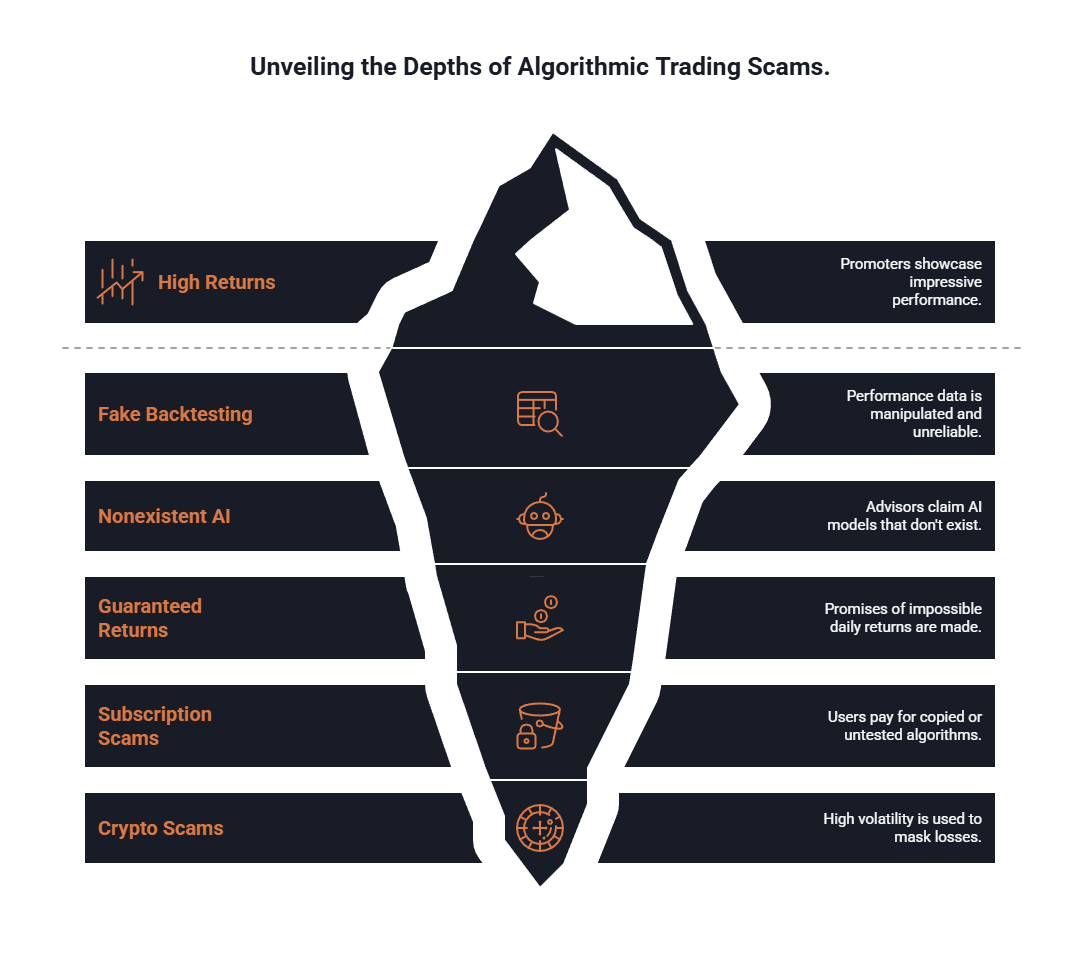
- Fake or Manipulated Backtesting
Promoters often present performance charts showing high returns with low risk, but this data is frequently cherry-picked, simulated, or overfitted to match historical prices rather than reflecting real-world performance.
- Nonexistent AI Models
Advisors may claim to use deep learning or reinforcement learning bots. In reality, the model may not exist or may be a simple moving-average strategy disguised as AI.
- “Guaranteed” or Predictable Returns
Pitches promising “0.5% daily returns” or “drawdown-proof models” are mathematically impossible in legitimate markets and are a major indicator of fraud.
- Subscription-Based and Licensed Algorithms
Users may pay for “proprietary signals” or “predictive price alerts” that are actually copied from open-source libraries or built from outdated indicators that have never been tested in live markets.
- Crypto and Forex AI Scams
These schemes rely on the high volatility of the crypto and forex markets to justify sudden losses while maintaining a false narrative of long-term profitability.
How Promoters Use Technical Jargon to Deceive Tech Professionals
Scammers tailor their messaging to meet the technical expectations of engineers, using sophisticated visualizations and credentials to build an illusion of stability.
- Technical Obfuscation: Terms like “GPU-accelerated analytics,” “Monte Carlo optimization,” and “AI inference engines” are used to mask weak or nonexistent systems.
- Faking Data Science: Dashboards may display fake heatmaps, regression outputs, and correlation matrices to mimic real data science tools.
- Misrepresenting Expertise: Fraudsters often claim they have engineering backgrounds from Stanford or MIT or have held quant roles at prestigious hedge funds or companies like Google, Meta, or OpenAI.
- Social Proof: Scammers use Discord groups, Slack channels, and LinkedIn to create a sense of community and fabricated user enthusiasm.
Our lawyers are nationwide leaders in investment fraud cases.
Important Points: Red Flags Investors Should Watch For
Investors should be extremely cautious if an AI-driven product features:
- Guaranteed returns or unrealistic backtesting.
- Vague or inaccessible code and overly technical language.
- Missing third-party audits or lack of regulatory registration.
- Crypto-only payments and pressure to invest quickly.
- Unverifiable founder credentials and no clear risk disclosure.
We Are The firm other lawyers
call for support.
How a San Francisco Investment Fraud Lawyer Helps Victims Recover
The fraud described in these schemes is deliberate. Promoters study their targets, adopt the language of data science, build convincing dashboards, and lean on the credibility of the AI industry to manufacture trust. By the time the losses become undeniable, the evidence is often gone. Acting quickly to preserve records and get a legal assessment is not just advisable; it is critical.
Meyer Wilson Werning has recovered more than $350 million for investors across the country over the past 25 years. If you lost money through a purported AI trading platform or algorithmic investment strategy, we want to hear from you. Contact us today for a free and confidential consultation. You pay nothing unless we recover for you.
Frequently Asked Questions
How do I know if an AI trading platform is legitimate?
Legitimate platforms are transparent about their risks and typically registered with regulators like the SEC or FINRA. Watch for red flags like guaranteed returns, unverifiable code, and pressure to invest quickly.
Can I recover losses if the scam involved cryptocurrency?
Yes, recovery may still be possible, especially if a licensed financial advisor or brokerage firm was involved in recommending the product or failing to supervise the transaction.
What evidence should I save if I suspect fraud?
You should preserve all communications, performance reports, and bank records. It is also critical to take screenshots of dashboards and metrics, as fraudulent platforms often delete data once they are discovered.
Is “backtesting” a reliable way to judge an AI model?
Not necessarily. Fraudulent promoters often use cherry-picked, simulated, or overfitted data to create charts that show high returns with zero risk, which does not accurately predict future performance.
Why is arbitration the primary path for recovery?
Most brokerage and advisor agreements require disputes to be resolved through arbitration rather than traditional court litigation. It is often a faster, private, and more structured way for investors to seek compensation.
Recovering Losses Caused by Investment Misconduct.