


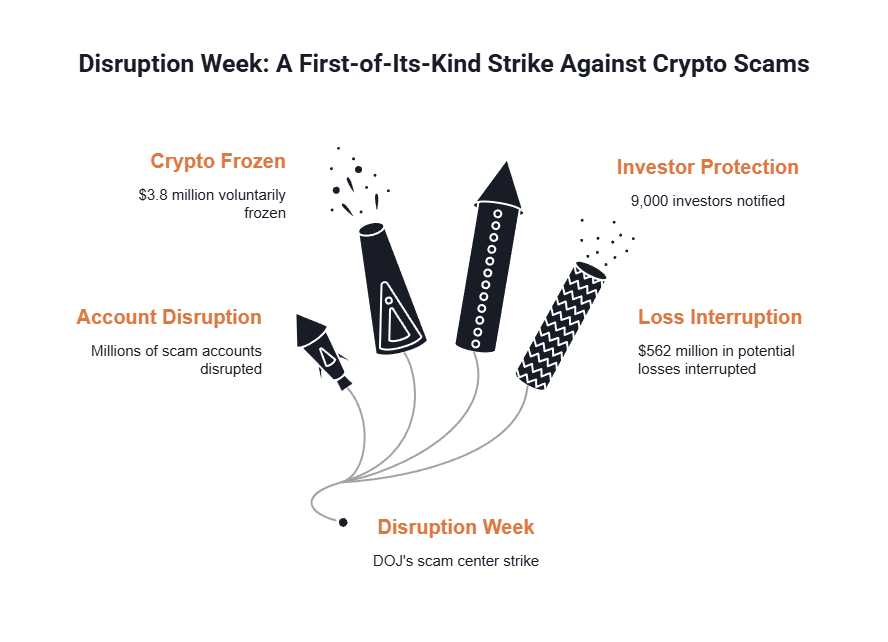
The U.S. Department of Justice has taken an unprecedented step in the fight against cryptocurrency investment fraud. Through its Scam Center Strike Force, the DOJ convened a first-of-its-kind “Disruption Week” from May 18 to May 21, bringing together federal law enforcement, foreign government officials, and major private sector companies to directly disrupt the infrastructure behind pig butchering scams targeting Americans. As a result, millions of scam accounts were interrupted across social media and internet platforms, and over $3.8 million in cryptocurrency voluntarily frozen by private sector participants.
If a licensed financial professional, broker, or advisor facilitated your investment in a fraudulent cryptocurrency platform, the cryptocurrency fraud attorneys at Meyer Wilson Werning are reviewing claims now. Contact us today for a free and confidential consultation, and you pay nothing unless we recover for you.
What Was Disruption Week?
Disruption Week was organized by the DOJ’s Scam Center Strike Force, launched in November 2025 by U.S. Attorney Jeanine Ferris Pirro for the District of Columbia, in partnership with Assistant Attorney General A. Tysen Duva of the DOJ’s Criminal Division.
During the event, federal investigators from the FBI, U.S. Secret Service, and Homeland Security Investigations (HSI) shared intelligence on specific fraud targets with private industry representatives. Based on that data, participants voluntarily identified and disrupted scam actors on their networks. Private sector participants included officials from Apple, Coinbase, Google, Meta, Microsoft, Silent Push, SpaceX, TRM Labs, and Zenlayer. Foreign law enforcement counterparts from the Australian Federal Police, Canadian Anti-Fraud Centre, New Zealand Police, Royal Thai Police, and U.K. National Crime Agency also joined. Meta played a central role in coordinating broad participation.
“Disruption Week shows what is possible when governments and private industry focus their efforts in tandem: millions of scam accounts interrupted, and criminal networks pushed off the U.S. internet platforms on which they rely,” said U.S. Attorney Pirro.

We Have Recovered Over
$350 Million for Our Clients Nationwide.
Operation Level Up: The FBI’s Proactive Victim Notification Program
Since January 2024, FBI San Diego and FBI Phoenix have jointly operated Operation Level Up, a proactive initiative that identifies active victims of cryptocurrency investment fraud and notifies them before their losses grow further. As of April 2026, the program had contacted nearly 9,000 victims and is estimated to have interrupted approximately $562 million in potential losses.
How Pig Butchering Scams Work and Why Losses Keep Rising
Cryptocurrency investment fraud, referred to by scammers as “pig butchering,” is now among the fastest-growing and most financially devastating forms of fraud targeting Americans. According to the FBI’s Internet Crime Complaint Center (IC3), reported losses climbed from $3.96 billion in 2023 to $5.8 billion in 2024, then rose another 24 percent in 2025 to over $7.2 billion. Those figures are believed to significantly underrepresent actual losses. A conservative government estimate put the annual value of funds stolen by scam syndicates worldwide at nearly $64 billion as of the end of 2023.
The scheme follows a consistent pattern:
- Grooming: Contact is initiated through a dating app, LinkedIn, or social media. The scammer builds trust over days or weeks before introducing an investment opportunity.
- Fake platform: The person is directed to a fraudulent trading app displaying fabricated gains designed to encourage larger deposits.
- Escalating demands: When the person attempts to withdraw, the platform demands additional payments for nonexistent “taxes,” “fees,” or “compliance requirements.”
- Disappearance: Once the person runs out of money or discovers the fraud, contact is cut off entirely.
Many of these operations are run from industrial-scale compounds in Cambodia, Laos, and Burma. The indictments unsealed in connection with a subsequent wave of 276 arrests offer some of the most detailed public documentation of how these compounds are staffed and managed. According to the DOJ, criminal syndicates lure workers with promises of legitimate jobs, then traffic them into scam compounds where they are allegedly forced to conduct fraud operations under threat of violence. Public reporting has documented beatings, electrocutions, and murder inside these facilities.
We covered this story on X as it broke:
DOJ's "Disruption Week" just froze over $3.8 million in crypto and interrupted millions of scam accounts targeting Americans. Crypto fraud losses hit $7.2 billion in 2025:https://t.co/CgKD7WHwBu#CryptoScams #DOJ #DisruptionWeek
— Meyer Wilson Werning (@Investor_Claims) July 4, 2026
Our lawyers are nationwide leaders in investment fraud cases.
What the Strike Force’s Actions Mean for Defrauded Investors
The Scam Center Strike Force has filed criminal complaints against individuals involved in cryptocurrency fraud operations in Burma, seized cryptocurrency and related infrastructure, and coordinated with a growing roster of federal partners including the U.S. Postal Inspection Service, IRS Criminal Investigation, HSI-DC, and U.S. Attorney’s Offices in Alaska, Rhode Island, and Western Washington.
These are meaningful steps. But investors need to understand their limits:
- Criminal prosecution does not equal direct recovery. Government restitution processes can take years and frequently do not fully compensate individual investors.
- Civil claims remain the primary recovery path. Investors who suffered losses through a U.S.-based broker, financial advisor, or regulated platform may have independent civil claims through arbitration or litigation.
- Third parties may share responsibility. Banks, brokerage firms, and payment processors that allegedly failed to flag suspicious transactions or facilitated transfers to fraudulent platforms may face liability of their own.
We Are The firm other lawyers
call for support.
Key Points for Investors
- Verify before investing. Confirm that any platform, advisor, or broker is registered with the SEC or FINRA. Unregistered entities are a serious red flag.
- Treat unsolicited contact as suspect. Legitimate investment professionals do not cold-contact potential clients through dating apps or social media.
- Never send additional funds to unlock withdrawals. Any platform demanding new deposits to release existing funds is almost certainly fraudulent.
- Document everything. Save all communications, transaction records, wallet addresses, and account screenshots for both law enforcement reporting and any civil recovery effort.
- Act quickly. Statutes of limitations on securities-related claims are finite. Early legal consultation can be the difference between a viable claim and a time-barred one.

How Meyer Wilson Werning Can Help
The FBI reported more than $7.2 billion in cryptocurrency fraud losses in 2025 alone, and Disruption Week, for all its historic scope, did not change what that number means for the people already behind it. Criminal enforcement and civil recovery are separate tracks. For investors who lost money to a pig butchering scheme, the federal response is meaningful context, but it is not a path to getting their money back.
For over 25 years, Meyer Wilson Werning has recovered more than $350 million for investors harmed by fraud and broker misconduct. The firm’s legal team includes attorney Courtney M. Werning, who focuses specifically on crypto and digital asset fraud claims. If you lost money in a pig butchering scheme or fraudulent cryptocurrency platform, contact us today for a free and confidential consultation. You pay nothing unless we recover for you.
Frequently Asked Questions
What was Disruption Week and what did it accomplish?
Disruption Week was a DOJ Scam Center Strike Force enforcement event held May 18 to 21. Federal investigators shared intelligence with major private companies including Apple, Coinbase, Google, and Meta, enabling voluntary disruption of millions of scam accounts and the freezing of over $3.8 million in cryptocurrency tied to fraud operations targeting Americans.
How much have pig butchering scams cost American investors?
According to the FBI’s IC3, reported losses from cryptocurrency investment fraud rose from $3.96 billion in 2023 to $5.8 billion in 2024, then surged over 24 percent in 2025 to more than $7.2 billion. These figures are believed to significantly underrepresent actual losses. A government estimate placed global annual losses from scam syndicates at nearly $64 billion as of the end of 2023.
Will the DOJ’s enforcement actions compensate investors directly?
Not directly. Government asset seizures and penalties go through a restitution process that can take years and may not fully repay individual investors. Investors may have separate civil claims that can be pursued through arbitration or litigation on a much faster timeline.
What should I do if I lost money in a cryptocurrency investment scheme?
Stop sending money immediately. Document all communications, transaction records, wallet addresses, and account screenshots. Report the scheme to the FBI’s IC3 and consult with an experienced cryptocurrency fraud attorney as soon as possible, since statutes of limitations on securities-related claims are time-sensitive.
Recovering Losses Caused by Investment Misconduct.