


Emerson Equity broker, George Wallace Smith, is now facing 11 pending customer disputes on his BrokerCheck record. He is at the center of widening investor allegations involving high-risk, illiquid real estate and private placement securities.
According to publicly available records, the pending complaints allege unsuitable recommendations, misrepresentations and omissions, breach of fiduciary duty, negligence, and violations of Regulation Best Interest tied to sales of Emerson Equity LLC offerings. Across the matters with stated amounts, investors are seeking more than $14.5 million in claimed damages, with a single 2026 filing alone requesting $10,000,000 in compensatory damages. The scope of these allegations now spans Colorado, California, and Texas, pointing to a widening pattern of alleged investor harm.
If you or a family member experienced significant investment losses involving Emerson Equity broker George Wallace Smith, Meyer Wilson Werning can help. Our team of experienced broker misconduct attorneys focus on representing investors who have been misled by financial professionals. Contact us for a free and confidential consultation.
What Do Current Disclosures Report About George Wallace Smith?
According to his FINRA BrokerCheck profile, George Wallace Smith (CRD# 4844156) currently has 11 pending customer dispute disclosures, all of which involve allegations connected to real estate and private placement securities distributed through Emerson Equity LLC. Smith has been registered with Emerson Equity since approximately 2020.
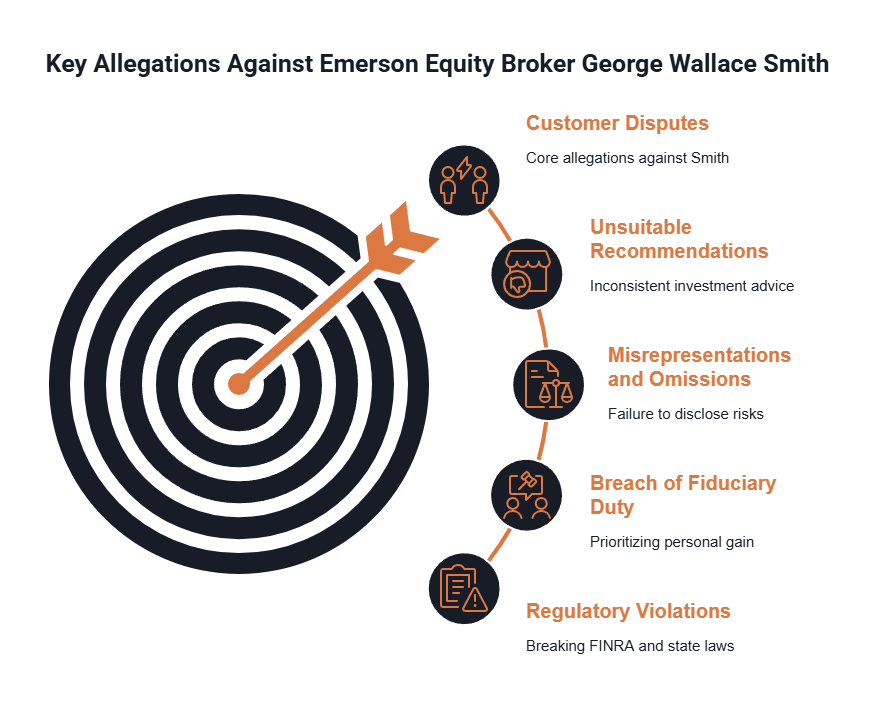
The pending disputes collectively allege a broad range of misconduct. Across the filings, investors have raised the following categories of allegations:
- Unsuitable recommendations: Investors allege that Smith recommended high-risk, illiquid real estate securities that were inconsistent with their stated investment objectives, risk tolerances, and income needs.
- Misrepresentations and omissions: Multiple complaints accuse Smith of failing to disclose material risks and overstating the safety or expected returns of Emerson Equity offerings.
- Breach of fiduciary duty: Filings claim Smith placed his own compensation interests ahead of his clients’ financial well-being.
- Negligence and gross negligence: Investors allege that Smith failed to exercise reasonable care in evaluating the suitability and risks of the products he recommended.
- Violation of Regulation Best Interest: Several recent filings explicitly cite Reg BI violations, asserting that Smith did not act in the best interest of retail customers when recommending these securities.
- Violation of FINRA Rules 2210 and 2010: Complaints allege misleading marketing and sales communications in connection with the sale of Emerson Equity products, as well as failures to observe high standards of commercial honor.
- Violation of state securities laws: Recent arbitration filings identify alleged violations of the Colorado Securities Act, the California Securities Act, and Section 27.01 of the Texas Business and Commerce Code.
- Common law fraud and breach of contract: Some filings include allegations that written contracts and warranties were breached, and that investors were allegedly defrauded through the sales process.
- Promissory estoppel and vicarious liability: Additional legal theories assert that Emerson Equity bears responsibility for Smith’s alleged conduct.

We Have Recovered Over
$350 Million for Our Clients Nationwide.
How Much Have Investors Claimed in Damages Against Smith?
The scale of alleged losses in these pending disputes is significant. Claimed damages across matters with stated amounts exceed $14.5 million in total, with individual claims ranging from the hundreds of thousands to a single 2026 filing seeking $10,000,000 in compensatory damages. Several additional matters list damages as unspecified in their statements of claim.
The complaints span investments purchased as early as 2020, with trades executed as recently as April 2024. At least one Colorado-based arbitration involves a retiree and his sister seeking up to $3,000,000 for allegedly unsuitable, illiquid real estate investments sold by Smith.
What Do Pending Disputes Indicate for Emerson Equity Investors?
Key data points about the Emerson Equity complaint pattern include:
- Multiple brokers at Emerson Equity have been named in investor disputes involving similar product categories, including high-risk, illiquid real estate and private placement offerings.
- The complaints against Smith span multiple states, with arbitration filings citing violations of Colorado, California, and Texas securities laws, suggesting investors across the country may have been affected.
- Investments at the center of the disputes were purchased as early as 2020, with trades executed as recently as April 2024, indicating the alleged sales practices continued over an extended period.
- The scale of damages claimed, exceeding $14.5 million across pending matters with stated amounts, reflects the concentrated, illiquid nature of the products involved and the difficulty investors face in recovering losses outside of formal arbitration.
The complaints against Smith span multiple states and involve investors who purchased real estate and private placement securities through Emerson Equity between 2020 and 2024. Arbitration allows investors to seek damages without filing a traditional lawsuit, and experienced legal representation can make a meaningful difference in the outcome.
Our lawyers are nationwide leaders in investment fraud cases.
How Meyer Wilson Can Help
Investors who purchased real estate securities through Emerson Equity and relied on George Wallace Smith’s recommendations deserve straight answers about what went wrong and whether they can recover. Smith has eleven pending arbitration claims, with alleged damages exceeding $14.5 million, reflecting the scale of potential harm tied to these illiquid, high-risk products. The time to act is not after documents are lost or deadlines have passed.
With more than $350 million recovered for investors nationwide, Meyer Wilson Werning has spent over 25 years holding brokers and brokerage firms accountable for exactly this kind of misconduct. If you suffered losses in Emerson Equity real estate or private placement securities recommended by George Wallace Smith, contact us today for a free and confidential consultation. You pay nothing unless we recover for you.
We Are The firm other lawyers
call for support.
Frequently Asked Questions

What are the current fraud and misconduct allegations against Emerson Equity broker George Wallace Smith?
George Wallace Smith now has 11 pending customer disputes on his FINRA BrokerCheck record. The complaints allege unsuitable recommendations, misrepresentations and omissions, breach of fiduciary duty, negligence, and Regulation Best Interest violations tied to Emerson Equity real estate and private placement offerings. Several filings also assert violations of state securities laws in Colorado, California, and Texas.
What does George Wallace Smith’s FINRA BrokerCheck record show about pending disputes and claimed damages?
BrokerCheck shows 11 pending customer disputes, up from six previously reported. Claimed damages across matters with stated amounts exceed $14.5 million, including one 2026 filing seeking $10,000,000 in compensatory damages. Other recent disputes report claimed losses of $1,100,000, $671,228, and $200,000, with several additional filings listing unspecified amounts.
How can investors pursue a FINRA arbitration claim against Emerson Equity and George Wallace Smith?
Investors can typically pursue recovery through arbitration rather than traditional litigation. To begin, an investor files a statement of claim outlining the alleged misconduct and damages sought. Gathering account statements, correspondence, and offering documents early is important, as is working with experienced counsel. FINRA arbitration has strict deadlines, so investors are advised not to delay.
Why are Regulation Best Interest and state securities laws central to the complaints against Emerson Equity and George Wallace Smith?
Regulation Best Interest requires brokers to act in retail customers’ best interests when making recommendations. Many pending complaints allege Smith failed to meet that standard while selling high-commission, illiquid real estate securities without adequate risk disclosure. Filings also cite the Colorado Securities Act, the California Securities Act, and Texas Business and Commerce Code Section 27.01, adding state-law claims that can strengthen an investor’s arbitration case.
Recovering Losses Caused by Investment Misconduct.