


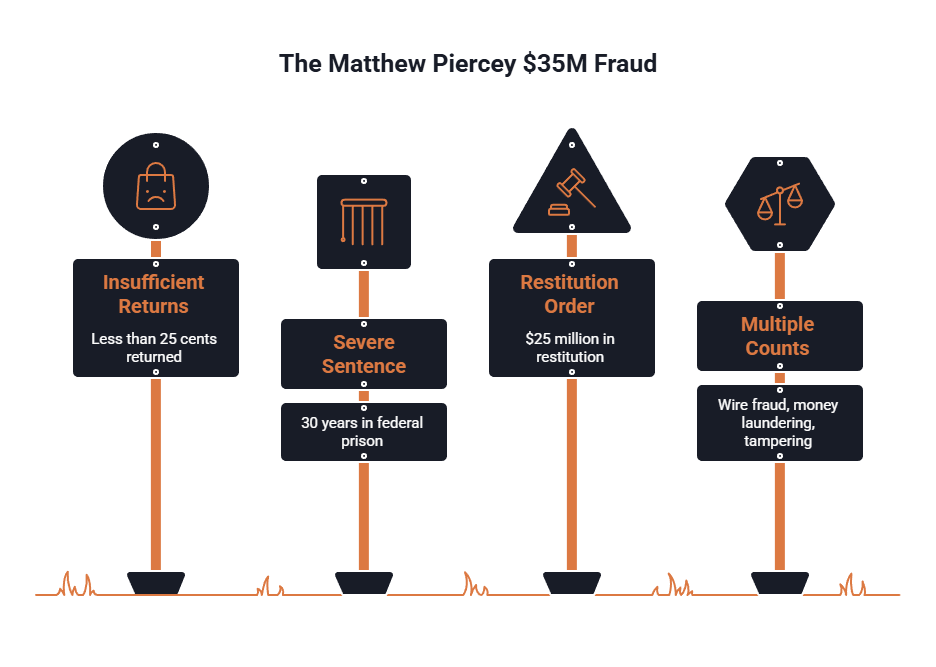
Matthew Piercey, 49, of Palo Cedro, California, was sentenced to 30 years in federal prison on May 21, 2026, for running a $35 million Ponzi-style investment fraud scheme that preyed on trusting investors, many of whom he recruited at church. Chief U.S. District Judge Troy L. Nunley also ordered Piercey to pay approximately $25 million in restitution to the investors his scheme left without their savings.
Because the entities behind this scheme were not registered broker-dealers or licensed investment advisers, Meyer Wilson Werning is only able to pursue claims on your behalf if a registered financial professional or licensed broker-dealer was involved in directing your investment.
If a licensed broker, financial advisor, or registered firm recommended or facilitated your participation in this scheme, the Ponzi scheme attorneys at Meyer Wilson Werning are reviewing claims now. Contact us today for a free and confidential consultation, and you pay nothing unless we recover for you.
How the Matthew Piercey Investment Fraud Scheme Operated
Between July 2015 and August 2020, Piercey presented himself as a legitimate investment advisor through two purported companies, Family Wealth Legacy and Zolla Financial, and made false and misleading statements to investors about trading algorithms, investment performance, fee structures, and the liquidity of their holdings.
The centerpiece of the fraud was the “Upvesting Fund,” marketed as an automated algorithmic trading fund with a proven track record. It did not exist. Court documents show Piercey privately admitted to an associate that there was no such fund, even as he continued collecting investor money into it. Many products were structured as fixed-return loans to project safety, while new investor money was used to pay earlier investors, the defining feature of a Ponzi-like scheme.
Of the approximately $35 million raised, only about $8.8 million was ever returned. The remainder was spent on personal expenses, a criminal defense firm, and two residential properties. U.S. Attorney Eric Grant stated at sentencing that Piercey “preyed on trusting investors, many of whom he met at church, convincing them to hand over decades’ worth of savings.” This is affinity fraud at its most deliberate, leveraging community trust as a recruitment strategy rather than earning confidence through legitimate performance.

We Have Recovered Over
$350 Million for Our Clients Nationwide.
How Piercey Tried to Evade Arrest and Obstruct Justice
When Piercey learned he was under federal investigation, he worked to prevent witnesses from responding to grand jury subpoenas and siphoned off nearly $775,000 from investors into a bank account he controlled. On November 16, 2020, when FBI agents moved to arrest him, he led law enforcement on a vehicle chase before entering Lake Shasta with a Yamaha 350Li underwater sea scooter. He was arrested after approximately 20 minutes in the water.
After arrest, Piercey rented a storage locker in Redding under the fictitious name Chadwick Givens using a fake California driver’s license. When FBI agents searched it, they found a wig and 31,000 Swiss francs. On May 15, 2025, four days before his scheduled trial, Piercey pleaded guilty to all 27 counts, including wire fraud, concealment money laundering, and witness tampering. Co-conspirator Kenneth Winton, 73, of Chico, is scheduled for sentencing on August 27, 2026.
Key Points for Investors in This Case
- Matthew Piercey was sentenced to 30 years in prison on May 21, 2026, after pleading guilty to 27 counts
- The scheme operated from July 2015 through August 2020 through Family Wealth Legacy and Zolla Financial
- Piercey raised approximately $35 million and returned only about $8.8 million
- Many investors were recruited through church communities, a hallmark of affinity fraud
- A court order requires Piercey to pay approximately $25 million in restitution
- Investors directed into this scheme by a licensed financial professional may have independent civil claims
Our lawyers are nationwide leaders in investment fraud cases.
How Meyer Wilson Werning Can Help Investors Who Lost Money
A 30-year federal prison sentence and a $25 million restitution order are a measure of accountability. They are not a recovery plan. Federal restitution orders are frequently difficult to collect, and investors who lost money in this scheme cannot count on the criminal process to put funds back in their accounts. If a licensed financial professional, broker, or registered adviser played a role in directing you toward Family Wealth Legacy or Zolla Financial, a separate civil claim may be available to you on its own timeline, independent of the criminal case entirely.
With more than $350 million recovered for investors nationwide, Meyer Wilson Werning has spent over 25 years holding the licensed professionals and registered firms that put investors in harm’s way accountable for the damage they cause. Because MWW’s practice is limited to claims against registered financial professionals and licensed broker-dealers, direct claims against the entities behind this scheme are generally not available through our firm. But if a licensed broker or financial advisor recommended this investment to you, contact us today for a free and confidential consultation. You pay nothing unless we recover for you.
We Are The firm other lawyers
call for support.
Frequently Asked Questions
What was the Matthew Piercey investment fraud scheme?
Matthew Piercey operated a Ponzi-style fraud from July 2015 through August 2020 through Family Wealth Legacy and Zolla Financial. He raised approximately $35 million using false statements about trading algorithms and a fabricated product called the “Upvesting Fund.” He was sentenced to 30 years in federal prison on May 21, 2026.
Can investors still recover losses from the Family Wealth Legacy or Zolla fraud?
A criminal conviction does not guarantee financial recovery. However, investors who were directed into these products by a licensed financial advisor or broker may have separate civil claims against that professional and their firm, independent of the criminal restitution process.
Is there a deadline for filing an investment fraud claim in California?
Statutes of limitations vary by legal theory and jurisdiction. The clock generally begins when an investor knew or should have known of the potential fraud. If you lost money in this scheme, do not delay in seeking legal advice.
Recovering Losses Caused by Investment Misconduct.