


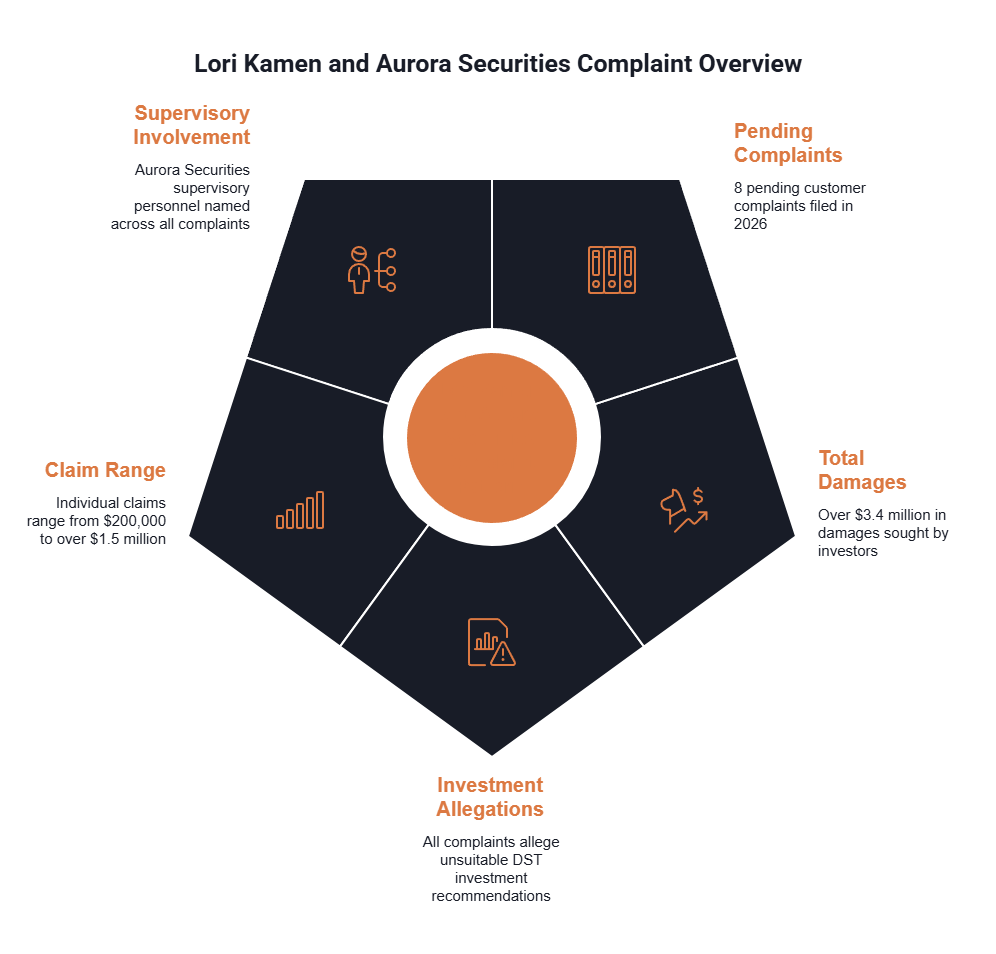
Former Aurora Securities broker Lori Kamen is facing eight pending customer dispute disclosures on her FINRA BrokerCheck record, with investors collectively seeking more than $3.4 million in damages.
The complaints, all filed in 2026, allege that Kamen recommended unsuitable investments, including Delaware Statutory Trust products, to clients who may not have been appropriate candidates for those illiquid, complex securities. DSTs fall into the broader category of alternative investment loss claims, which often involve products sold to investors without adequate disclosure of the risks or restrictions involved.
Kamen reportedly served as president and chief compliance officer of Aurora Securities, which places her at the center of both the suitability allegations and the firm’s supervisory framework. All complaints remain pending and unproven.
What Do Current Disclosures Report About Lori Kamen?
FINRA BrokerCheck records for Lori Beth Kamen’s FINRA BrokerCheck profile identify eight pending customer dispute disclosures on record. Lori Beth Kamen (CRD# 2805591) is currently registered with Republic Capital Group and previously held registrations with Aurora Securities, where she reportedly functioned in a supervisory capacity.
According to available BrokerCheck data and secondary reporting, the customer complaints center on allegations of unsuitable investment recommendations across different product types. A complaint filed on March 23, 2026, reportedly requests $222,513.53 in damages. According to a secondary report referencing BrokerCheck, Kamen has denied the allegations, stating she did not recommend or solicit the investments at issue and was named in the complaints based on her supervisory role as Aurora Securities’ president and chief compliance officer.
All reported complaints against Kamen remain pending and unproven. No final adjudication, settlement, or regulatory finding has been confirmed at this time. Investors can review the FINRA BrokerCheck PDF for Lori Beth Kamen for additional disclosure details.
The overall pattern of multiple customer complaints alleging unsuitable recommendations, including at least one involving a substantial claimed loss, warrants close attention from investors who held accounts at Aurora Securities or who received investment advice associated with Kamen.

We Have Recovered Over
$350 Million for Our Clients Nationwide.
What Does Aurora Securities’ Complaint History Mean for Investors?
Aurora Securities is the brokerage firm where Lori Kamen allegedly oversaw compliance and supervision as president and chief compliance officer. The filing of multiple customer complaints against a firm’s senior compliance officer raises serious questions about the adequacy of the firm’s supervisory framework. Aurora Securities is not the only firm with DST-related complaints on record, a separate complaint filed against Aurora Securities broker Austin Bowlin over DST investment recommendations suggests a broader pattern worth examining.
Under FINRA Rule 3110, broker-dealer firms must establish and maintain supervisory systems reasonably designed to ensure their associated persons comply with applicable securities laws and FINRA rules. This includes reviewing the suitability of investment recommendations, monitoring accounts for red flags, and enforcing written supervisory procedures. When those systems break down, or when the individual responsible for supervision is personally named in investor complaints, the question of whether meaningful failure-to-supervise liability exists becomes central to any recovery effort.
Investors who held accounts at Aurora Securities during Kamen’s reported tenure should consider reviewing their account records for recommendations that did not match their stated risk tolerance or investment objectives.
How Meyer Wilson Werning Can Help
DST investments are among the most difficult products for investors to escape once they are in. They are illiquid, complex, and often carry years-long lock-up periods that leave little room for error if the recommendation was wrong from the start. When the broker who made those recommendations also served as the firm’s president and chief compliance officer, the supervisory failure runs from the trading desk all the way to the top. Eight pending complaints and more than $3.4 million in alleged damages suggest this may not be an isolated problem for Aurora Securities clients.
With more than $350 million recovered for investors nationwide, Meyer Wilson Werning has spent over 25 years holding brokers and brokerage firms accountable for exactly this kind of misconduct. If you lost money in DST investments or other alternative investments recommended through Aurora Securities, contact us today for a free and confidential consultation. You pay nothing unless we recover for you.
Our lawyers are nationwide leaders in investment fraud cases.
Frequently Asked Questions
What is a Delaware Statutory Trust, and why are DSTs considered risky?
A Delaware Statutory Trust is a legal structure that allows multiple investors to hold fractional ownership interests in real estate. DSTs are considered risky because they are illiquid, carry complex fee structures, and lack a secondary trading market, meaning investors may be unable to access their capital for years. These characteristics make DSTs unsuitable for many investors, particularly those with conservative risk profiles or near-term liquidity needs.
How can I check Lori Kamen’s complaint history on FINRA BrokerCheck?
You can review Lori Kamen’s disclosure history by visiting her FINRA BrokerCheck profile using CRD# 2805591. BrokerCheck provides information about customer complaints, regulatory actions, and employment history for registered brokers. Investor Claims also maintains a broker complaint database that can help you research broker records.
What does it mean when a firm’s chief compliance officer is named in customer complaints?
When a chief compliance officer is named in customer complaints, it can raise questions about whether the firm’s supervisory systems were adequate. Under FINRA Rule 3110, firms must maintain supervision reasonably designed to prevent violations. Multiple complaints against a supervisory principal may indicate systemic concerns with the firm’s compliance practices.
What is the deadline for filing a FINRA arbitration claim?
FINRA arbitration claims generally must be filed within six years of the event giving rise to the dispute. However, the specific deadline can vary depending on the circumstances. Investors who believe they suffered losses due to unsuitable recommendations should consult an attorney promptly to avoid missing applicable filing deadlines.
Recovering Losses Caused by Investment Misconduct.