


A Kirkland, Washington financial advisor is facing a $1 million investor complaint alleging that his recommendations in Delaware Statutory Trust investments and 1031 exchange strategies were unsuitable for his client’s needs. According to FINRA BrokerCheck, Austin Bowlin is registered as a broker with Aurora Securities and as an investment adviser with Secure Asset Management, doing business as Real Estate Transition Solutions (RETS).
If you invested in DSTs, 1031 exchange replacement properties, or other real estate securities through Austin Bowlin, Aurora Securities, or a similar advisor, the experienced alternative investment loss attorneys at Meyer Wilson Werning can help evaluate whether your losses are the result of actionable misconduct. Contact us today for a free and confidential consultation, and you pay nothing unless we recover for you.
The Complaint: $1 Million in Alleged Damages
A customer complaint filed in October 2025 alleges that Bowlin, acting as a representative of Aurora Securities, recommended unsuitable real estate investments. The pending complaint seeks $1 million in damages, filed as FINRA Claim No. 25-02090. The allegations raise questions under FINRA Rule 2111 (Suitability), FINRA Rule 3110 (Supervision), and the SEC’s Regulation Best Interest. The matter remains pending and no liability has been established.

We Have Recovered Over
$350 Million for Our Clients Nationwide.
Austin Bowlin’s FINRA Disclosure History
According to FINRA BrokerCheck, Austin Bowlin (CRD# 5674142) has 6 disclosures on his record, including 5 pending customer disputes and 1 criminal disclosure that was dismissed.
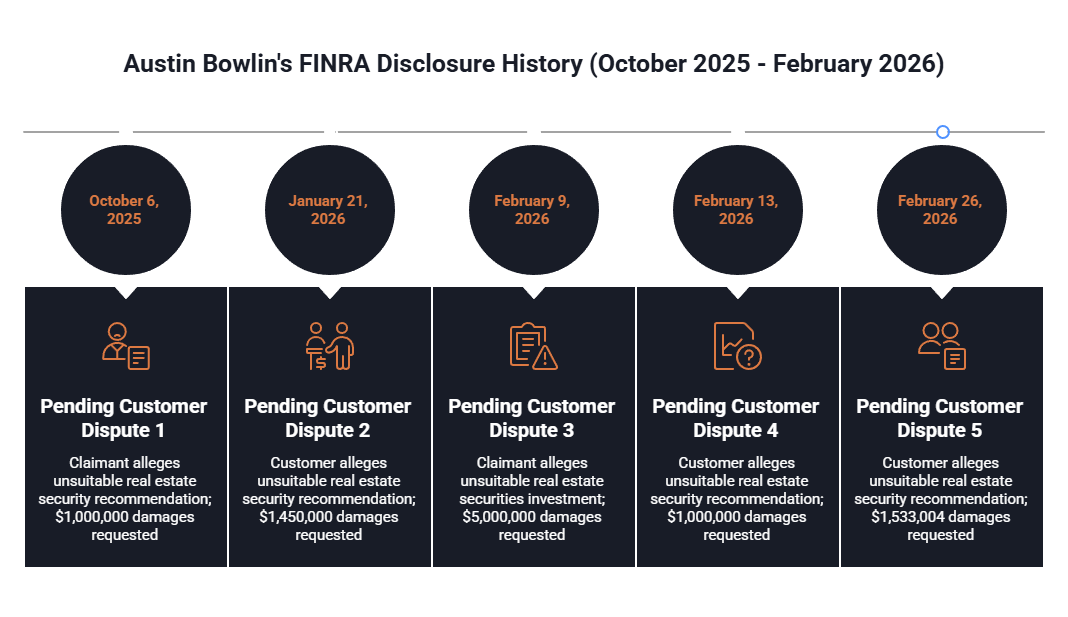
The five pending customer complaints were all filed between October 2025 and February 2026, and all allege unsuitable investment recommendations in real estate securities. The combined damages requested across these complaints total more than $10 million:
- October 6, 2025: Pending. Claimant alleges unsuitable investment recommendation. Damages requested: $1,000,000
- January 21, 2026: Pending. Customer alleges unsuitable investment recommendation in a real estate security. Damages requested: $1,450,000
- February 9, 2026: Pending. Claimant alleges unsuitable investment recommendation in a real estate securities investment. Damages requested: $5,000,000
- February 13, 2026: Pending. Customer alleges unsuitable investment recommendation in real estate security. Damages requested: $1,000,000
- February 26, 2026: Pending. Customer alleges unsuitable investment recommendation in real estate security. Damages requested: $1,533,004
The pattern of five complaints filed in rapid succession, all alleging the same core misconduct, is notable. When multiple investors independently raise the same allegation against a single advisor over a short period, it can indicate a systemic suitability problem rather than an isolated dispute.
The Risks of DSTs and 1031 Exchange Strategies
Delaware Statutory Trusts are passive real estate structures frequently used as replacement properties in 1031 exchanges. While they may offer tax deferral benefits, they carry risks that are not always fully understood at the time of purchase:
- Illiquidity. DST interests cannot be easily sold. Capital is typically locked in for years, which can create serious hardship for retirees who need access to their savings.
- Strict timelines. A 1031 exchange requires identifying a replacement property within 45 days and closing within 180 days, which can pressure investors into unsuitable choices.
- Tax deferral is not elimination. Investors who mistake deferral for permanent tax avoidance may face unexpected consequences when the property is eventually sold.
- Overconcentration. Placing a substantial portion of liquid assets into a single DST or group of similar properties creates concentration risk that may be inappropriate for conservative investors.
When an advisor recommends DST investments without adequately accounting for a client’s liquidity needs, income requirements, and risk tolerance, that recommendation may fall short of the standards required by Regulation Best Interest and FINRA Rule 2111.
Our lawyers are nationwide leaders in investment fraud cases.
How Meyer Wilson Werning Can Help
Investors who followed their advisor’s guidance on 1031 exchanges and DSTs trusted that the complexity of those products had been fully evaluated against their actual needs. When that trust is misplaced and illiquid investments leave retirees without access to their savings, that is exactly the kind of harm that investor protection law is designed to address.
With more than $350 million recovered for investors nationwide, Meyer Wilson Werning has spent over 25 years holding brokerage firms and financial advisors accountable for unsuitable recommendations and supervisory failures. If you suffered losses through DST investments, 1031 exchange strategies, or other unsuitable real estate securities recommended by Austin Bowlin, Aurora Securities, or any other advisor, contact us today for a free and confidential consultation. You pay nothing unless we recover for you.
We Are The firm other lawyers
call for support.
Frequently Asked Questions

What does the complaint against Austin Bowlin allege?
A complaint filed in October 2025 alleges that Bowlin recommended unsuitable real estate investments while acting as a representative of Aurora Securities. The pending complaint seeks $1 million in damages as FINRA Claim No. 25-02090. No liability has been established.
What are the risks of Delaware Statutory Trust investments?
DSTs are illiquid, not publicly traded, and can be sensitive to interest rate changes. Once invested, capital is typically locked in for years. For investors with income needs or conservative risk profiles, heavy concentration in DSTs may be inappropriate.
What is a 1031 exchange and what makes it risky?
A 1031 exchange allows real estate investors to defer capital gains taxes by reinvesting proceeds into a like-kind property within strict IRS deadlines. The 45-day identification window and 180-day closing requirement can pressure investors into unsuitable replacement properties that do not match their financial goals.
What is Regulation Best Interest and how does it apply here?
Regulation Best Interest requires broker-dealers to act in the best interest of retail customers when making investment recommendations, including evaluating risks, costs, and reasonably available alternatives. A broker who recommends illiquid real estate products without adequately accounting for a client’s liquidity needs may be violating their Reg BI obligations.
Can investors recover losses from unsuitable DST recommendations?
Yes. Investors may pursue recovery through FINRA arbitration on claims including unsuitable recommendations, failure to supervise, and breach of fiduciary duty. An experienced attorney can evaluate whether the specific facts support a claim and the most viable path to recovery.
Recovering Losses Caused by Investment Misconduct.