


Retirees and income-focused investors who bought into a non-traded interval fund called Priority Income Fund were told the investment was designed to deliver consistent, high-yield distributions. The fund’s per-share NAV has since fallen approximately 75 percent.
The fund’s per-share net asset value (NAV) has fallen from an initial offering price of $15.00 to approximately $3.70 as of April 2026, according to investor-alert filings from multiple securities law firms. The fund concentrates its portfolio in collateralized loan obligations (CLOs), complex structured credit products that carry meaningful illiquidity and default risk, and has drawn multiple investor-protection investigations and at least one seven-figure FINRA arbitration claim on behalf of retired shareholders.
The alternative investment loss attorneys at Meyer Wilson Werning are actively investigating claims on behalf of investors who suffered losses in Priority Income Fund. If Craig Sturges or another licensed financial professional, broker, or advisor recommended this fund to you, contact us today for a free and confidential consultation, and you pay nothing unless we recover for you.
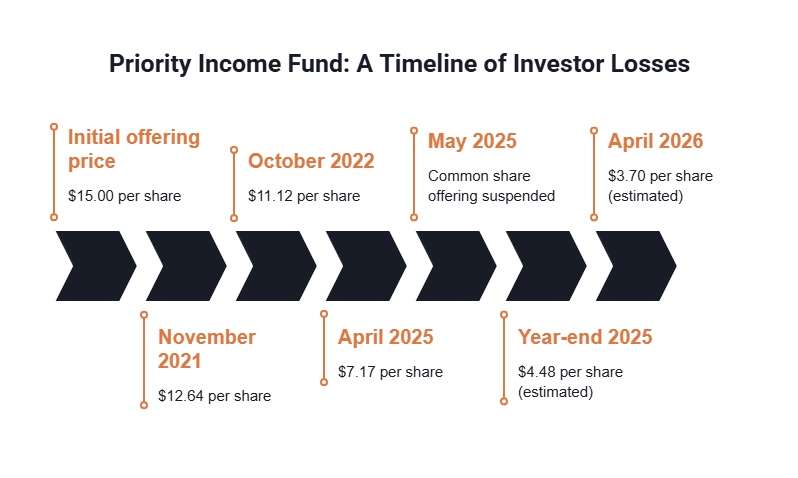
How Priority Income Fund’s NAV Declined: A Timeline of Losses
Priority Income Fund launched as a non-traded closed-end interval fund, marketing a high distribution yield to income-focused investors, including retirees. The fund concentrated its portfolio in collateralized loan obligations (CLOs), which are pools of leveraged corporate loans that carry meaningful credit and liquidity risk.
According to investor-protection investigations and financial-news reporting, the fund’s NAV trajectory tells a troubling story:
- $15.00 per share at initial offering
- $12.64 per share as of November 30, 2021
- $11.12 per share as of October 31, 2022
- $7.17 per share as of April 30, 2025
- $4.48 per share (estimated) at year-end 2025
- $3.70 per share (estimated) as of April 2026
That trajectory represents a roughly 75% decline from the original offering price.

We Have Recovered Over
$350 Million for Our Clients Nationwide.
Liquidity Restrictions, Offering Suspension, and Investor Arbitration Claims
Alongside the NAV deterioration, the fund took several steps that further affected shareholders. According to investigation filings, the fund altered its liquidity strategy, moving from a commitment to pursue a liquidity event upon completion of its offering to language stating it “may, but is not obligated to,” pursue such an event. In May 2025, the fund suspended its common share offering, and in a prior quarterly repurchase period, repurchased only approximately 60% of shares tendered at the $7.17 NAV.
In September 2025, the fund circulated a proxy seeking shareholder approval to amend its charter in anticipation of a potential exchange listing. According to reporting on the proxy, any listing would include temporary restrictions on share sales: shareholders would allegedly be permitted to sell only 25% of their holdings in successive 90-day windows during the first 270 days after listing. The fund indicated it anticipated pursuing a listing before December 31, 2026.
According to financial-news reporting, at least one arbitration claim has been filed on behalf of a retired couple alleging losses tied to the fund. Separately, FINRA records show that Craig Sturges, formerly registered with Centaurus Financial, Inc. through December 2025, has at least one customer complaint on record alleging misrepresentation and breach of fiduciary duty. That complaint was ultimately closed with no action. Investors who worked with Sturges during his tenure at Centaurus should review their account history carefully. Public records available through FINRA’s case information portal may provide additional detail on pending arbitration matters related to the fund.
Why Priority Income Fund’s CLO Strategy Created Outsized Risk for Retail Investors
Priority Income Fund’s CLO-focused strategy carried risks that may not have been fully explained to retail investors at the point of sale. CLOs are structured credit products that can lose significant value during periods of credit stress or rising defaults in the underlying loan pools. The fund’s equity and junior CLO positions absorb losses first, meaning shareholders bore the sharpest exposure when credit conditions deteriorated.
The non-traded structure compounded those risks. Because shares were never listed on a public exchange, investors who needed to access their capital had no straightforward path to sell. The fund’s quarterly repurchase program was the primary liquidity mechanism available to shareholders, and the fund demonstrated it could fulfill only a fraction of redemption requests when it repurchased approximately 60% of tendered shares before suspending its common share offering in May 2025.
Our lawyers are nationwide leaders in investment fraud cases.
Brokers and Firms Connected to Priority Income Fund Sales
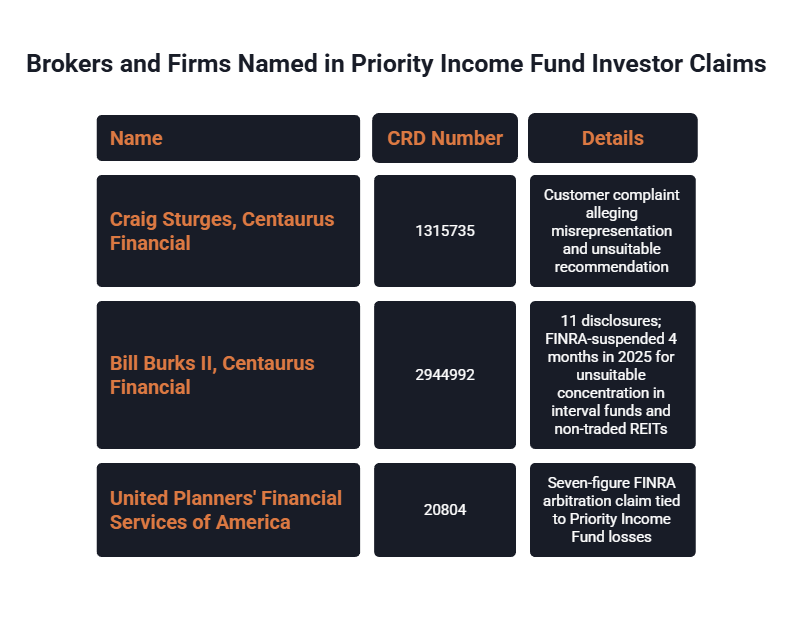
Priority Income Fund was sold through multiple independent broker-dealers. Based on public FINRA records and investor-protection filings, several brokers and firms have been identified in connection with alleged unsuitable recommendations of the fund.
Two registered representatives formerly or currently affiliated with Centaurus Financial, Inc. (CRD# 30833) appear in investor complaints tied to the fund. Craig Sturges (CRD# 1315735), who was registered with Centaurus from January 2004 through December 2025 before moving to Lifemark Securities Corp., has at least one customer complaint on record alleging misrepresentation, an unsuitable investment recommendation, and breach of fiduciary duty. William “Bill” Burks II (CRD# 2944992) carries at least 10 total disclosures and was formally sanctioned by FINRA in August 2025 for recommending unsuitably concentrated positions in alternative investments, specifically including non-traded REITs, business development companies, and interval funds, to customers with low or moderate risk tolerance. He received a four-month suspension and a $10,000 fine.
A separate seven-figure FINRA arbitration claim has been filed against United Planners’ Financial Services of America A Limited Partnership (CRD# 20804), a Scottsdale, Arizona-based independent broker-dealer, in connection with Priority Income Fund investor losses. These are not the only firms that may have sold this product, and investors who worked with advisors at other broker-dealers may have equally valid claims.
We Are The firm other lawyers
call for support.
What Legal Options Do Priority Income Fund Investors Have
For retirees and conservative, income-focused investors, a recommendation to place meaningful assets into a non-traded CLO fund may have been unsuitable given their risk tolerance, time horizon, and liquidity needs. Investor-protection attorneys investigating Priority Income Fund losses have identified several common claim theories, including unsuitability, misrepresentation of risk, and failure to disclose material facts about the fund’s fees and liquidity limitations.
Investors who want to research the background of the broker or advisor who recommended the fund can use the Investor Claims broker complaint database to check for prior complaints or regulatory disclosures. The SEC’s EDGAR filing system also contains the fund’s regulatory filings, which may provide additional context on the fund’s financial condition and disclosures.
For this type of non-traded fund dispute, the primary avenue of recovery is typically FINRA arbitration rather than a traditional court lawsuit. Claims focus on whether the broker-dealer or financial advisor met their obligations under securities industry rules when recommending the investment, including the suitability of the recommendation, the adequacy of risk disclosures, and whether the selling firm conducted appropriate due diligence before offering the fund to clients.
How Meyer Wilson Werning Can Help
For retirees and income-focused investors who were placed in a non-traded CLO interval fund without a full explanation of the risks, the losses in Priority Income Fund may represent more than a bad outcome. They may represent a breach of the obligations your broker owed you.
Meyer Wilson Werning is actively investigating claims on behalf of Priority Income Fund investors and is accepting new clients nationwide. With more than $350 million recovered for investors across the country over the past 25 years, the firm has the experience and track record to evaluate whether your losses are the result of actionable misconduct. If you invested in Priority Income Fund and believe your broker or advisor failed to fully explain the risks, contact us today for a free and confidential consultation. You pay nothing unless we recover for you.
Frequently Asked Questions

What are Priority Income Fund losses and why are investors concerned?
Priority Income Fund’s estimated per-share NAV has fallen from its original $15.00 offering price to approximately $3.70 as of April 2026, according to investor-alert filings from multiple securities firms. One firm reports the fund has allegedly lost roughly half its value in recent months, raising concerns among retirees and income-focused investors who relied on the fund for portfolio income.
Why is Priority Income Fund considered illiquid?
Priority Income Fund is a non-traded closed-end fund whose shares are not listed on a public securities exchange. Investors generally cannot sell their shares on the open market and must rely on the fund’s limited quarterly repurchase program or a future liquidity event. When the fund repurchased only about 60% of tendered shares before suspending its common share offering in May 2025, many shareholders found themselves unable to exit their positions.
Can Priority Income Fund investors recover losses through FINRA arbitration?
Several investor-protection firms report that affected shareholders are pursuing or considering FINRA arbitration claims alleging unsuitable recommendations, misrepresentations, and failures to disclose risks related to the fund’s CLO strategy and illiquidity. For non-traded fund disputes, FINRA arbitration is typically the primary avenue of recovery rather than a traditional court lawsuit.
Recovering Losses Caused by Investment Misconduct.