


For more than fifty years, there was an unwritten compact at the center of every SEC enforcement settlement: the accused firm or financial advisor could avoid admitting wrongdoing, but they could not publicly deny it either. That compact ended on May 18, 2026, when the Securities and Exchange Commission rescinded Rule 202.5(e), the regulation critics had long called the SEC’s “gag rule.”
Most of the resulting conversation has focused on what the change means for defendants. Very little of it has focused on what it means for the investors those defendants allegedly harmed.
The SEC’s rescission of its no-deny settlement policy has meaningful consequences for investors who suffered losses. If a licensed financial professional, broker, or advisor was involved in your investment losses, the experienced FINRA arbitration attorneys at Meyer Wilson Werning can help evaluate whether your losses are the result of actionable misconduct.
What Was the SEC’s No-Deny Policy?
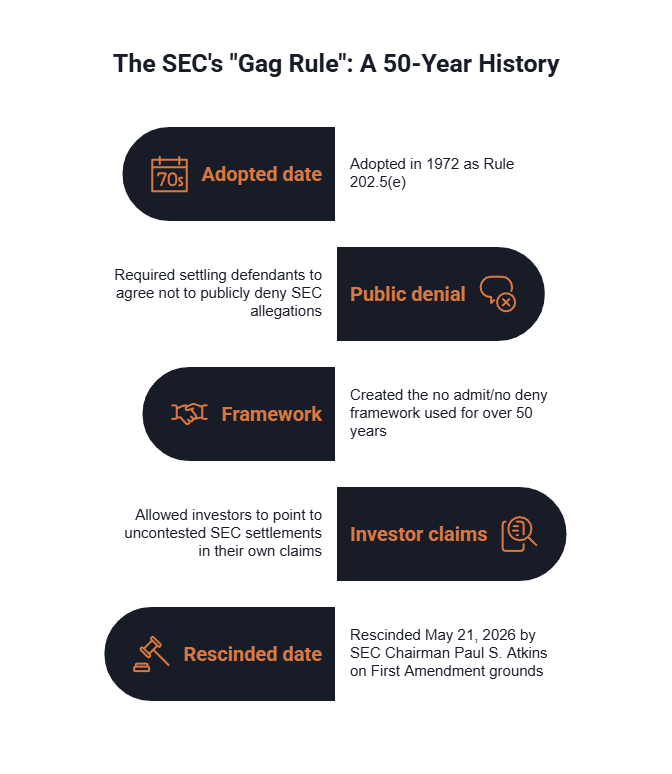
Rule 202.5(e), adopted in 1972, established that the SEC would not accept a settlement involving sanctions unless the defendant also agreed not to publicly deny the agency’s allegations. This created the familiar “no admit/no deny” framework: settling parties avoided acknowledging liability but were contractually barred from claiming the SEC’s account of events was false.
For investors harmed by the conduct at issue, this mattered. When a broker or firm settled an SEC enforcement action, that settlement record stood unchallenged. Investors could point to it in their own arbitration or litigation claims without facing a coordinated public campaign from the defendant contesting the SEC’s findings.

We Have Recovered Over
$350 Million for Our Clients Nationwide.
What Changed on May 18, 2026?
SEC Chairman Paul S. Atkins formally rescinded Rule 202.5(e), effective May 21, 2026, framing the decision in First Amendment terms: “speech critical of the government is an important part of the American tradition.” The Commission cited several reasons, including sustained constitutional challenges to the rule, alignment with the majority of federal agencies that impose no comparable restriction, and the practical difficulty of enforcing no-deny provisions in a social media environment.
Critically, the SEC also stated it will not enforce existing no-deny provisions in prior settlements, meaning defendants who settled years ago are now free to publicly contest the SEC’s account of those cases.

What This Change Does and Does Not Affect for Investors
The rescission does not change the SEC’s no-admit policy. Settling defendants still do not have to admit liability as a standard condition of settlement. That practice remains intact.
The rescission also does not affect private investor claims. An SEC enforcement action and a private investor’s claim through arbitration or securities litigation are separate legal proceedings. An investor harmed by broker misconduct, unsuitable investment recommendations, or outright fraud retains every legal avenue available to recover those losses, regardless of what the firm says publicly after an SEC settlement.
What has changed is the information environment. Going forward, a firm that pays an SEC sanction can immediately issue a public statement asserting the charges lacked merit. For decades, settled enforcement actions presented an uncontested public record that investors and their attorneys could rely on. That dynamic is now fundamentally altered.
In parallel litigation, defendants are likely to increasingly frame SEC settlements as pragmatic business resolutions unrelated to actual wrongdoing, specifically to defuse the evidentiary weight of those settlements in investor recovery proceedings. For investors trying to understand what happened to their money, the post-settlement information environment just became significantly more complex. That is confusion that is not accidental, and that experienced investor protection attorneys know how to cut through.
Our lawyers are nationwide leaders in investment fraud cases.
What to Do If You Lost Money and a Broker or Firm Faced SEC Action
The rescission of Rule 202.5(e) does not touch the rights of individual investors. The existence of an SEC settlement remains part of the public record and part of the evidentiary landscape of any claim you bring. What it does mean is that the firms and advisors you may be pursuing will be more aggressive in contesting the SEC’s account of events publicly. That is exactly the kind of adversarial environment that requires experienced, prepared investor protection counsel in your corner.
With more than $350 million recovered for investors nationwide, Meyer Wilson Werning has spent over 25 years holding financial institutions accountablet. If you believe you have a claim, contact us today for a free and confidential consultation. You pay nothing unless we recover for you.
We Are The firm other lawyers
call for support.
Frequently Asked Questions

What is Rule 202.5(e) and why was it called the “gag rule”?
Rule 202.5(e) was an SEC regulation requiring defendants settling enforcement actions to agree not to publicly deny the agency’s allegations as a condition of settlement. Critics called it a “gag rule” because it permanently barred settling parties from publicly contesting the SEC’s version of events.
Does the SEC’s rescission of the no-deny rule affect my ability to pursue a claim?
No. The rescission applies only to what a settling defendant can say publicly. It has no effect on your independent right as an investor to pursue claims through FINRA arbitration or securities litigation.
Can a broker who settled with the SEC now claim they did nothing wrong?
Yes. As of May 21, 2026, settling defendants are no longer prohibited from publicly denying the SEC’s allegations. The SEC has also stated it will not enforce no-deny provisions in settlements already entered, so prior settlements are also affected.
Recovering Losses Caused by Investment Misconduct.