


Every year, regulators and arbitration panels produce a public record of which financial firms failed their clients. Fines, investor payouts, cease-and-desist orders. It’s all there if you know where to look. The question is whether anyone bothers to read it before they hand over their retirement savings.
We do.
This list covers October 2025 through June 2026, picking up where our 2025 edition left off. The firms here earned their spots through documented misconduct: regulatory penalties, investor losses, and arbitration panels that found them liable for harming the people who trusted them.
If you or someone you know lost money with any of these firms, the investment fraud attorneys at Meyer Wilson Werning can tell you whether you have a claim. We’ve recovered over $350 million for more than 1,000 investors nationwide, and we don’t charge anything unless we win.
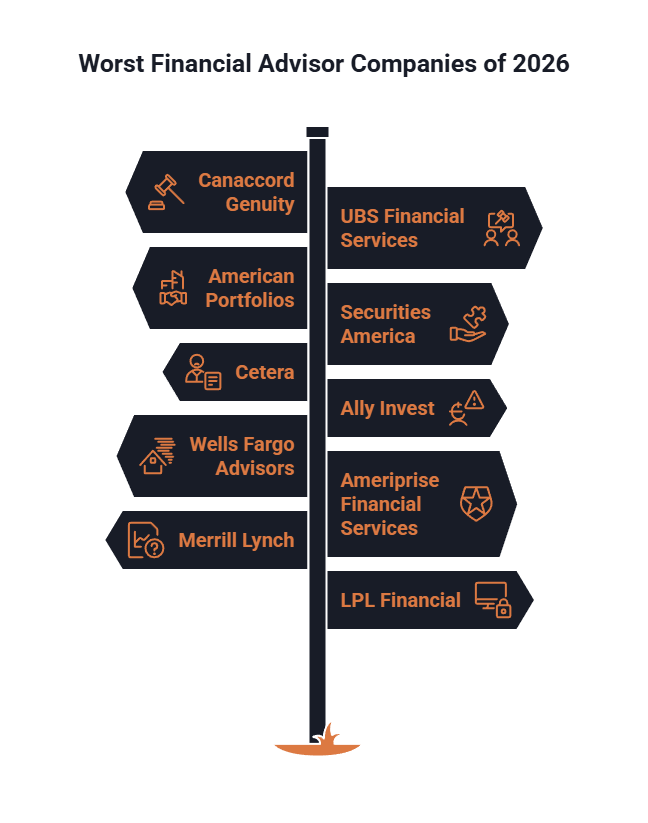
Canaccord Genuity LLC
You know it’s serious when three federal regulators show up at the same time.
On March 6, 2026, the U.S. Treasury’s Financial Crimes Enforcement Network (FinCEN) hit Canaccord Genuity with an $80 million fine, the single largest Bank Secrecy Act penalty ever imposed on a broker-dealer in American history, with concurrent actions from the SEC and FINRA included in that total.
What did they find? Canaccord’s anti-money laundering program was broken for over six years, from 2018 through 2024. The firm failed to file more than 160 Suspicious Activity Reports. Employees falsified records claiming compliance reviews had been completed when they hadn’t. Policies were backdated. And all of this was happening at a firm that was an active market maker in low-priced OTC securities, one of the most fraud-prone corners of the market. At least one customer account had alleged ties to a firm helping Russian oligarchs evade sanctions.
FinCEN called it “a wake-up call to broker-dealers.” For investors who traded securities through Canaccord’s platform during this period, it may have been a lot worse than that.
Read our full breakdown of what this means for investors.

We Have Recovered Over
$350 Million for Our Clients Nationwide.
UBS Financial Services, Inc.
This entry didn’t come from a regulator. It came from investors who sued and won big.
In May 2026, a federal judge upheld a $92 million FINRA arbitration award against UBS, refusing the firm’s attempt to have it thrown out. The award included $23 million in compensatory damages and $69 million in punitive damages. That second number is important. Punitive damages aren’t just about compensating victims. They’re about punishment. A neutral arbitration panel found UBS’s conduct egregious enough to warrant it.
The case centered on a high-risk short-selling strategy involving Tesla stock that UBS advisors recommended to clients it wasn’t appropriate for. The clients argued the firm knew, or should have known, the strategy was unsuitable. The arbitrators agreed. UBS tried to have the award thrown out in federal court. The court said no.
There’s a lesson here: when a firm pushes a complex or aggressive investment strategy you don’t fully understand, that’s worth paying attention to.
Learn more about your rights as a UBS investor.
American Portfolios Financial Services, Inc. (Osaic)
Cash sweep programs might sound like a footnote on your account statement. For the clients of American Portfolios, they turned out to be a hidden fee machine.
FINRA ordered American Portfolios, now part of the Osaic network, to pay $4.6 million in restitution to clients and fined the firm an additional $550,000 in December 2025 after finding that it had misrepresented how fees were calculated on its bank deposit cash sweep program for approximately 85,000 clients over more than four years.
The short version: clients were told fees were based on one interest rate, but the firm actually used a different, more favorable-to-itself rate. American Portfolios quietly retained over $3 million in excess fees that clients hadn’t agreed to pay, plus another $1.25 million in undisclosed surplus interest. The firm also filed inaccurate net capital reports with FINRA, meaning even regulators weren’t getting the full picture.
Cash sweep fees are easy to overlook. That’s exactly what American Portfolios was counting on.
Our lawyers are nationwide leaders in investment fraud cases.
Securities America, Inc. (Osaic)
Also under the Osaic umbrella, Securities America was ordered to pay $2,019,040 in restitution directly to harmed clients and fined $1 million in December 2025 for failing to catch a years-long pattern of unnecessary mutual fund switching.
Between January 2018 and June 2024, the firm failed to supervise more than 1,000 Class A mutual fund switches and 2,000+ short-term sales, transactions that generated new front-end sales charges every time a client was moved from one fund to another. Across $3.8 billion in Class A share purchases, clients paid more than $2 million in fees they didn’t need to pay.
This is one of the most classic forms of broker misconduct: moving clients between funds not because it benefits them, but because it generates a commission. A supervisory system designed to catch it would have stopped this years earlier. Securities America didn’t have one.
Learn more about your rights as a Securities America investor.
We Are The firm other lawyers
call for support.
Cetera Advisors LLC / Cetera Wealth Services / Cetera Investment Services
The dollar amount here is smaller than others on this list, but Cetera earns its spot through volume and pattern.
FINRA sanctioned three Cetera broker-dealer entities in January 2026 for anti-money laundering failures that allowed more than 800 million shares of low-priced OTC securities to move through customer accounts without monitoring. In one transaction, a single customer deposited and liquidated 100 million shares of OTC stock, exactly the kind of activity that should trigger an immediate review, without any response from the firm. Cetera Advisors also failed to supervise and retain tens of thousands of consolidated account reports sent to clients over a four-year period.
But here’s the bigger picture: this is not the first time. Cetera has 14+ prior FINRA disciplinary proceedings on its record. That’s not a compliance stumble. That’s a pattern.
Learn more about your rights as a Cetera investor.
Ally Invest Advisors, Inc.
Robo-advisors are marketed as the clean, conflict-free alternative to human brokers. Ally Invest is a reminder that the conflicts don’t disappear. They just get harder to see.
The SEC ordered Ally Invest Advisors to pay $500,000 in March 2026 after finding that the company had been quietly routing 30% of every client’s “Cash-Enhanced” robo-advisor portfolio to cash, not because it was the best strategy for clients, but because that cash earned revenue for Ally’s affiliated bank and broker-dealer. This went on for six years, from September 2019 through August 2025, affecting approximately 80,000 clients and $1.4 billion in assets.
Ally also told clients that Modern Portfolio Theory governed the cash allocation in those accounts. The SEC found that was false.
You put money in a robo-advisor, the algorithm quietly parks 30% of it in cash that profits the parent company, and the explanation you’re given doesn’t match what’s actually happening. That’s what the SEC found here.
Learn more about your rights as an Ally Invest investor.

Wells Fargo Advisors
Wells Fargo Advisors is no stranger to regulators. In January 2026, FINRA fined Wells Fargo Clearing Services, LLC (WFCS), the primary broker-dealer and clearing entity that supports all of Wells Fargo’s wealth management channels, $1.25 million for leaving municipal securities transactions unresolved beyond the required close-out timeframes, a practice that ran for seven years. That same month, WFCS was also censured and fined $125,000 for failing to report hundreds of thousands of trades and maintaining inadequate supervisory systems. Because WFCS is the shared infrastructure behind Wells Fargo Advisors, Wells Fargo Advisors Financial Network (FiNet), and the firm’s broader wealth management operations, these compliance failures were firm-wide, not isolated to any single channel.
Those are the newest entries in a well-documented history. In January 2025, the SEC charged Wells Fargo Advisors alongside Merrill Lynch for cash sweep program failures, and the two firms paid a combined $60 million in civil penalties. In prior years, the firm agreed to pay $35 million to settle SEC charges over unsuitable single-inverse ETF sales to retirees, and another $35 million over $26.8 million in advisory account overcharges affecting more than 10,900 clients.
When supervisory failures show up across product sales, fee calculations, trade reporting, and recordkeeping in the span of a few years, the pattern is hard to ignore.
Learn more about your rights as a Wells Fargo Advisors investor.
Ameriprise Financial Services, LLC
In April 2026, FINRA fined Ameriprise $450,000 and ordered nearly $1 million in restitution to clients for supervisory failures tied to variable annuity exchanges involving guaranteed lifetime withdrawal benefit riders. The underlying conduct occurred between January 2015 and December 2018. The action reflects a compliance gap at a firm serving millions of retail investors nationwide.
Ameriprise is one of the largest financial advisory networks in the country, with thousands of advisors managing client retirement and investment accounts. That scale demands supervisory systems that actually work. When FINRA finds that clients were harmed by products that should have been flagged before they were sold, the question isn’t just what went wrong on individual accounts. It’s how the firm’s oversight allowed it to happen across enough accounts to generate a restitution order.
Learn more about your rights as a Ameriprise Financial Services investor.
Merrill Lynch, Pierce, Fenner & Smith
This one just happened. FINRA issued the fine the same week this post was published.
Between January 2021 and September 2023, Merrill Lynch failed to tell 1,072 self-directed customers something material before they bought municipal bonds: that a portion of their returns might be taxable as ordinary income rather than at the lower capital gains rate. That distinction can meaningfully change what you actually pocket from an investment. The affected trades totaled roughly $87 million in principal value across 4,181 transactions. The fine was $175,000.
Merrill Lynch not only failed to make the disclosures, it had no written procedures requiring advisors to make them. The gap wasn’t a mistake on one trade. It was a missing policy.
This follows the January 2025 SEC action charging Merrill Lynch and Wells Fargo a combined $60 million in cash sweep program penalties. For an institution Merrill Lynch’s size, regulators keep finding things that should have been caught before they reached clients.
Learn more about your rights as a Merrill Lynch investor.
LPL Financial LLC
LPL Financial is the largest independent broker-dealer in the country. More than 32,000 advisors. Roughly $2.3 trillion in client assets. That kind of scale demands a compliance infrastructure that actually works. The public record over the past 12 months suggests it’s been a work in progress.
In November 2025, LPL detected a phishing attack that had compromised 1,581 client accounts, exposing personal and financial data to unauthorized access. The firm completed its formal state regulatory filings and sent mandatory client notification letters in April 2026. That breach sat on top of an already crowded enforcement history: an $18 million SEC fine in January 2025 for failing to verify identities and restrict thousands of high-risk accounts, a $2.75 million FINRA AML settlement in March 2025, and a $26 million NASAA state settlement over unregistered securities sales that dates to 2018.
LPL’s BrokerCheck record lists 193+ total disclosures. When a firm this large carries that kind of cumulative regulatory history, investors deserve to know about it.
Learn more about your rights as an LPL Financial investor.
What “Worst” Really Means for Harmed Investors
A list like this can feel abstract. Fines and enforcement orders are numbers on a page. But behind every action cited here, there are real people who trusted a firm with money they spent decades building, and came away with less than they started with.
That’s the part regulators don’t capture. FINRA can fine a broker-dealer millions of dollars. The SEC can require restitution. But neither can give back the years a retiree lost rebuilding a portfolio. Neither can undo the anxiety of watching a retirement account drain while a firm’s compliance department looked the other way.
The firms on this list were not brought down by rogue actors operating in the shadows. They were penalized for institutional failures: supervisory breakdowns, undisclosed conflicts of interest, and compliance gaps that went unaddressed for years. The investors harmed by these failures typically had no idea anything was wrong until it was too late.
That’s what makes financial misconduct different from most other harms. The damage is invisible at first. By the time it surfaces, the window to act may already be closing.
Check out our 2025 edition here.
If Your Firm Is on This List
If you worked with any of these firms and experienced losses you couldn’t explain, fees that seemed off, or recommendations that didn’t fit your situation, it’s worth having an attorney take a look.
Arbitration cases typically resolve within 12 to 18 months, but eligibility windows close. Waiting is the most common mistake harmed investors make.
FINRA BrokerCheck is free and takes two minutes. Search your advisor and your firm. Look for customer disputes, regulatory actions, and terminations.
And if something doesn’t look right, we’re here to talk it through. Meyer Wilson Werning works on pure contingency, no hourly fees, no upfront costs. If we don’t recover for you, you owe us nothing.
Contact us today at Meyer Wilson Werning for a free and confidential consultation.
Frequently Asked Questions
Does my firm being on this list mean I have a case?
Not automatically. A regulatory fine or arbitration award tells you that the firm’s systems broke down in documented ways. Whether you have a claim depends on what happened in your specific account. An experienced securities attorney can review your situation and tell you within a free consultation whether the firm’s misconduct contributed to your losses.
How do FINRA arbitration awards differ from regulatory fines?
A regulatory fine is imposed by a government agency like the SEC or FINRA for violations of securities laws. A FINRA arbitration award is issued by a neutral panel of arbitrators after hearing claims from individual investors. Both reflect accountability, but an arbitration award means actual investors brought claims and won.
How long do I have to file a claim against a brokerage firm?
FINRA’s eligibility rule generally gives investors six years from the date of the event that caused their loss to file a claim. However, other time limits may also apply depending on the specific claims involved. Waiting is the biggest mistake harmed investors make. If you think you have a claim, talk to an attorney as soon as possible.
What types of losses can I recover through FINRA arbitration?
Investors can pursue recovery for losses caused by unsuitable investment recommendations, undisclosed conflicts of interest, excessive fees, churning, failure to supervise, and misrepresentation, among other forms of misconduct. In some cases, punitive damages may also be available.
Recovering Losses Caused by Investment Misconduct.