


On June 5, 2026, the SEC announced that Pasadena-based Western Asset Management Company, LLC agreed to pay a $100 million civil penalty to settle charges related to a former co-Chief Investment Officer’s alleged cherry-picking scheme.
The cherry-picking enforcement action, detailed in the SEC’s settled order, alleges that the firm failed to take reasonable steps to detect and prevent the scheme, which reportedly involved hundreds of millions of dollars in trades from January 2021 through October 2023. The case raises serious questions about supervisory breakdowns at one of the nation’s largest fixed-income managers and whether investors who suffered losses may have claims beyond the SEC’s Fair Fund.
If you or a family member experienced significant investment losses involving Western Asset Management’s Core, Core Plus, or other affected strategies, Meyer Wilson Werning can help. Our team of experienced investment adviser misconduct attorneys focuses on representing investors who have been harmed by supervisory failures and trade allocation fraud. Contact us for a free and confidential consultation.
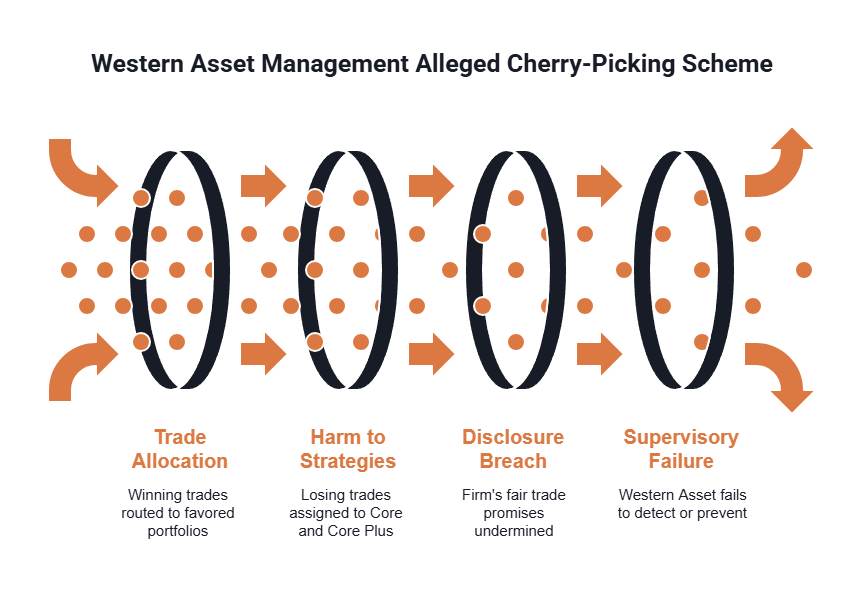
What Happened at Western Asset Management
Western Asset Management, a fixed-income unit of Franklin Resources, is an SEC-registered investment adviser based in Pasadena, California. In November 2024, the SEC first charged the firm’s former co-CIO in a separate litigated district court action alleging that he engaged in a cherry-picking scheme from January 2021 through October 2023.
The June 2026 settled order against the firm itself centers on Western Asset’s alleged failure to supervise its former co-CIO adequately. According to the SEC:
- Western Asset was aware that the former co-CIO’s trading and allocation practices diverged from those of other portfolio managers.
- The firm knew or should have known about the co-CIO’s practices but allegedly did not respond adequately.
- Western Asset failed to implement its own internal policies and procedures relating to trade reallocations.
- The firm failed to ensure that the co-CIO’s allocation practices were consistent with its fiduciary duties and its disclosures that investment allocations would be fair and equitable.
Without admitting or denying the SEC’s findings, Western Asset agreed to a cease-and-desist order, a censure, and the $100 million civil penalty. The SEC indicated the penalty will be placed into a Fair Fund to compensate harmed investors in the affected portfolios. News reports note that the alleged scheme involved approximately $600 million in trades and has contributed to significant client outflows and reduced assets under management.

We Have Recovered Over
$350 Million for Our Clients Nationwide.
How the Alleged Western Asset Management Cherry-Picking Scheme Worked
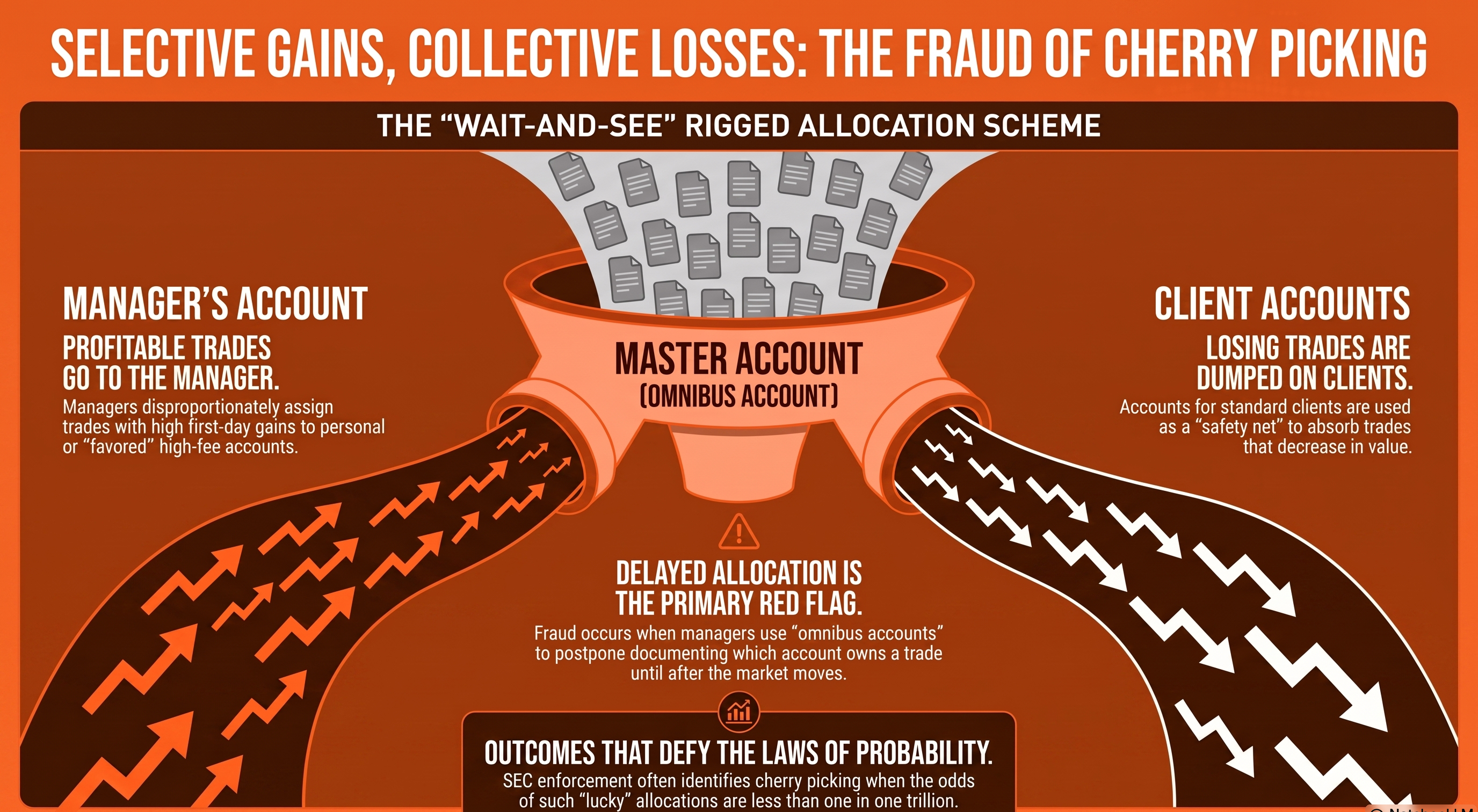
Cherry-picking is a form of trade allocation fraud in which a portfolio manager or adviser allocates favorable trades to certain preferred accounts while steering losing trades to other clients. In the Western Asset Management case, the SEC alleged that the former co-CIO:
- Disproportionately allocated trades with net realized and unrealized first-day gains to certain favored portfolios
- Directed trades with net realized and unrealized first-day losses to disfavored portfolios, including Core and Core Plus strategies
- Undermined the firm’s own disclosures promising fair and equitable trade allocation across all client portfolios
Cherry-picking violates an investment adviser’s fiduciary duty, the legal obligation to act in every client’s best interest at all times. Investment advisers registered under the Investment Advisers Act of 1940 owe clients this fiduciary duty, and the SEC treats trade allocation fraud as one of the most serious forms of adviser misconduct.
Investors should watch for these warning signs that may indicate cherry-picking or unfair trade allocation:
- Persistent underperformance in your account compared to the firm’s stated benchmark or other comparable strategies managed by the same adviser
- Unexpected or unexplained losses that do not correlate with broader market conditions
- Lack of transparency in how trades are allocated across client accounts
- Sudden changes in portfolio composition without prior discussion or authorization
A failure to supervise at the firm level, as the SEC alleged against Western Asset, can enable cherry-picking schemes to continue undetected for years, compounding investor harm.
What This Means for Investors in Core and Core Plus Strategies
The SEC’s Fair Fund is designed to return the $100 million civil penalty to investors harmed by the alleged cherry-picking scheme. However, Fair Fund distributions often take months or years to reach affected investors, and the amounts distributed may not fully compensate for all losses sustained.
Investors in Western Asset Management’s Core, Core Plus, or other affected strategies may have additional avenues of recovery beyond the Fair Fund. Those avenues can include breach of fiduciary duty claims asserting that Western Asset failed to act in clients’ best interests by allowing its co-CIO to engage in the alleged scheme, as well as negligence and failure to supervise claims arguing that the firm’s compliance and supervisory systems were inadequate to detect or prevent the alleged misconduct. Depending on the account agreement and the nature of the investment, recovery may also be pursued through arbitration or civil litigation.
Importantly, receiving a distribution from an SEC Fair Fund does not necessarily prevent an investor from pursuing a separate private claim. Investors who suffered significant losses should evaluate whether additional recovery is available based on their specific account history, investment objectives, and the nature of the harm.
Our lawyers are nationwide leaders in investment fraud cases.
How Meyer Wilson Werning Can Help
Meyer Wilson Werning represents investors nationwide who have been harmed by trade allocation fraud, cherry-picking schemes, and investment adviser supervisory failures like those alleged in the Western Asset Management SEC enforcement action. Led by founding partner David P. Meyer, our legal team evaluates whether investors in Core, Core Plus, or other strategies have actionable claims for breach of fiduciary duty, negligence, or failure to supervise. These claims can be pursued independently of any SEC Fair Fund distribution.
With more than 75 years of combined experience and over $350 million recovered for our clients over more than 26 years, Meyer Wilson Werning is uniquely positioned to help investors navigate the complexities of trade allocation fraud cases. Contact us today for a free and confidential consultation to determine if you have a path to recovery.
We Are The firm other lawyers
call for support.
Frequently Asked Questions
What did the SEC allege in the Western Asset Management cherry-picking case?
In its settled order announced on June 5, 2026, the SEC alleged that Western Asset Management Company, LLC failed to detect and prevent its former co-Chief Investment Officer’s alleged cherry-picking scheme from January 2021 through October 2023. According to the SEC, the former co-CIO disproportionately allocated profitable first-day trades to favored portfolios while steering losing trades to disfavored portfolios, including Core and Core Plus strategies.
How much did Western Asset Management agree to pay to settle the SEC cherry-picking charges?
Western Asset Management agreed to pay a $100 million civil penalty to resolve the SEC enforcement action. Without admitting or denying the SEC’s findings, the firm also consented to a cease-and-desist order and a censure. The SEC has stated the penalty will be placed into a Fair Fund to compensate harmed investors.
What is a cherry-picking scheme in investment management?
A cherry-picking scheme occurs when a portfolio manager allocates favorable trades with early gains to preferred accounts while assigning losing trades to other clients. In the Western Asset Management case, regulators alleged the former co-CIO did exactly this across favored and disfavored portfolios. Cherry-picking violates an adviser’s fiduciary duty and SEC rules requiring fair and equitable trade allocation.
How are investors compensated in the Western Asset Management SEC settlement?
The $100 million civil penalty will be distributed through a Fair Fund, which allows SEC-collected penalties to be returned directly to injured investors rather than the U.S. Treasury. Investors in the affected Core, Core Plus, and other portfolios may also have additional recovery avenues, including private breach of fiduciary duty or negligence claims.
Recovering Losses Caused by Investment Misconduct.