

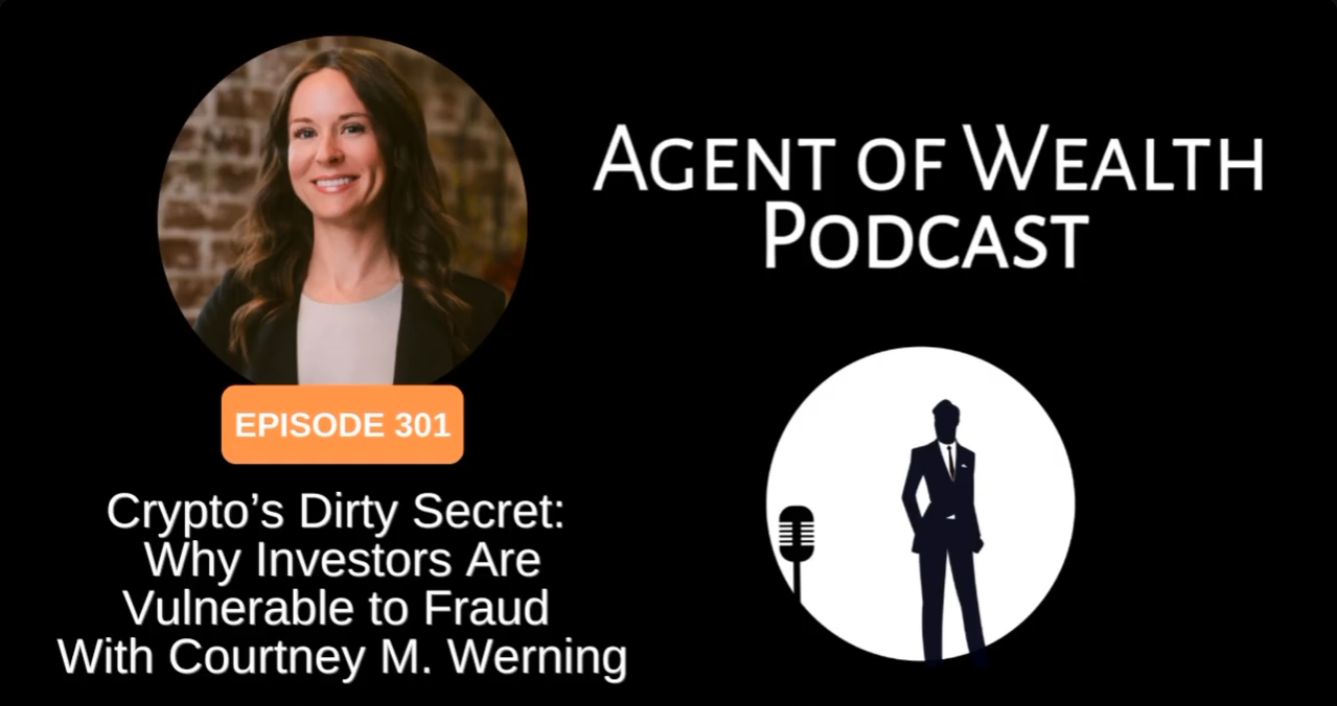
Meyer Wilson Werning Partner Courtney M. Werning was featured as the guest on Episode 301 of the Agent of Wealth podcast, produced by Bautis Financial. The episode, titled “Crypto’s Dirty Secret: Why Investors Are Vulnerable to Fraud,” brings Werning’s firsthand litigation experience to a national audience and breaks down why so many cryptocurrency losses are not simply the product of market swings but the direct consequence of fraud.
Investors who have been targeted by cryptocurrency scams or suspect they have lost funds due to an exchange’s failure to protect their accounts can learn more about the cryptocurrency fraud practice at Meyer Wilson Werning here.
What the Agent of Wealth Episode Covers
The Agent of Wealth podcast reaches investors and financial professionals interested in wealth management, financial planning, and investment education. In this episode, Courtney M. Werning walks listeners through the most common types of cryptocurrency fraud, including social engineering attacks, account takeovers, phishing schemes, and recovery scams, which are fraudulent operations that target people who have already lost money to an initial scam.
The conversation also addresses why younger and Gen Z investors face heightened risks. Scammers increasingly use unsolicited social-media messages, hijacked accounts belonging to trusted individuals, and viral investment pitches to make fraudulent opportunities appear legitimate. The episode explains that these tactics exploit trust and familiarity, making social-engineering and account-takeover attacks particularly effective against investors who are highly active on digital platforms.
Werning also addresses the question of platform responsibility during the episode. When a cryptocurrency exchange fails to meet its duty of care, whether through internal security gaps, data breaches, or negligent protocols, investors who lose funds may have legal options that go beyond simply accepting the loss.

We Have Recovered Over
$350 Million for Our Clients Nationwide.
Why This Conversation Matters for Cryptocurrency Investors
The Agent of Wealth episode arrives at a time when crypto fraud continues to grow in both scale and sophistication. AI-powered scams are making it harder for even experienced investors to distinguish real opportunities from traps, and pig-butchering schemes, in which fraudsters build fake relationships over weeks or months before directing victims to send funds to fraudulent platforms, have caused losses reaching into the millions of dollars. Werning’s own efforts have returned approximately $4 million to victims of one such pig-butchering scheme, according to USA Today reporting.
For investors who recognize the fraud patterns described on the Agent of Wealth, Werning and other investor-protection sources recommend several immediate steps:
- Stop sending additional funds, document and preserve all evidence including devices, emails, text messages, screenshots, and transaction records, and report the incident to local law enforcement and the FBI’s Internet Crime Complaint Center at IC3.gov.
- Consult a securities or cryptocurrency fraud attorney to evaluate whether claims may exist against any licensed professionals, platforms, or exchanges involved in the loss.
These steps are consistent with guidance from government agencies, including the Massachusetts Secretary of the Commonwealth, which recommends that crypto fraud victims report wallet addresses and transaction hashes to law enforcement and file complaints with the relevant state attorney general when applicable.
The episode also connects to Meyer Wilson Werning’s broader work through the Crypto.court platform for investors harmed by cryptocurrency exchange failures, which pursues claims against exchanges that allegedly failed their customers by allowing unauthorized access, breaches, or negligent security practices.
Meyer Wilson Werning’s Cryptocurrency Fraud Practice and Courtney M. Werning’s Leadership
Courtney M. Werning’s leadership reflects years of focused work on behalf of investors harmed by cryptocurrency and digital-asset fraud. As a named partner at Meyer Wilson Werning, she leads the firm’s cryptocurrency practice, which pursues claims against exchanges where alleged internal security failures, data breaches, or negligent protocols allowed hackers or scammers to steal investor funds.
Werning’s media presence extends well beyond the Agent of Wealth appearance. She has been featured on Money Life discussing the psychology of investment fraud and has appeared on other national platforms to educate investors about crypto scam warning signs. Her appointment to FINRA’s National Arbitration and Mediation Committee and her leadership roles with PIABA and crypto-focused task forces further position her as a leading voice in cryptocurrency investor protection.
Our lawyers are nationwide leaders in investment fraud cases.
How Meyer Wilson Werning Can Help
Meyer Wilson Werning has a proven track record, having recovered more than $350 million for clients across the country over the last 26 years. The firm works on a contingency fee basis, meaning if the firm is not able to recover your losses, its services come at no cost to you.
If you lost money to a cryptocurrency scam, exchange hack, or social-engineering attack like those discussed on the Agent of Wealth, contact us today for a free and confidential consultation.
We Are The firm other lawyers
call for support.
Frequently Asked Questions
What immediate steps should investors take if they recognize crypto fraud patterns described on the Agent of Wealth?
Investors who recognize these fraud patterns should immediately stop sending further funds, preserve all evidence including devices, emails, screenshots, and transaction records, and report the incident to local law enforcement and the FBI’s Internet Crime Complaint Center at IC3.gov. Consulting a securities or cryptocurrency fraud attorney can help assess whether claims may exist against the platforms, exchanges, or licensed professionals involved.
Why are younger and Gen Z investors particularly vulnerable to crypto fraud schemes?
Younger and Gen Z investors are frequently targeted because they are highly active on social media and digital platforms where scammers operate. Fraudsters use unsolicited messages, hijacked accounts belonging to trusted contacts, and viral investment pitches to promote fake opportunities, making these schemes appear credible and increasing the effectiveness of social-engineering and account-takeover attacks.
Recovering Losses Caused by Investment Misconduct.