

On July 3, 2026, Courtney Werning of Meyer Wilson Werning was featured as a trusted legal authority on AI-enabled investment fraud in two separate news reports, offering guidance on how Ohio investors can protect themselves and what legal recourse is available when they have been defrauded. The coverage reflects a sobering reality: AI is no longer a future threat. It is actively being used to steal retirement savings and life savings from Ohioans right now.
The Akron Beacon Journal published an in-depth report on the rising tide of AI-enabled scams hitting northeast Ohio residents, centering on the growing threat to elderly residents and retirees in the Akron area. The same day, the Record-Courier published a companion piece, expanding on how scammers based as far away as Ghana are using artificial intelligence to target victims across Ohio and the rest of the country.
Read the full Akron Beacon Journal report here.
What Courtney Werning Told the Akron Beacon Journal
The Beacon Journal report focused on the escalating threat facing elderly residents and retirees across the Akron area, where Medicare scammers and investment fraudsters are bombarding people with an increasing volume of AI-generated calls, texts, and emails. Courtney Werning contributed two key pieces of guidance that every Ohio investor should know.
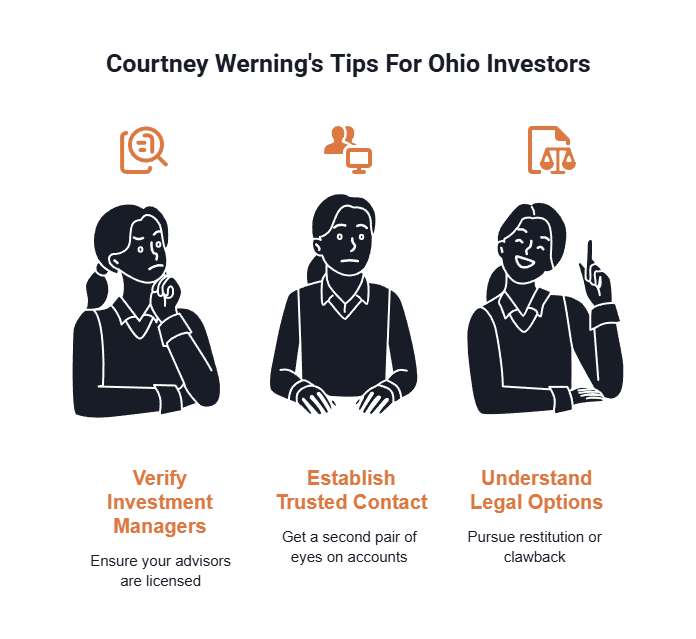
Work with licensed investment managers. Courtney urged investors to verify that anyone handling their money is properly licensed and registered before transferring funds. The Constantine Antonas case covered in the Beacon Journal is a stark example, nearly a dozen investors lost close to $25 million to an unlicensed adviser operating within the Northeast Ohio Greek Orthodox community. Checking a person’s registration on FINRA BrokerCheck takes minutes and can prevent catastrophic losses.
Establish a trusted contact on your accounts. Courtney described a trusted contact as the financial equivalent of an emergency contact: a designated person who serves as a second pair of eyes on new investments and can flag unusual activity, without having any authority to act on the account. A trusted contact can be a family member, attorney, accountant, or any trusted third party who is at least 18 years old. The SEC recommends this step, and it can interrupt many AI-driven impersonation schemes before funds leave the account.
Understand your legal options. As Courtney and Summit County Prosecutor Elliot Kolkovich explained, criminal charges can lead to restitution. But when a perpetrator dies or cannot be prosecuted, civil clawback lawsuits become the primary recovery path. In the Antonas case, attorneys and receiver Mark Dottore recovered nearly $1 million through clawback actions targeting net-winners who received more than they invested. For many victims of affinity fraud, civil action is the only remaining route to any recovery at all.

We Have Recovered Over
$350 Million for Our Clients Nationwide.
Courtney Werning in the Record-Courier: AI Is Making Scams Worse
The Record-Courier published a companion piece on July 3, 2026, featuring Courtney as a legal expert on AI-enabled fraud. The article centered on the federal case against Abu Trica, a Ghana-based social media influencer facing charges for allegedly swindling roughly $15 million from U.S. residents using AI-generated deepfake personas in romance and investment schemes.
Courtney explained how these operations work using what she called “long-confidence” fraud, better known as pig butchering, scammers build relationships over weeks or months before escalating financial requests until victims have transferred everything they have.
“AI has made it worse. It helps scammers pound these people day in and day out and increases the sheer amount of calls,” she told the Record-Courier.
The piece also cited FBI data showing scam-related losses grew from $16.6 billion in 2024 to $20.9 billion in 2025, with investment fraud alone reaching $8 billion.
What This Means for Ohio Investors and Retirees
Older adults and retirees are disproportionately targeted by AI-enabled investment scams because they often hold concentrated retirement savings and may be less familiar with how deepfake technology works. The Akron Beacon Journal report described cases where Ohio seniors were contacted by scammers using cloned voices of grandchildren or financial advisors, creating panic-driven scenarios designed to bypass rational decision-making.
Beyond individual losses, AI scams threaten the broader trust that Ohio investors place in legitimate financial institutions and advisory relationships. When a retiree in Akron or Columbus falls victim to a deepfake crypto pitch, the damage extends beyond the dollar amount lost. It erodes confidence in digital communication, online banking, and the ability to distinguish real advisors from imposters.
For families caring for aging parents, the SEC’s trusted contact recommendation offers a practical safeguard. By designating a trusted contact person on brokerage and retirement accounts, investors create an additional checkpoint that firms can use to verify unusual activity or large withdrawals. This step alone can interrupt many AI-driven impersonation schemes before funds leave the account.
Our lawyers are nationwide leaders in investment fraud cases.
How Meyer Wilson Werning Can Help
Meyer Wilson Werning represents investors across Ohio and nationwide who have been harmed by AI-enabled scams, crypto investment fraud, deepfake schemes, and affinity fraud operations. With more than 75 years of combined experience and over $350 million recovered for clients, the firm is led on AI and digital asset matters by Courtney Werning, who was featured in both the Akron Beacon Journal and the Record-Courier on July 3, 2026, as a trusted authority on how artificial intelligence is being used to defraud investors.
Whether your losses stem from a fake AI trading platform, a deepfake impersonation, or an affinity scheme promoted through a community group, if a licensed financial professional, broker, or advisor was involved, Meyer Wilson Werning can assess your situation and determine whether you have claims through arbitration, court litigation, or regulatory proceedings. Contact us today for a free and confidential consultation. You pay nothing unless we recover for you.
We Are The firm other lawyers
call for support.
Frequently Asked Questions

What are AI scams and how are they affecting investors in Ohio?
AI scams use artificial intelligence to create convincing deepfake voices, videos, and messages that trick people into sending money or sharing sensitive information. Scammers use these tools to impersonate loved ones, fabricate investment pitches, and build fake trading platforms. For Ohio investors, the most common versions involve unregistered crypto and “AI trading” programs promising guaranteed or high returns, which are classic hallmarks of investment fraud.
Are AI-based investment platforms that promise guaranteed returns a red flag for fraud?
Yes. Securities regulators warn that platforms claiming to use AI to guarantee high investment returns, particularly in cryptocurrency, are frequently unregistered and fraudulent. Any pitch offering guaranteed gains with little or no risk is a scam, regardless of the technology behind it. Before investing, verify the firm and advisor using Investor.gov, and treat any platform that cannot explain its regulation or withdrawal process as a serious warning sign.
How can Ohio investors protect themselves from AI-enabled scams and deepfakes?
Use strong passwords and two-factor authentication on financial and email accounts, and limit personal information shared on social media. Behaviorally, slow down when faced with urgent or secret financial requests, independently verify any message from a relative, advisor, or government agency, and require written documentation before moving money. Working with a registered advisor and establishing a trusted contact on your accounts adds a further layer of defense.
What should I do if I suspect I have been targeted by an AI investment or affinity scam?
Act quickly. Preserve all evidence, including texts, emails, screenshots, and transaction records, and report to the FBI’s Internet Crime Complaint Center (IC3), the FTC’s ReportFraud portal, and relevant state regulators. Then consult an experienced investment fraud attorney to evaluate potential civil claims, including arbitration, particularly if retirement or life savings were involved.
Recovering Losses Caused by Investment Misconduct.