


Ben Sweeney, a Morgan Stanley financial advisor operating out of Dallas, Texas, is the subject of multiple investor complaints alleging that he recommended a municipal bond strategy that was unsuitable for his clients’ financial profiles.
According to FINRA BrokerCheck records, Benjamin Joseph Sweeney currently has three publicly disclosed investor complaints on file, all of which were pending as of March 2026. Investors who suffered losses in accounts managed by Sweeney may have legal options for recovery through arbitration.
If you or a family member experienced significant investment losses involving Ben Sweeney or another Morgan Stanley advisor, Meyer Wilson Werning can help. Our team of experienced broker misconduct attorneys focuses on representing investors who have been misled by financial professionals. Contact us for a free and confidential consultation.
What Do Current Disclosures Report About Ben Sweeney?
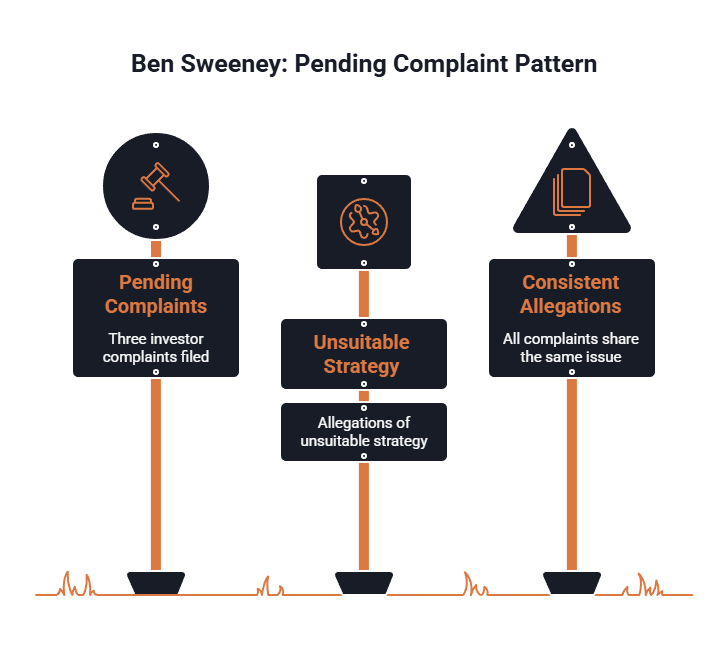
FINRA BrokerCheck records identify him as Benjamin Joseph Sweeney (CRD# 2885369), registered as both a broker and an investment adviser with Morgan Stanley. As of March 2026, Sweeney’s BrokerCheck profile lists at least three customer complaint disclosures, all pending resolution. Across those complaints, investors allege that Sweeney employed a municipal bond strategy that did not align with their investment objectives, risk tolerance, or overall financial situation.
Notably, Sweeney’s BrokerCheck record shows no publicly reported regulatory disciplinary history, civil lawsuits, consumer actions, or terminations as of June 2024. The three pending complaints represent the entirety of his current disclosure record. That these complaints are concentrated around a single investment strategy, municipal bonds, raises questions about whether a pattern of unsuitable recommendations may have affected multiple clients in a similar way.

We Have Recovered Over
$350 Million for Our Clients Nationwide.
Why Municipal Bond Strategies Generate “Not in Best Interest” Claims
Municipal bonds are often marketed as conservative, income-oriented investments, especially for retirees and high–tax bracket investors. But a “municipal bond strategy” can still expose investors to meaningful risk depending on how it is constructed and managed.
In cases where investors later allege the strategy was not in their best interest, the dispute often centers on questions like:
- Concentration risk: Was too much of the portfolio allocated to municipal bonds or to a narrow slice of the muni market?
- Interest-rate and duration risk: Did the portfolio take on long-duration exposure that could magnify losses when rates rise?
- Credit and liquidity risk: Were lower-quality, thinly traded, or complex municipal securities used to boost yield without clearly explaining the downside?
- Strategy fit: Did the allocation match the investor’s stated goals (income vs. preservation), time horizon, and ability to tolerate drawdowns?
- Ongoing monitoring: If market conditions changed, was the strategy reviewed and adjusted, or left in place despite new risks?
If you invested in a municipal bond strategy through Morgan Stanley (or any firm) and experienced significant losses, consider gathering your account statements, new account forms, and any written communications about the strategy’s purpose and risks. Those records can help an attorney evaluate whether the recommendations and ongoing management aligned with your objectives and risk profile, and whether arbitration may be an appropriate path to pursue recovery.
How Meyer Wilson Werning Can Help
Investors who lost money because of allegedly unsuitable recommendations by Ben Sweeney or another Morgan Stanley advisor have the right to pursue recovery through FINRA arbitration. The process is designed to resolve disputes between investors and brokerage firms more efficiently than traditional litigation, and investors do not need to prove fraud, demonstrating that a recommendation was unsuitable for their financial profile may be sufficient.
Meyer Wilson Werning represents investors nationwide who have been harmed by broker misconduct and unsuitable investment recommendations. With more than 75 years of combined experience and over $350 million recovered for our clients, our team is dedicated to holding negligent firms accountable. Attorney David P. Meyer has extensive experience representing investors in suitability and FINRA arbitration cases, and our firm works on a contingency fee basis, meaning if we are not able to recover your losses, our services are at no cost to you. Contact us today for a free and confidential consultation to discuss your path to recovery.
Our lawyers are nationwide leaders in investment fraud cases.
Frequently Asked Questions

What does Ben Sweeney’s BrokerCheck record show?
Ben Sweeney’s FINRA BrokerCheck profile lists CRD# 2885369 and identifies him as Benjamin Joseph Sweeney, a broker and investment adviser at Morgan Stanley. The record reports three publicly disclosed investor complaints focused on suitability concerns and no reported regulatory disciplinary history, civil lawsuits, or terminations as of June 2024.
How do I pursue a FINRA claim for unsuitable recommendations against a Morgan Stanley advisor?
Investors who lost money because of unsuitable recommendations may pursue recovery through FINRA arbitration, a streamlined dispute resolution process. A suitability claim typically focuses on whether the advisor recommended investments that did not fit the customer’s objectives, risk tolerance, or financial needs. An experienced securities attorney can evaluate account records, identify evidence of unsuitable recommendations, and guide the investor through the arbitration process from filing to resolution.
What is an unsuitable investment recommendation?
An unsuitable recommendation is an investment suggestion that does not match the customer’s goals, risk tolerance, or overall financial profile. Under FINRA Rule 2111, brokers must have a reasonable basis to believe that each recommendation is appropriate for the individual client. When a broker applies a single strategy, such as a concentrated municipal bond allocation, across accounts with different investor profiles, the recommendation may be deemed unsuitable under both FINRA rules and Regulation Best Interest.
Recovering Losses Caused by Investment Misconduct.