


Canaccord Genuity LLC, an SEC-registered broker-dealer, has been penalized a combined $80 million by the U.S. Treasury’s Financial Crimes Enforcement Network (FinCEN), the Securities and Exchange Commission (SEC), and the Financial Industry Regulatory Authority (FINRA) for sweeping failures in its anti-money laundering (AML) program. FinCEN called it the largest penalty ever imposed against a broker-dealer for violating the Bank Secrecy Act — and described it as “a wake-up call to broker-dealers that willfully fail to comply with their obligations to safeguard the financial system from illicit actors.”
For everyday investors, this isn’t just a regulatory headline. When a broker-dealer’s compliance infrastructure breaks down this completely, the people who pay the price are the investors who trusted that firm with their money.
If you or someone you know suffered investment losses through Canaccord Genuity or another broker-dealer with a history of compliance failures, don’t hesitate to reach out to Meyer Wilson Werning today. Our team of Broker Misconduct Lawyers will help guide you through the process with a free consultation to determine whether your losses are the result of actionable misconduct.
What Regulators Found at Canaccord Genuity
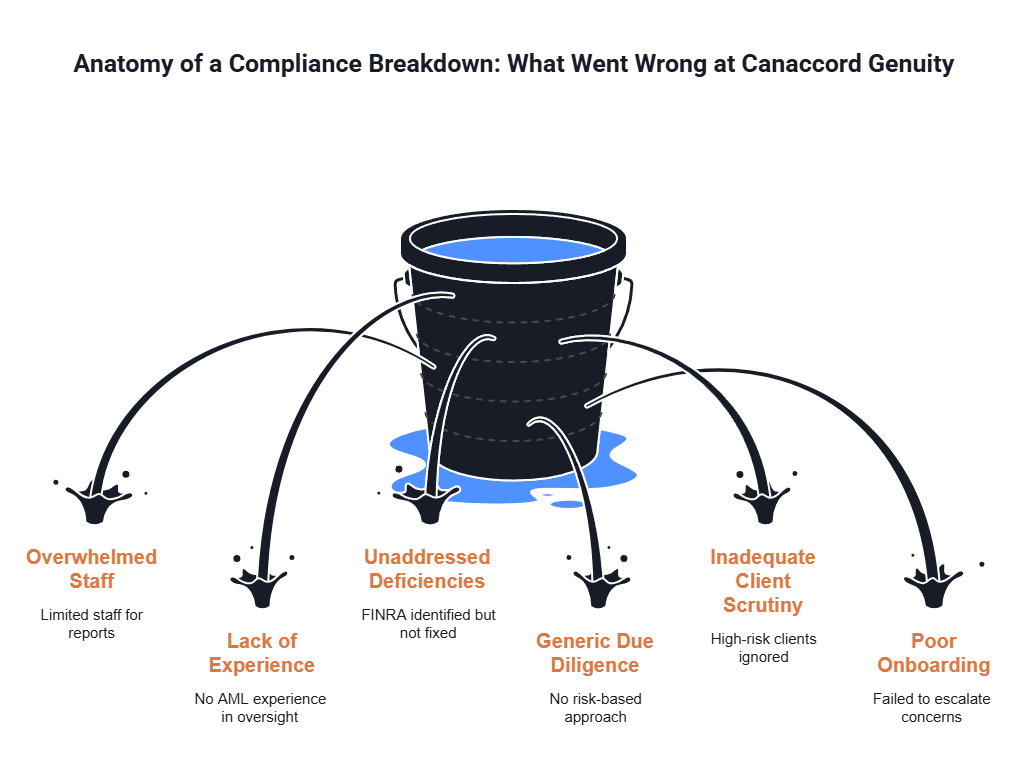
The coordinated enforcement actions reveal systemic failures across nearly every part of Canaccord’s AML compliance program from March 2018 through June 2024, more than six years of alleged neglect. Canaccord Genuity LLC (CRD #: 1020) failed at its core to devote adequate resources to compliance.
Important Points of Compliance Failure:
- For years, just four employees, all of whom had other responsibilities, were tasked with reviewing more than 100 unique surveillance reports, many generated daily.
- The person overseeing trade surveillance reportedly lacked prior AML experience, and the firm had no formal AML compliance training before November 2021.
- FINRA repeatedly identified deficiencies during examinations, but Canaccord allegedly failed to fix them.
- Canaccord also applied the same basic due diligence to every customer regardless of risk.
- High-risk clients, including foreign financial institutions, received no additional scrutiny.
- The firm onboarded a Bahamas-based foreign bank without adequate diligence and failed to escalate concerns even after its own compliance officer, law enforcement, and another financial institution raised alarms.
As part of its resolution, Canaccord formally admitted to willfully violating the Bank Secrecy Act, a significant concession that goes beyond a typical settlement. The consent order further revealed that among the high-risk customers onboarded without adequate scrutiny were a customer who was subsequently fined and barred from the penny stock industry by the SEC, a customer who reportedly helped Russian oligarchs move money out of Russia, and a customer tied to a Venezuelan individual designated by the U.S. Treasury’s Office of Foreign Assets Control (OFAC). FinCEN Director Andrea Gacki stated that the action reflects Treasury’s “broader efforts to combat fraud and its harmful effects on our financial markets.”

We Have Recovered Over
$350 Million for Our Clients Nationwide.
How the Compliance Failures Enabled Fraud
Canaccord was an active market maker in OTC low-volume and low-priced securities — a space regulators have long flagged as high-risk for manipulation. Despite being positioned to detect suspicious activity, the firm allegedly allowed pump-and-dump schemes to run through its platform without detection.
In one case, after the SEC suspended trading in a stock due to “unusual and unexplained market activity,” Canaccord resumed trading without reviewing its own activity. An internal recommendation to file a Suspicious Activity Report (SAR) was made, but Canaccord never filed it. An independent review later identified at least 160 SARs that should have been filed but weren’t.
In 2021, the firm discovered that certain compliance reviews required under its own policies were never performed, and that employees had falsified documentation claiming they had been completed. Those employees were terminated, but the damage to investor protection had already been done.
Why This Matters for Investors
When a broker-dealer’s compliance infrastructure is this broken, fraud goes undetected, red flags get ignored, and investors bear the consequences. Investors who traded in securities affected by the undetected pump-and-dump schemes may have suffered losses directly tied to fraud the firm should have caught.
AML and customer due diligence rules exist specifically to keep bad actors out of the financial system. When a firm applies the same cursory onboarding to a retiree in Ohio and a high-risk foreign bank, the system fails everyone. This isn’t an isolated case. In the past two calendar years alone, the SEC brought 12 enforcement actions and FINRA brought 34 enforcement actions against broker-dealers for AML failures. The SEC’s FY2026 examination priorities confirm that broker-dealer AML programs remain a top enforcement focus.
Our lawyers are nationwide leaders in investment fraud cases.
Legal Options for Affected Investors
Investors who suffered losses through Canaccord Genuity, or any broker-dealer with a pattern of compliance and supervisory failures, may have legal options for recovery. Common claims include:
- Failure to supervise: When a firm does not adequately oversee its brokers, trading activity, or compliance programs, and investors suffer losses as a result.
- Unsuitable recommendations: When investments do not match an investor’s financial goals, risk tolerance, or experience level.
- Negligence: When a firm’s failure to implement reasonable compliance controls directly contributes to investor harm.
- Breach of fiduciary duty: When a firm or broker puts its own interests ahead of its obligations to clients.
Most brokerage account agreements require disputes to be resolved through arbitration, a structured process that allows investors to present claims before a neutral panel. In cases involving documented compliance failures like Canaccord’s, the regulatory record itself can serve as powerful evidence. Arbitration cases typically resolve within 12–18 months.
We Are The firm other lawyers
call for support.
How Meyer Wilson Werning Helps Investors
The Canaccord case is a textbook example of what happens when a broker-dealer treats compliance as an afterthought. At Meyer Wilson Werning, we represent investors who have suffered losses due to broker-dealer misconduct, supervisory failures, and exactly the kind of systemic negligence exposed here.
With more than $350 million recovered for over 1,000 clients nationwide since 1999, our firm has the track record and the resources to go toe-to-toe with even the largest financial institutions. If you invested through Canaccord Genuity or another firm and experienced losses you believe were caused by compliance failures or misconduct, contact us today for a free and confidential consultation to determine whether your losses are the result of actionable misconduct.
Frequently Asked Questions
What is the Canaccord Genuity $80 million penalty for?
FinCEN, the SEC, and FINRA penalized Canaccord Genuity LLC for widespread failures in its anti-money laundering program, including failure to file Suspicious Activity Reports, inadequate customer due diligence, and allowing its platform to be used for pump-and-dump schemes.
How did Canaccord Genuity’s compliance failures harm investors?
When a broker-dealer does not monitor for suspicious activity, fraud schemes like pump-and-dump manipulation can run unchecked. Investors who traded in the affected securities may have suffered losses that the firm’s compliance program should have prevented.
Can investors recover money lost through Canaccord Genuity?
Investors who suffered losses tied to compliance failures or misconduct may be able to pursue recovery through arbitration. An experienced securities attorney can evaluate the facts and determine whether actionable claims exist.
What is arbitration?
Arbitration is a dispute resolution process used to resolve claims between investors and brokerage firms. Most brokerage agreements require investors to use this process instead of going to court. It typically resolves within 12–18 months.
What should I do if I think my broker-dealer has compliance problems?
Check your firm and broker’s record on FINRA BrokerCheck. If you see a pattern of regulatory actions, customer complaints, or enforcement penalties, consult a securities attorney to discuss whether your account may have been affected.
Recovering Losses Caused by Investment Misconduct.