

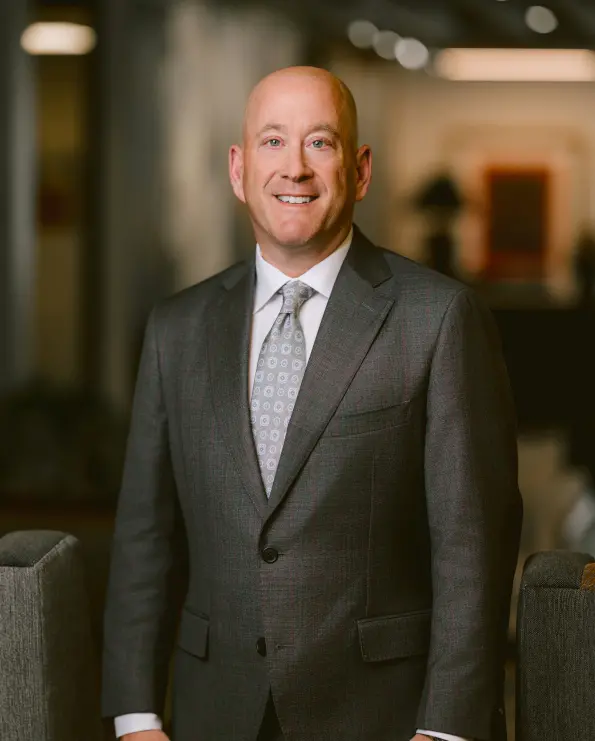
Meyer Wilson Werning principal attorney Courtney Werning recently appeared as a featured guest on NightSide with Dan Rea, broadcast on WBZ — Boston’s News Radio, to discuss the growing threat of cryptocurrency and AI-enabled investment fraud targeting American seniors. The conversation covered how these schemes actually work, why seniors are disproportionately targeted, and what victims can do to pursue recovery.
If you or someone you know has been harmed by a cryptocurrency fraud scheme or AI-enabled investment scam, our attorneys at Meyer Wilson Werning are here to help. Contact us today for a free and confidential consultation, you pay nothing unless we recover for you.
About NightSide with Dan Rea
NightSide with Dan Rea is a long-running talk program on WBZ, one of the most listened-to news radio stations in New England. Hosted by veteran broadcaster Dan Rea, the show tackles a wide range of political, economic, and social issues with a commitment to challenging conversation and diverse perspectives. Courtney’s appearance brought one of the most urgent consumer protection issues of our time to a broad regional audience.

We Have Recovered Over
$350 Million for Our Clients Nationwide.
Where Do Crypto Scams Actually Start?
One of the central points Courtney made during the interview: the most damaging investment scams rarely begin with an obvious red flag. Most people picture a suspicious phone call with a robotic voice or broken English, and while those exist, they’re not where the real financial devastation happens.
Today’s most sophisticated crypto and AI-enabled fraud schemes start with an unsolicited direct message on social media platforms like LinkedIn, WhatsApp, or X (formerly Twitter). A stranger reaches out. The conversation starts casually. Maybe a shared interest, a friendly comment, an offer to connect. There’s no immediate pitch. No obvious warning sign.
That’s precisely the point. By the time a financial opportunity is introduced, the victim has already developed a sense of trust. And trust, in the world of investment fraud, is the most dangerous thing a scammer can manufacture.
The “Long Con”: How Are These Scams Built to Succeed?
Courtney described a fraud pattern known as the “long con,” a scheme designed not to steal quickly, but to extract as much as possible over an extended period by building genuine emotional connection first. It shares many of the same psychological mechanics as affinity fraud, where trust within a group is weaponized to bypass skepticism.
Important Points on how these schemes typically unfold:
- Initial contact is made through social media: casual, friendly, no obvious agenda.
- Trust is cultivated over days, weeks, or even months before any investment is mentioned.
- Small amounts are encouraged first, and the victim is actually shown a fake investment dashboard showing “profits.”
- Withdrawals are permitted early to reinforce the illusion that the platform is real and the money is growing.
- Larger and larger contributions are encouraged over time.
- Once the victim is fully committed, the platform goes dark, the contact disappears, and the money is gone.
By the time most victims realize what happened, they’ve already invested far more than they ever intended, because they were never given a reason to stop.
Our lawyers are nationwide leaders in investment fraud cases.
Why Are Seniors the Primary Target for These Schemes?
Courtney was direct on this point: scammers go where the money is. And right now, the money is concentrated in the hands of retirees.
American seniors hold the majority of the country’s investable wealth, and they are often the least familiar with the digital environment these scams exploit. A suspicious URL, a slightly off email domain, an investment platform that looks professional but has no regulatory registration: these are cues that experienced tech users may catch, but that seniors navigating these platforms for the first time may not.
There’s also a psychological dimension. Many seniors live with some degree of social isolation, and the fraudulent “relationship” that scammers build can feel genuinely meaningful. Cognitive factors can also play a role. And critically, Courtney pointed out that these operations exploit well-documented psychological principles, including sunk cost bias, the deeply human tendency to keep investing in something once you’ve already committed, rather than accepting a loss.
The result is a fraud ecosystem that is specifically, deliberately, and systematically engineered to exploit the people who worked a lifetime to build their savings.
We Are The firm other lawyers
call for support.
Understanding the Scale of International Fraud Operations
Another important point from the interview: these aren’t individual bad actors running scams from a laptop. The criminal enterprises behind crypto and AI investment fraud are large, organized, and internationally operated — and they come with their own disturbing humanitarian crisis. Many of the individuals actually making contact with victims are themselves victims of human trafficking, forced to run fraud operations overseas under threat of violence.
Understanding the scale of these operations matters for victims, because it means the emotional manipulation they experienced was not accidental. It was engineered by professionals with extensive resources and no legal accountability in their home countries.
What Should You Do If You Have Been Scammed?
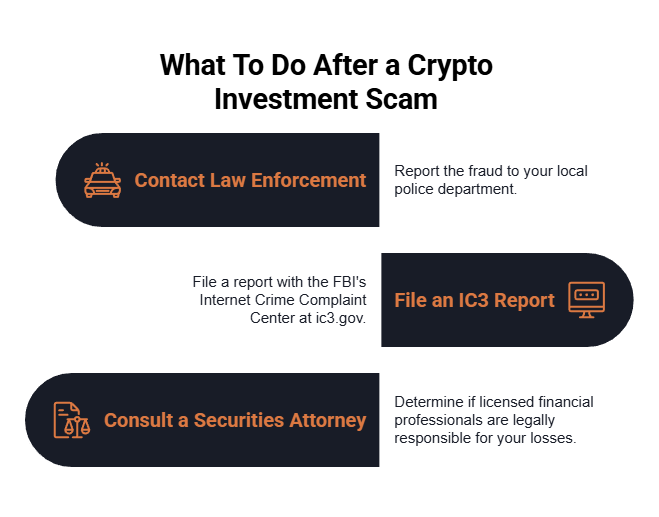
If you or someone you know has been involved in a crypto or investment fraud scheme, Courtney outlined the immediate steps to take:
- Contact local law enforcement to report the fraud.
- File an IC3 report at the FBI’s Internet Crime Complaint Center (ic3.gov).
- Consult a securities attorney to determine whether any licensed financial professionals, advisors, brokers, or platforms, bear legal responsibility for your losses.
That third step is critical. Depending on how the fraud was introduced, whether through a referral from a financial advisor, a registered investment platform, or another regulated party, there may be a legal path to recovery through arbitration that victims aren’t aware of.
About Principal Attorney Courtney Werning
Courtney Werning is a principal attorney at Meyer Wilson Werning and leads the firm’s cryptocurrency fraud practice through Crypto.court. She has been appointed to FINRA’s National Arbitration and Mediation Committee (NAMC), one of the most selective appointments in investor protection law. She is the incoming PIABA President (2027), set to become just the fourth woman to hold that role in the organization’s history. Courtney represents both traditional investors and crypto fraud victims nationwide, and is widely recognized as one of the most credentialed legal voices at the intersection of financial regulation and emerging technology.
How Meyer Wilson Werning Helps Crypto Fraud Victims
When a financial scam leaves someone without their savings, the question isn’t just “how did this happen?” It’s “is there anyone who can be held accountable?” That answer depends on the specifics of how the fraud was carried out, and it requires an attorney who understands both traditional securities law and the rapidly evolving world of crypto and digital asset fraud.
Meyer Wilson Werning has recovered more than $350 million for investors nationwide since 1999, and we take every case on a pure contingency basis, no fees unless we win. If you or someone you know has lost money to a cryptocurrency or AI-enabled investment scheme, contact us today for a free and confidential consultation.
Frequently Asked Questions
What is the “Long Con” in investment fraud?
The “long con” refers to a scheme where scammers build trust and emotional rapport with victims over a long period (often weeks or months) before suggesting an investment. This allows them to extract much larger sums of money than a quick, hit-and-run scam would permit.
Why do scammers use social media like WhatsApp and LinkedIn?
Scammers use these platforms because they allow for direct, personal messaging that bypasses traditional spam filters. They can also use professional-looking profiles to appear credible to victims, especially when targeting those in professional networks like LinkedIn.
Can an attorney help me recover money lost to a crypto scam?
Yes. A securities attorney can review the details of your case to see if any regulated third parties, such as a broker-dealer or a financial advisor, failed in their duty to supervise accounts or protect you from fraud. Recovery often happens through the process of arbitration.
Recovering Losses Caused by Investment Misconduct.