


Government impersonation scams nearly doubled in volume last year, are being turbocharged by artificial intelligence, and for millions of potential targets, especially older Americans, they are nearly impossible to identify before it is too late.
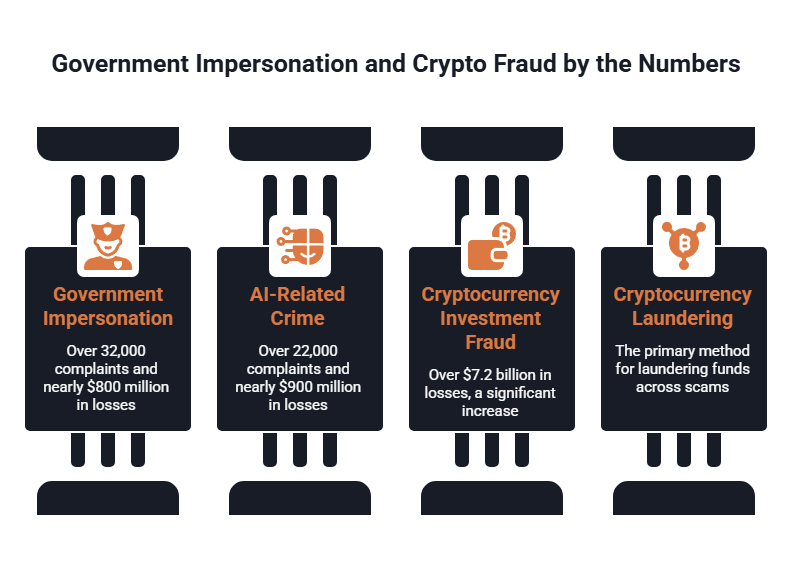
The FBI’s 2025 Internet Crime Report, covered by The Wall Street Journal on May 26, 2026, puts the scale in stark terms: Americans lost nearly $21 billion to internet crime last year. Government impersonation scams generated more than 32,000 complaints, nearly double the prior year’s approximately 17,000, with losses reaching $797.9 million. Cryptocurrency was the primary mechanism used to collect those stolen funds.
Courtney Werning, a partner at Meyer Wilson Werning and the attorney leading the firm’s cryptocurrency fraud practice through Crypto.court, was quoted in the Wall Street Journal’s coverage. She currently represents a 93-year-old client who lost $1.5 million to one of these exact schemes. These are not abstract statistics. They are real people and a lifetime of savings gone in days.
How Government Impersonation Scams Have Evolved and Why They Work
“What began as clumsy phone calls from fake IRS agents demanding gift cards has evolved into something far more sophisticated and far harder to dismiss,” said Judson Dressler, director of the risk operations center at Resilience, in the Wall Street Journal report.
Today’s government impersonation scam may involve:
- Spoofed caller IDs displaying actual government agency phone numbers
- Official-looking emails carrying authentic agency seals and accurate regulatory language
- AI deepfake government fraud tactics, including cloned audio replicating real officials’ voices
- AI-generated deepfake video used in “verification calls” featuring a real federal employee’s face
FBI Cyber Division Deputy Assistant Director Michael Machtinger told the Wall Street Journal that fraudulent communications now “can look very official and very legitimate to even the most trained individuals.” If law enforcement professionals acknowledge the difficulty of detection, the expectation that an elderly person living alone should catch these schemes in real time is simply unfair.

We Have Recovered Over
$350 Million for Our Clients Nationwide.
Key Points: The FBI Impersonation Scam Numbers From 2025
- 32,000+ government impersonation complaints in 2025, nearly double the prior year
- $797.9 million in reported losses from government impersonation scams
- 22,000+ AI-related crime complaints, the first year tracked by the FBI, with $893 million in losses
- $7.2 billion in cryptocurrency investment fraud losses, up from $5.8 billion the prior year
- Cryptocurrency was the primary laundering method across government impersonation, tech support, and investment scams
A 93-Year-Old Client, $1.5 Million, and a Crypto ATM Scam
Criminals posing as FBI officials contacted Courtney Werning’s 93-year-old client and, over multiple conversations, convinced her that her assets had been targeted. Their solution: drain her accounts and deposit the funds into cryptocurrency ATMs, where the thieves immediately withdrew the cash. She lost $1.5 million.
These scammers are professional psychological operators. They identified someone likely to be isolated, to hold the FBI in high regard, and to respond to fear with compliance. They manufactured a crisis, provided a solution, and built urgency that overrode any opportunity for a trusted person to intervene.
“It’s a perfect storm to get these older people to trust the process,” Courtney Werning told the Wall Street Journal.
This trust-building playbook is a hallmark of what fraud experts call pig-butchering scams, schemes where criminals cultivate a relationship over days or weeks before moving in for the financial kill. Government impersonation fraud has adopted the same patient, methodical approach.
Our lawyers are nationwide leaders in investment fraud cases.
AI Deepfake Government Fraud Is Getting Worse
The FBI formally tracked AI-related crime for the first time in 2025: more than 22,000 complaints and $893 million in losses. AI deepfake government fraud now gives criminals the ability to clone officials’ voices, generate convincing video impersonations, and produce documents indistinguishable from genuine government correspondence.
Jake Braun, executive director of the Cyber Policy Initiative at the University of Chicago’s Harris School of Public Policy and a former acting principal deputy national cyber director, put it plainly in the Wall Street Journal: “The AI companies like to say that today’s AI is the worst AI you will ever use. What’s also true is that these are the lowest number of AI complaints we are ever going to see.”
The tools available to scammers today are rudimentary compared to what is coming. Every iteration makes these schemes harder to detect and more financially damaging.
We Are The firm other lawyers
call for support.
Talk to a Crypto Fraud Attorney Before You Accept Total Loss
When financial platforms, crypto ATM operators, or other intermediaries fail to maintain adequate security protocols or flag clearly abnormal transactions, those failures may create legal liability. No outcome can be guaranteed, but accepting total loss without consulting a crypto fraud attorney first is a mistake worth avoiding.
At Crypto.court, the dedicated cryptocurrency fraud platform of Meyer Wilson Werning, we represent clients targeted by exactly these schemes. We have recovered more than $350 million for investors and fraud victims since 1999. Every case is handled on pure contingency. Clients pay nothing unless we recover.
Contact us today for a free and confidential consultation.
Frequently Asked Questions

What is a government impersonation scam and how does it work?
Criminals pose as officials from agencies such as the FBI, IRS, or Social Security Administration to pressure victims into transferring money or providing personal information. They use spoofed numbers, official-looking documents, and AI deepfake government fraud tactics including cloned audio and video to appear legitimate.
Why is the crypto ATM scam so common in government impersonation fraud?
Cryptocurrency ATM transactions are fast, largely irreversible, and pseudonymous. Once funds reach a scammer-controlled wallet through a crypto ATM, they are extremely difficult to trace or recover without legal intervention.
What did the FBI impersonation scam data show in 2025?
The FBI’s 2025 Internet Crime Report recorded more than 32,000 government impersonation complaints and $797.9 million in losses, nearly doubling from the prior year. Cryptocurrency was confirmed as the primary method used to launder the proceeds.
How is AI deepfake government fraud different from traditional phone scams?
AI tools now allow criminals to clone real officials’ voices, generate convincing deepfake video, and produce flawless fraudulent documents. The FBI tracked AI-related crime for the first time in 2025, with losses exceeding $893 million.
When should I contact a crypto fraud attorney after a government impersonation scam?
Immediately. A crypto fraud attorney can evaluate whether platforms or intermediaries failed their legal obligations, which may support a recovery claim. Do not assume your losses are unrecoverable before getting a legal assessment.
Is money lost in a government impersonation scam always unrecoverable?
Not necessarily. If financial intermediaries failed to implement required safeguards or flag suspicious transactions, there may be grounds for a claim. Every case is different and no recovery can be guaranteed, but speaking with a crypto fraud attorney is always the right first step.
Recovering Losses Caused by Investment Misconduct.