


Former Edward Jones financial advisor Eijroghene Okuma recently pleaded guilty to one count of wire fraud after allegedly stealing nearly $10 million from an elderly client. Investors are facing massive potential losses of nearly $10 million from this devastating scheme, which regulators claim involved unauthorized account openings, forged documents, and the systematic draining of life savings to fund a lavish personal lifestyle.
If you or someone you know has suffered significant losses working with Eijroghene Okuma or a related financial firm, immediate action is required to preserve your claim. The experienced lawyers at Meyer Wilson Werning handle cases involving broker misconduct and elder financial exploitation, and we offer a free and confidential consultation to review your legal options.
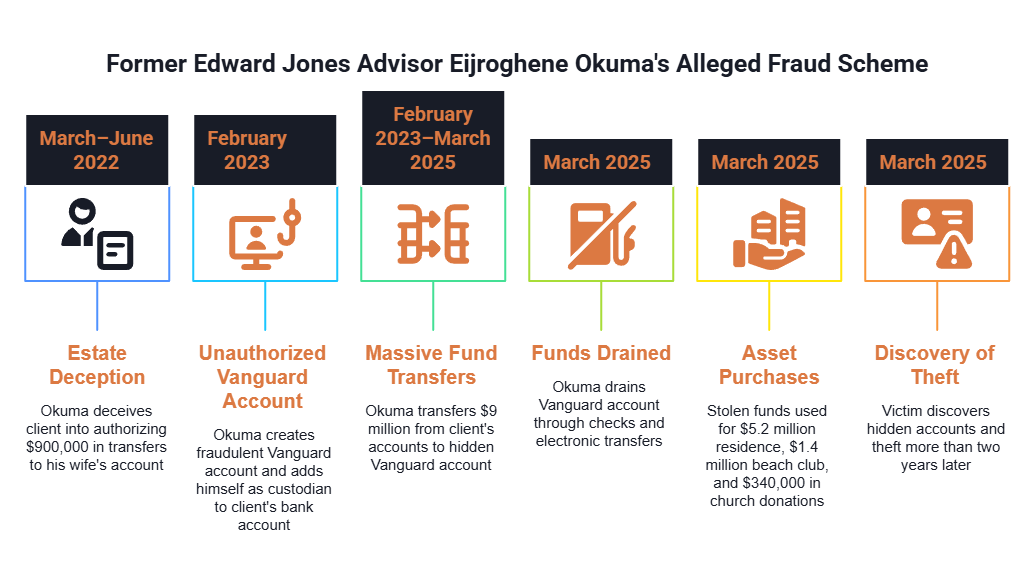
How Did the Alleged Fraud Scheme Operate?
Eijroghene Okuma (also known as Ejiro Ode Okuma or EJ Okuma) served as a financial advisor with Edward Jones from 2010 to May 2023. According to the U.S. Attorney’s Office and the U.S. District Court for the Northern District of Georgia, Okuma exploited his position of absolute trust to systematically loot the accounts of a vulnerable client born in 1944. Okuma carries the CRD# 5774832, while Edward Jones is registered under CRD# 250.
The fraudulent activity began in early 2022 after Okuma inserted himself into the administration of the victim’s sister’s estate.
Important points regarding the timeline and mechanics of the theft include:
- March–June 2022: Okuma falsely claimed the sister’s estate required capital, deceiving his client into authorizing approximately $900,000 in transfers that were diverted to a bank account controlled by Okuma’s wife.
- February 2023: Okuma established an unauthorized Vanguard brokerage account in the victim’s name using a fraudulent email address. That same day, he added himself as a custodian to the client’s bank account, granting himself full withdrawal authority.
- February 2023–March 2025: The advisor transferred roughly $9 million from the victim’s primary accounts into the hidden Vanguard account, subsequently draining those funds through checks and electronic transfers.
The stolen assets were reportedly used to finance a $5.2 million residence in Vinings, Georgia, a $1.4 million beach club membership and fractional beach house, and approximately $340,000 in church donations. The victim had no knowledge of the hidden accounts until the theft was uncovered more than two years later.

We Have Recovered Over
$350 Million for Our Clients Nationwide.
What Actions Have Regulators Taken Against Eijroghene Okuma?
On March 17, 2026, Okuma formally pleaded guilty to one count of wire fraud, with sentencing scheduled for June 23, 2026.
The Securities and Exchange Commission (SEC) also filed a settled civil action against Okuma on January 30, 2026. A final judgment was entered shortly after on February 18, 2026, ordering the former advisor to pay more than $13 million in restitution and fines. This total includes over $1 million in prejudgment interest and a $3 million civil penalty.
Could Edward Jones Be Held Liable for Investor Losses?
A criminal conviction penalizes the individual advisor, but victims are often left wondering how a massive scheme could go undetected at a major brokerage firm for three years. Although Okuma was later associated with Equitable Advisors, LLC (CRD# 6627), the bulk of the misconduct occurred during his tenure at Edward Jones.
Brokerage firms have a strict regulatory obligation to monitor their representatives. They must enforce systems reasonably designed to flag unauthorized account openings, unusual transfer patterns, and the misappropriation of funds. When a firm fails to supervise its personnel and an investor suffers harm, that brokerage can be held financially responsible for the damages through arbitration.
Elder financial fraud costs Americans an estimated $3.4 billion annually. Recognizing the warning signs of advisor fraud is critical for protection:
- Requests to move money for vague or unfamiliar reasons
- New accounts opened without your consent
- An advisor acting as a trustee or estate administrator
- Unexplained changes to account ownership, custodial access, or beneficiary designations
- Reluctance by the advisor to provide clear account statements
Our lawyers are nationwide leaders in investment fraud cases.
How Meyer Wilson Werning Helps Eijroghene Okuma Investors
The criminal conviction of Eijroghene Okuma exposes the hidden risks and devastating impact of elder financial exploitation in the brokerage industry. While this specific case involves egregious allegations of unauthorized accounts and misappropriated funds by Eijroghene Okuma, it serves as a stark reminder that investment firms have a fundamental duty to supervise their representatives and protect their clients from internal misconduct.
With more than 20 years in the industry and over $350 million recovered for clients, Meyer Wilson Werning has the resources and experience to hold negligent firms accountable. Contact us today for a free and confidential consultation to discuss your specific case and learn how we can assist in protecting your financial interests.
We Are The firm other lawyers
call for support.
Frequently Asked Questions

What should I do if my advisor opens an account without my permission?
Immediately document the unauthorized activity and contact independent legal counsel. Do not confront the advisor directly, as they may attempt to alter records or conceal the misconduct before an investigation can begin.
Can I sue the brokerage firm if my financial advisor steals from me?
Yes. Brokerage firms can be held financially responsible in arbitration for failing to supervise their advisors. If the firm missed clear red flags of theft, forged documents, or unauthorized transfers, they may be required to compensate you for the stolen funds.
How does arbitration work for investment fraud victims?
Arbitration is a binding dispute resolution process used to handle claims against registered brokers and brokerage firms. It is generally more efficient than traditional court litigation and serves as the primary recovery path for defrauded investors seeking to reclaim their life savings.
Recovering Losses Caused by Investment Misconduct.