


The Garfield Building, an 11-story historic structure at 1965 East 6th Street in downtown Cleveland, Ohio, became the subject of a significant federal tax dispute after its owner, Corning Place Ohio LLC, claimed a charitable contribution deduction of roughly $22 million to $22.6 million for a conservation easement donated in 2016. That figure was nearly four times what the entity had paid for the building.
The Internal Revenue Service disallowed the Garfield Building conservation easement deduction and imposed penalties, with both the U.S. Tax Court and the U.S. Court of Appeals for the Sixth Circuit upholding the IRS’s position. The case has direct implications for investors in historic-property and tax-credit fund structures, where aggressive tax strategies can lead to IRS audit exposure and financial loss.
If a licensed financial professional, broker, or advisor recommended, sold, or facilitated your investment in a historic-property partnership, tax-credit fund, or conservation easement transaction and you are now facing IRS penalties, disallowed deductions, back taxes, or investment losses, an alternative investment attorney can help determine if your losses are actionable.
What Happened with the Garfield Building Easement
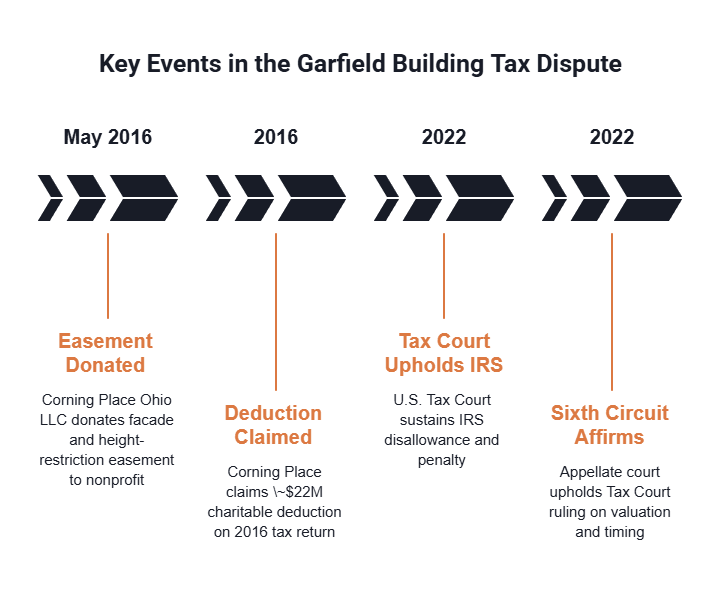
Corning Place Ohio LLC owned the Garfield Building, a certified historic structure in downtown Cleveland that had already generated approximately $5 million in Ohio historic preservation tax credits and about $4.17 million in federal rehabilitation tax credits under an approved rehabilitation plan. In May 2016, the entity donated a facade and height-restriction conservation easement over the building to a nonprofit preservation organization, restricting construction of a proposed 34-story vertical addition. On its 2016 partnership return, Corning Place claimed a charitable deduction of approximately $22 million to $22.6 million based on those alleged lost development rights. This type of structure, where investors in a pass-through entity claim outsized deductions tied to a donated easement, has drawn sustained IRS scrutiny.
The IRS issued a Final Partnership Administrative Adjustment disallowing the deduction in full. The agency found that the deduction was claimed for a year in which Corning Place was not operating as a taxable partnership, that the easement’s fair market value was approximately $900,000 rather than $22 million, and that roughly $665,000 in related expense deductions were not properly documented
A 40% gross valuation misstatement penalty was imposed on top of the disallowed deduction. Tax authorities characterized the transaction as a “double dip,” noting that the same property had already yielded millions in federal and state tax credits before the easement deduction was claimed. For investors evaluating similar structures, the gap between the claimed deduction and the property’s actual appraised value is among the most significant warning signs courts and regulators have consistently flagged.


We Have Recovered Over
$350 Million for Our Clients Nationwide.
What This Means for Investors
When a partnership’s claimed tax deduction is disallowed or sharply reduced, individual partners and fund investors face back taxes, interest, and penalties that can erase the tax savings the deal was supposed to deliver. In the Corning Place case, the 40% gross valuation misstatement penalty alone represented a substantial additional cost on top of the disallowed deduction. Investors who entered these arrangements on the strength of a broker or advisor’s representations about the safety of the deduction may find they now owe the IRS money they never expected to pay. The Patrick Capital Markets conservation easement investigation is one example of how broker-recommended deals of this type have led to investor claims.
The Garfield Building case highlights several warning signs that apply to any historic-property or tax-credit structure:
- A deduction amount that far exceeds the purchase price of the underlying property
- Valuation based on speculative development assumptions rather than grounded market analysis
- Conservation easement deductions stacked on top of existing historic preservation tax credits
- Failure to meet IRS Notice 2017-10 disclosure requirements or IRC Section 170 documentation standards
Investors who participated in similar structures and now face audit activity, or who believe a fund sponsor misrepresented the risks involved, may have grounds to pursue investment loss recovery.
How Meyer Wilson Werning Can Help
When a fund sponsor or financial advisor promotes a tax-credit partnership or conservation easement transaction as a reliable path to tax savings, investors have every reason to expect the strategy was sound. The Garfield Building case illustrates what can happen when those promises do not hold up: a deduction that was disallowed in full, a 40% gross valuation misstatement penalty, and investors left to absorb consequences that were never part of the pitch. For anyone who entered a similar structure on the recommendation of a broker, advisor, or promoter, those losses may not be theirs alone to carry.
With more than $350 million recovered for investors nationwide, Meyer Wilson Werning has spent over 25 years holding licensed advisors and broker dealers accountable. If you invested in a historic-property deal, tax-credit fund, or conservation easement transaction and are now facing IRS penalties, disallowed deductions, or investment losses at the recomendation of a licensed financial professional, contact us today for a free and confidential consultation. You pay nothing unless we recover for you.
Our lawyers are nationwide leaders in investment fraud cases.
Frequently Asked Questions

What happened in the Garfield Building conservation easement tax deduction case?
Corning Place Ohio LLC donated a facade and height-restriction easement over the historic Garfield Building in Cleveland in 2016 and claimed a charitable deduction of about $22 million to $22.6 million based on alleged lost development rights. The IRS disallowed the deduction, and both the U.S. Tax Court and the Sixth Circuit Court of Appeals upheld the disallowance and imposed a 40 percent gross valuation misstatement penalty.
Why did the IRS and courts reject Corning Place’s tax deduction for the Garfield Building?
According to the Tax Court and Sixth Circuit, the partnership claimed the deduction for a year when it was not a taxable partnership, the $22-plus million valuation was based on speculative development assumptions rather than a non-speculative highest-and-best-use analysis, and the entity failed to meet documentation and appraisal requirements for a qualified conservation contribution under Internal Revenue Code Section 170.
How do historic preservation tax credits interact with conservation easement deductions?
In the Garfield Building case, the developer had already received roughly $5 million in Ohio historic preservation tax credits and about $4.17 million in federal rehabilitation tax credits for the same property. The additional conservation easement deduction was characterized as an attempted “double dip” on tax benefits, and the IRS and courts scrutinized whether a further charitable deduction was justified given the existing credit-driven restrictions.
Recovering Losses Caused by Investment Misconduct.