


A significant $940,000 corporate-debt claim filed on January 29, 2025, has intensified the investigation into investment recommendations made by financial advisor James John Raia. Currently registered with Emerson Equity LLC in Irvine, California, James Raia is facing multiple allegations of unsuitable investment advice, negligence, and misrepresentation. These claims primarily involve complex and often illiquid products, including corporate debt and Real Estate Investment Trusts (REITs).
If you or a family member experienced meaningful losses while working with James John Raia or Emerson Equity LLC, our experienced alternative investment loss attorneys at Meyer Wilson Werning can help evaluate whether your losses are the result of actionable misconduct. Contact us today for a free and confidential consultation, and you pay nothing unless we recover for you.
What Recent Corporate Debt Claims Have Been Filed Against James Raia?
According to public records and FINRA Case filings, James John Raia (CRD# 2397301) has been the subject of several recent disputes centered on corporate debt strategies. These filings allege that the recommendations were unsuitable for the investors’ profiles and that the risks associated with these debt instruments were not properly disclosed.
- January 2025: A pending arbitration (FINRA Case 25-00196) involves allegations of suitability and negligence regarding corporate debt investments made between 2019 and 2021. The customer is seeking $940,000 in damages.
- April 8, 2025: A dispute involving corporate debt recommendations from 2018 to 2021 resulted in a settlement of $192,500. The claimant originally requested $412,600 (FINRA Case 24-00509).
- December 5, 2024: An arbitration alleging suitability and negligence involving corporate debt from 2019 to 2020 was settled for $22,378.67 after a claim of $50,000 was filed (FINRA Case 23-01410).

We Have Recovered Over
$350 Million for Our Clients Nationwide.
Understanding the History of REIT and Real Estate Security Complaints
Beyond corporate debt, James Raia’s disclosure history includes a pattern of complaints involving REITs, real estate securities, and oil and gas interests. In December 2025, a customer filing for $115,000 alleged misrepresentations and suitability concerns after dividends were reportedly suspended on a REIT and real estate security. While that matter was eventually withdrawn, similar allegations have appeared throughout his career. For instance, a 2017 claim for $110,000 involved the Phillips Edison REIT and guidance regarding a variable annuity that allegedly resulted in negative tax consequences.
Earlier disputes also highlight risks associated with specific products like the Behringer Harvard REIT I, which was the subject of a $100,000 unsuitable investment claim in 2018. Additionally, two separate matters involving real estate securities in 2013 resulted in settlements where James Raia personally contributed $24,500 and $24,395 respectively. These historical disclosures are often viewed as Important Points when evaluating whether a broker has a consistent habit of recommending high-risk, illiquid products to retail investors who may not fully understand the potential for loss or dividend pauses.
Why Do These Emerson Equity LLC Recommendations Face Legal Scrutiny?
The allegations against James Raia frequently implicate FINRA Rule 2111, which requires brokers to have a reasonable basis to believe a recommendation is suitable for a client’s specific financial situation. When a representative recommends higher-risk or illiquid products like corporate debt or non-traded REITs, they must ensure the investment aligns with the client’s risk tolerance and liquidity needs. Furthermore, FINRA Rule 3110 requires firms like Emerson Equity LLC and his former firm, Moloney Securities Co., Inc., to reasonably supervise their advisors to detect and prevent misconduct, such as overconcentration in a single asset class.
In many of these cases, investors claim they were misled about the safety of their principal or the stability of income distributions. When market stress occurs or distributions are halted, retirees often find themselves trapped in illiquid holdings that do not match their long-term goals. In the arbitration process, panels review evidence such as risk disclosures, account documentation, and the firm’s Written Supervisory Procedures (WSPs) to determine if the broker and the firm met their industry obligations.
Our lawyers are nationwide leaders in investment fraud cases.
What Are the Warning Signs of Investment Misconduct?
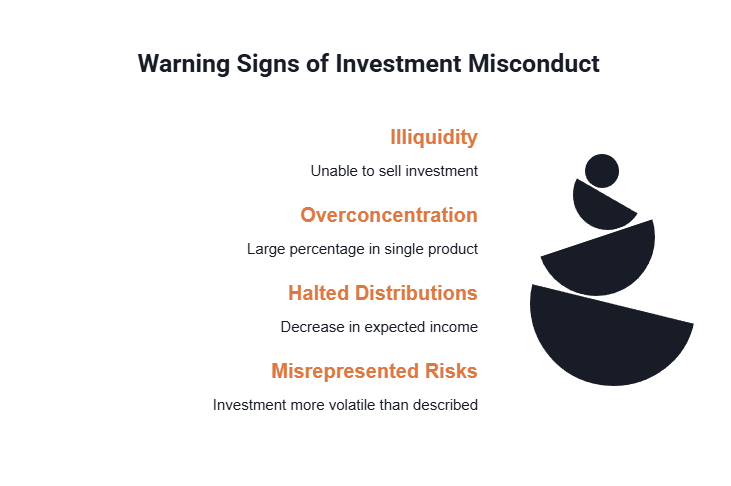
Investors should be vigilant if they notice certain patterns in their accounts or their interactions with a financial advisor. The following red flags are often present in cases involving unsuitable recommendations:
- Illiquidity: Finding that you are unable to sell an investment or exit a position when you need access to your funds.
- Overconcentration: Having a disproportionately large percentage of your portfolio invested in a single product type, such as REITs or corporate debt.
- Halted Distributions: A sudden stop or significant decrease in expected dividend payments or interest income.
- Misrepresented Risks: Discovering that an investment is much more volatile or speculative than it was originally described by the broker.
We Are The firm other lawyers
call for support.
How Meyer Wilson Werning Pursues Recovery for Investors
When an advisor’s record reflects years of similar complaints — corporate debt, REITs, real estate securities — across multiple firms and multiple clients, it raises questions worth asking. If you worked with James John Raia and experienced unexpected losses, you deserve a clear-eyed review of what happened and why.
Meyer Wilson Werning has spent more than 25 years helping investors get those answers. With over $350 million recovered for clients harmed by broker misconduct and supervisory failures, we know how to evaluate these claims and pursue the recovery investors deserve. Every matter we take is handled on a pure contingency fee — you pay nothing unless we recover money for you. Arbitration claims are subject to strict eligibility deadlines, so early action matters. Contact us today for a free and confidential consultation.
Frequently Asked Questions
Who is James John Raia and what is his CRD number?
James John Raia is a financial advisor currently registered with Emerson Equity LLC in Irvine, California. His CRD number is 2397301. He has a long history in the industry, having been registered with firms like Moloney Securities and Summit Brokerage Services.
What are the main allegations against James Raia?
The public disclosures on his record reference a pattern of unsuitable investment recommendations, negligence, and misrepresentation. These allegations are concentrated in corporate debt, REITs, and real estate securities.
How much have investors claimed in damages?
Recent claims involving corporate debt range from $30,000 to as high as $940,000. Other disputes involving real estate products have sought between $23,128 and $150,000.
Can I recover money if my dividends were suspended?
Yes. If you were sold a REIT or real estate security with the expectation of steady dividends and those payments were suspended, you may have grounds for a claim. Such claims often argue the broker misrepresented the product’s risks or failed to perform due diligence.
Why is the brokerage firm liable for these losses?
Under FINRA Rule 3110, brokerage firms have a legal obligation to supervise their advisors. If a firm failed to monitor James Raia’s activities or ignored red flags of unsuitable recommendations, they may be held responsible for investor losses in an arbitration claim.
Recovering Losses Caused by Investment Misconduct.