


Former customers of UBS Financial Services advisor Dimitrios Michelis are seeking more than $5.8 million in damages following allegations of significant investment misconduct. These claims involve high-risk Real Estate Investment Trusts (REITs) and “selling away” practices that reportedly left investors facing devastating financial losses.
If you believe your financial advisor at UBS sold you investments outside of firm oversight, the attorneys at Meyer Wilson Werning are experienced in UBS Financial Services claims and are reviewing investor complaints now. Contact us today for a free and confidential consultation, and you pay nothing unless we recover for you.
What Are the Specific Allegations Against Dimitrios Michelis?
According to public regulatory filings, Dimitrios Michelis (also known as Dimitrios Kosmo Michelis) is the subject of two major pending customer disputes filed on August 15, 2025. These complaints center on his conduct while registered with UBS Financial Services Inc. in New York.
Important Points Regarding the Pending Claims:
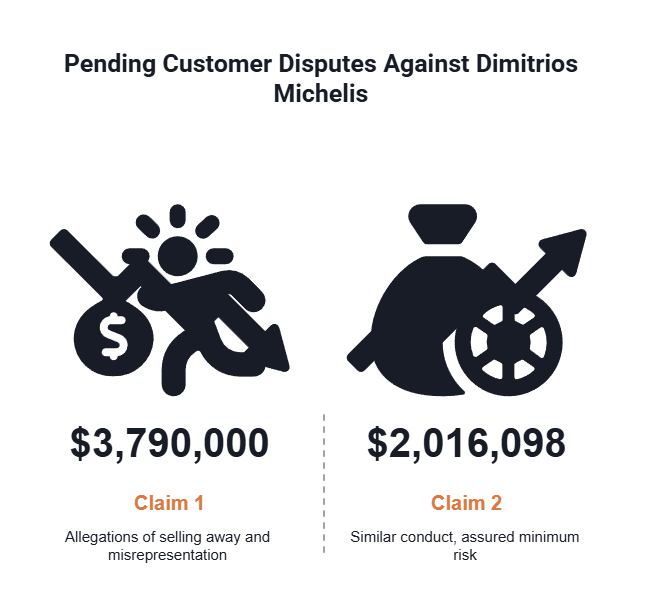
- $3,790,000 Claim: A customer alleges that between May 1, 2012, and August 15, 2025, Michelis engaged in selling away and misrepresentation. The claimant further alleges the investments were unsuitable, conflicted, and harmful.
- $2,016,098 Claim: A second investor filed a claim for similar conduct occurring between July 1, 2016, and August 15, 2025. This claim also specifies that Michelis allegedly assured the client the investments carried minimum risk and would pay promised interest.
- Misrepresentation of Risk: In both matters, investors claim they were told the products were safe, legitimate, and income-producing, despite their high-risk nature.
Dimitrios Michelis (CRD #2920152) has 28 years of experience in the industry. He was associated with UBS Financial Services from June 2011 until September 2025. He is currently registered as an investment adviser with Aegis Capital in New York.

We Have Recovered Over
$350 Million for Our Clients Nationwide.
Why Does “Selling Away” Pose a Significant Risk to Investors?
A central allegation in the lawsuits against Michelis is “selling away“. This is a serious violation of industry standards that can leave investors without the traditional protections offered by a major brokerage firm.
“Selling away” occurs when a broker sells investments that were never approved by their brokerage firm of record and without the firm’s knowledge. These unapproved products are inherently risky because they have not undergone the firm’s mandatory due diligence or vetting processes. Brokers may engage in this conduct to secure higher commissions or to conceal unauthorized activity from supervisors. Except in very specific cases where a broker obtains prior written authorization from their firm, this practice is strictly against regulations.
Can UBS Financial Services Be Held Liable for These REIT Losses?
Under industry regulations, brokerage firms have a non-negotiable duty to properly oversee their financial advisors and all activities within customer accounts. When oversight fails, the firm may be held legally responsible for the resulting financial damage.
The Duty of Supervision Includes:
- Detecting Red Flags: Firms must have systems in place to identify suspicious patterns, such as off-platform transactions or unsuitable concentrations in complex products like REITs.
- Monitoring Outside Business: Regulators require firms to monitor for unauthorized outside business activities (OBAs) that may lead to selling away.
- Protecting Client Interests: Firms must ensure that every recommendation made by their advisors is in the client’s “best interest” and matches their risk tolerance.
If UBS Financial Services failed to identify or stop the alleged misconduct of Dimitrios Michelis over the 13-year period cited in the claims, they may face liability in arbitration for a “failure to supervise“.
Our lawyers are nationwide leaders in investment fraud cases.
How Meyer Wilson Werning Can Help
The claims against Dimitrios Michelis span more than 13 years and allege that investors were repeatedly told these products were safe, income-producing, and low risk. If that is accurate, the investors were not just misled by one broker. They were let down by a firm that had more than a decade of opportunities to catch it.
For over 25 years, Meyer Wilson Werning has recovered more than $350 million for investors harmed by broker misconduct. If a UBS advisor recommended unsuitable or unauthorized investments without disclosing the real risks, you may have a claim against the firm. Contact us today for a free and confidential consultation. You pay nothing unless we recover for you.
Frequently Asked Questions

What is the specific nature of the claims against Dimitrios Michelis?
Investors allege that Michelis engaged in selling away, misrepresentation, and unsuitable recommendations involving REITs. The claims seek over $5.8 million in damages for losses sustained while he was with UBS Financial Services.
What are the risks of investing in REITs?
While some REITs are public, many recommended by brokers are high-risk, illiquid, and carry significant fees. They are often unsuitable for retirees or conservative investors who need access to their principal.
Is UBS Financial Services responsible if my broker “sold away”?
Yes. Under FINRA Rule 3110, firms are responsible for supervising their brokers. If a firm fails to detect red flags of unauthorized activity or unapproved sales, they may be held liable for the investor’s losses.
How can I verify the history of my financial advisor?
Investors can use tools like BrokerCheck or the Investment Adviser Public Disclosure (IAPD) system to research an advisor’s registration, licensing, and any past disciplinary history or customer complaints.
How do I begin the recovery process for my losses?
The first step is typically gathering all account documentation and consulting with a qualified attorney to evaluate your claims of unsuitability, negligence, or misrepresentation. Most recoveries are pursued through the arbitration process.
Recovering Losses Caused by Investment Misconduct.