


Federal authorities in North Carolina recently announced a massive seizure involving more than $61 million worth of Tether, a digital currency pegged to the U.S. dollar. According to the U.S. Attorney’s Office for the Eastern District of North Carolina, the funds were allegedly linked to a series of sophisticated cryptocurrency investment scams often referred to as “pig butchering.”
If you lost money to a pig-butchering scheme and your brokerage firm or financial institution processed suspicious transactions without flagging the activity, you may have a claim. Our team of experienced cryptocurrency attorneys can help evaluate whether the firms that handled your money failed in their duty to protect your account. At Meyer Wilson Werning, our team holds financial institutions accountable when they ignore the warning signs of fraud.
What Are the Allegations in the $61 Million “Pig Butchering” Case?
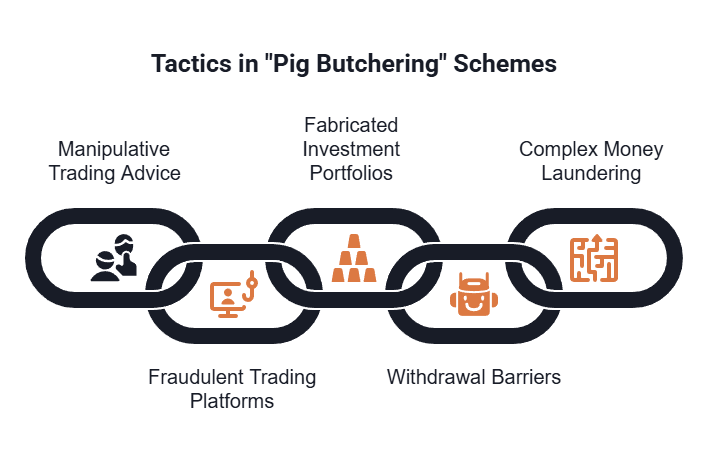
According to court filings, the criminal actors involved in this scheme allegedly targeted victims by establishing a high degree of trust under the pretense of a romantic relationship. Once this trust was secured, the perpetrators reportedly used several deceptive tactics to defraud investors:
- Manipulative Trading Advice: Scammers claimed to possess specialized techniques for generating substantial profits through cryptocurrency trading.
- Fraudulent Trading Platforms: Victims were directed to fake cryptocurrency trading sites that closely resembled legitimate platforms in both name and appearance.
- Fabricated Investment Portfolios: The fake sites displayed made-up portfolios showing unusually high returns to entice victims into investing more capital.
- Withdrawal Barriers: When victims attempted to withdraw their money, they were allegedly met with excuses or demands to pay a fake “tax” or “fee” to release the funds.
- Complex Money Laundering: Stolen money was quickly routed through numerous cryptocurrency wallets to conceal the source and ownership of the funds.
U.S. Attorney Ellis Boyle stated that his office’s asset forfeiture team worked diligently to “take the profit out of crime” by seizing these illicitly derived proceeds.

We Have Recovered Over
$350 Million for Our Clients Nationwide.
How Was the Cryptocurrency Fraud Investigation Conducted?
The investigation began after Homeland Security Investigations (HSI) in Raleigh, North Carolina, received a report of alleged investment fraud through the HSI Tip Line. Agents and analysts from HSI Charlotte and Raleigh worked to trace the victim’s money through a complex web of digital wallets used in the fraud and money laundering scheme.
On February 24, 2026, federal agents announced the successful seizure of the $61 million. HSI Charlotte Acting Special Agent in Charge Kyle D. Burns noted that criminal actors use cyber-enabled fraud to swindle victims and conceal gains, but federal agents remain committed to dismantling these transnational criminal organizations. The Department of Justice and HSI also acknowledged the assistance of Tether in transferring the seized assets to federal control.
How Meyer Wilson Werning Can Help
The scale of this seizure ($61 million) underscores just how profitable pig-butchering scams have become for criminal organizations, and how devastating they are for the people targeted.
Federal seizures like this one can sometimes lead to restitution, but that process is slow, uncertain, and rarely makes investors whole. For many investors, a more direct path to recovery exists through arbitration against the financial institutions that should have stopped the fraud before it escalated.
In many pig-butchering cases, victims move money through a brokerage account, bank, or regulated financial platform before it reaches the scammers. Those institutions have a legal duty to supervise accounts and flag suspicious activity, including large and unusual wire transfers, rapid movement of funds to unverified crypto wallets, or patterns consistent with known scam typologies. When a firm ignores those red flags or fails to implement reasonable safeguards, it may be held liable for the resulting losses.
Meyer Wilson Werning has more than 25 years of experience holding financial institutions accountable for exactly this kind of failure. Our team has recovered over $350 million for investors nationwide. If your brokerage firm or financial institution processed suspicious transactions without protecting your account, contact us today for a free and confidential consultation to find out whether you have a claim.
Our lawyers are nationwide leaders in investment fraud cases.
Frequently Asked Questions
What is a “pig butchering” scam?
A “pig butchering” scam is a form of investment fraud where scammers build a fake romantic or personal relationship to gain a victim’s trust, fattening them up, before directing them to fraudulent cryptocurrency trading platforms designed to steal their money. These schemes typically involve fabricated portfolios, fake returns, and barriers to withdrawing funds.
How can I tell if a cryptocurrency platform is fake?
Watch for platforms that closely mimic the names of legitimate exchanges, pressure you to invest quickly, or show portfolios with unusually consistent high returns. Demanding a “tax” or “fee” before allowing you to withdraw your own funds is a major red flag. If someone you met online is directing you to a specific trading platform, treat that as a warning sign.
What legal options do victims of pig-butchering scams have?
If you lost money to a pig-butchering scam, your legal options depend on how the funds moved. If your brokerage firm or financial institution processed the transactions and failed to flag suspicious activity or protect your account, you may be able to pursue recovery through arbitration. Financial institutions have a duty to supervise accounts and detect signs of fraud, and when they fall short, they can be held responsible. An experienced cryptocurrency attorney can evaluate your situation and determine whether a claim exists.
Recovering Losses Caused by Investment Misconduct.