

Investors in the Twin Cities and surrounding Minnesota communities are grappling with the aftermath of a “sham” investment scheme following the conclusion of an SEC enforcement action against Spartan Trading Company, LLC. The scheme reportedly involved misleading claims about high returns, leaving many individuals questioning their financial futures.
If a registered broker or financial advisor introduced you to Spartan Trading, you may have a separate claim against that firm. Our team of broker misconduct attorneys at Meyer Wilson Werning are here to help. Contact us today for a free and confidential consultation.
The SEC Enforcement Action Against Spartan Trading
The SEC’s complaint, filed as Civil Action No. 23-cv-1997 (JWB/DTS), alleged that from 2019 to 2023, Spartan Trading Company, LLC operated as an unregistered investment fund. Founded by Richard Myre, Dale Dahmen, and Dominick Dahmen, the firm solicited more than $3.7 million from dozens of local investors. The participants were told their money would be pooled for a sophisticated day-trading strategy focused on the stock market.
According to the SEC investigation, led by Lee Farnsworth and Larry Brannon and supervised by C.J. Kerstetter of the Chicago Regional Office, the fund was largely a vehicle for the founders’ personal enrichment. The litigation concluded with the court permanently enjoining Spartan Trading from violating core federal securities laws, including Section 17(a) of the Securities Act of 1933 and Section 10(b) of the Securities Exchange Act of 1934.

We Have Recovered Over
$350 Million for Our Clients Nationwide.
Allegations of Misconduct and “Sham” Strategies
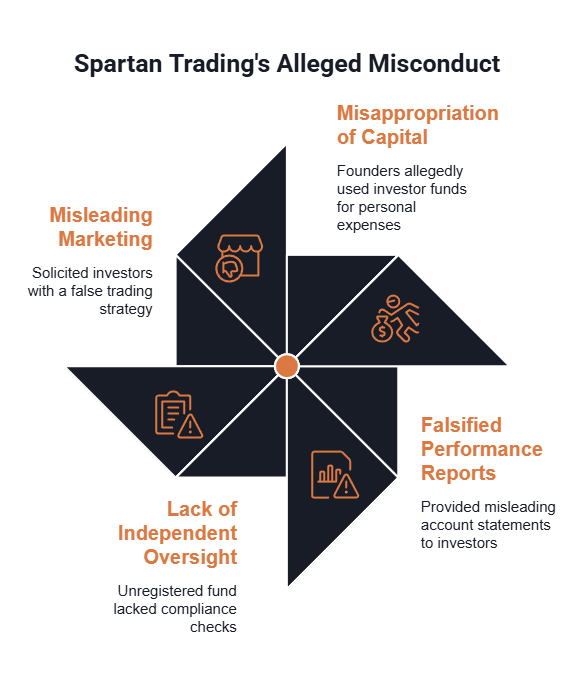
The regulatory filings detailed a series of deceptive practices used by Spartan Trading and its leadership to mislead investors and maintain the flow of capital into the firm. The SEC’s allegations included the following specific problems:
- Misappropriation of Capital: The founders allegedly withdrew more than $1.9 million of investor money for their own personal use, rather than investing it as promised.
- Falsified Performance Reports: Richard Myre and the firm allegedly provided investors with account statements showing consistent positive returns, while the fund was actually engaging in very little trading and often losing money.
- Lack of Independent Oversight: Because the entity was an unregistered investment fund, it lacked the standard compliance checks and balances that protect investors in registered environments.
- Misleading Marketing: Investors were solicited on the premise of a pooled day-trading strategy that, in reality, was described by the SEC as a sham.
Court-Ordered Remedies and Financial Penalties
On April 13, 2026, the court entered a final judgment by consent against the Estate of Richard Myre and an amended default judgment against Spartan Trading Company, LLC. The firm was held liable for a total of $1,319,823.02 in disgorgement and prejudgment interest. Under the terms of the judgment, the Myre Estate is jointly and severally liable for up to $695,000 of that amount.
Further penalties were leveled against the Estate of Dale Dahmen, which was ordered to pay $648,747.15 in disgorgement and $51,034.69 in prejudgment interest. While the SEC dismissed charges against the Estate of Dominick Dahmen, these judgments represent a significant effort to claw back the ill-gotten gains derived from the offering fraud. The enforcement action serves as a deterrent to others operating unregistered pools without regard for federal securities laws.
Our lawyers are nationwide leaders in investment fraud cases.
Important Points for Defrauded Investors
Investors of the Spartan Trading scheme should be aware of several critical takeaways as they consider their options for financial recovery. These points highlight the red flags and regulatory gaps that often accompany offering fraud:
- Unregistered Offerings: Securities offered outside of standard registration requirements often lack the transparency and auditing necessary to prevent misappropriation.
- Fabricated Statements: The appearance of steady gains on paper can be a deceptive tool used to discourage investors from requesting redemptions.
- Community-Based Solicitation: Fraudsters often target local communities, such as those in the Twin Cities, leveraging personal trust to bypass skepticism.
- Recovery Through Arbitration: While the SEC penalizes wrongdoers, individual recovery of lost principal often requires filing separate claims through the arbitration process.
We Are The firm other lawyers
call for support.
Pursuing Recovery Through Legal Action
The conclusion of the SEC’s litigation is an important milestone, but it may not automatically result in the full return of principal to every individual who lost money. Many investors choose to pursue recovery by filing claims based on negligence, misrepresentation, or failure to supervise. If a registered professional or firm was involved in the solicitation or sale of these unregistered products, they may be held accountable for failing to perform adequate due diligence.
At Meyer Wilson Werning, we have spent more than 26 years advocating for individuals who have been harmed by investment fraud. With over $350 million recovered for our clients, we understand the specialized strategies required to pursue claims against entities and estates involved in offering fraud. We are here to help you document your losses and build a strong case for compensation. To learn more about your options for seeking justice, contact us today for a free and confidential consultation.
Frequently Asked Questions
What was the outcome of the Spartan Trading lawsuit?
The SEC obtained final judgments in April 2026 against Spartan Trading Company, LLC and the estates of its founders. The court ordered more than $2 million in combined disgorgement and interest and issued permanent injunctions against the firm to prevent further violations of anti-fraud laws.
How did the Spartan Trading scheme work?
The founders allegedly raised over $3.7 million for an unregistered day-trading fund. They are accused of misappropriating nearly $1.9 million for personal use while sending investors fake statements that showed steady profits to hide actual trading losses.
Can I recover my money if the founders’ estates are involved?
Yes, it is possible to pursue recovery from estates and related entities. Legal claims often target the assets remaining in the estates of the responsible parties or investigate if other third-party firms are liable for a failure to provide proper supervision during the solicitation process.
Why is an SEC unregistered investment fund dangerous?
Unregistered funds do not have to provide the same level of disclosure as registered investments. This lack of oversight often leads to situations where founders can control investor cash flows and performance reports without independent verification, increasing the risk of fraud.
Recovering Losses Caused by Investment Misconduct.