

The Manhattan District Attorney’s Office has announced a state supreme court indictment against the operators of Coin Dispute Network for an alleged cryptocurrency recovery scam. Authorities claim the enterprise defrauded more than 200 victims who had previously lost digital assets, extracting upfront fees while generating zero recovered funds.
If you lost cryptocurrency to fraud and are trying to understand your legal options, Meyer Wilson Werning’s experienced cryptocurrency attorneys can help you evaluate whether you have a viable claim. Many crypto fraud victims have legitimate avenues for recovery that they are not aware of, against exchanges that failed their security obligations, brokers who directed funds improperly, or financial institutions that enabled the fraud.
What Are the Important Points of the Criminal Indictment?
The criminal charges outline a sophisticated operation designed to exploit the vulnerabilities of prior fraud victims. The indictment follows an extensive investigation by the Manhattan District Attorney’s Cyber Crime Bureau, executed in coordination with federal authorities.
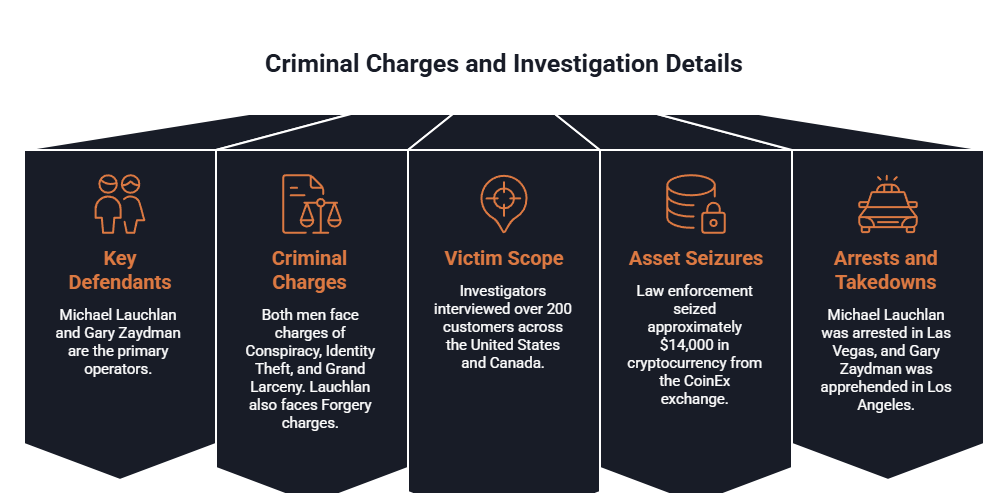
- Key Defendants: Manhattan DA Alvin L. Bragg, Jr. charged Michael Lauchlan (alias “Max Handler”) and Gary Zaydman (alias “Grant Hoffman”) as the primary operators.
- Criminal Charges: Both men face charges of Conspiracy, Identity Theft, and Grand Larceny. Lauchlan also faces Forgery charges for allegedly faking WeWork receipts.
- Victim Scope: Investigators interviewed over 200 customers across the United States and Canada, none of whom successfully recovered any funds.
- Asset Seizures: Law enforcement seized approximately $14,000 in cryptocurrency belonging to users from the CoinEx exchange in the Spring of 2024.
- Arrests and Takedowns: Following a June 2023 domain seizure, Michael Lauchlan was arrested in Las Vegas in July 2024, and Gary Zaydman was apprehended in Los Angeles in April 2025.

We Have Recovered Over
$350 Million for Our Clients Nationwide.
How Did the Fraudulent Operation Build Credibility?
Between January 2022 and June 2023, the defendants allegedly orchestrated a comprehensive deception campaign through the website coindisputenetwork.com. The firm falsely claimed to be headquartered in Manhattan and registered in Delaware. To lure victims, the operators used fabricated data claiming a success rate of approximately 80% for fund recovery.
Marketing for the enterprise relied heavily on manufactured social proof. The defendants allegedly paid actors to pose as satisfied clients in video testimonials on YouTube. They also maintained false personas on platforms like Reddit, Twitter, and LinkedIn to post positive reviews and defend the firm’s reputation while publishing falsified news articles to appear as an industry authority.
How Were the Upfront Fees Structured?
The financial mechanics of the scheme required clients to pay exclusively in cryptocurrency. Victims were first charged an initial consultation fee of 0.1 Ethereum, which was valued between $100 and $150 depending on the market. Once a client engaged their services, the firm demanded an additional “recovery fee” representing 10% to 15% of the total value of the assets the client was attempting to retrieve.
Our lawyers are nationwide leaders in investment fraud cases.
How Did the Defendants Prolong the Deception?
After collecting these payments, the defendants allegedly generated fake cryptocurrency tracing reports to convince victims that progress was being made. They drafted dispute letters and forwarded them to major cryptocurrency exchanges, even though those exchanges had already informed the firm that such letters would not be accepted or acted upon.
Knowing the dispute process was ineffective, the operators continued to send clients emails containing false progress updates. These tactics were designed to extract further payments and prevent victims from realizing they were being defrauded a second time.
We Are The firm other lawyers
call for support.
What Is the Broader Epidemic of Secondary Cryptocurrency Fraud?
The tactics utilized in this case represent a systemic crisis known as recovery fraud. When investors lose money to pig-butchering schemes or account hacks, their desperation to recover their life savings makes them highly susceptible to targeted exploitation.
The scale of this threat is immense. The FBI’s 2025 Internet Crime Report revealed that Americans lost $11.4 billion to cryptocurrency fraud over the course of the year. Within that total, $1.4 billion in losses came strictly from recovery scams. Older Americans bear the heaviest burden; victims age 60 and older accounted for $540.5 million in recovery scam losses alone in 2025.
How Meyer Wilson Werning Helps Victims of Recovery Scams
The collapse of Coin Dispute Network highlights the risks of opaque online asset recovery operations. These entities often prey on individuals who have already suffered severe financial harm. Legitimate legal firms have a strict duty to protect their clients and operate with total transparency.
Meyer Wilson Werning does not pursue recovery against defunct criminal enterprises like Coin Dispute Network. However, if you lost cryptocurrency to the original fraud that sent you searching for help in the first place, whether a pig-butchering scheme, an exchange failure, a hacked account, or a broker who mishandled your funds, those are the cases our attorneys are built to handle. Recovery may be available through arbitration, securities litigation, or exchange liability claims depending on the specifics of your situation.
Contact us today for a free and confidential consultation.
Frequently Asked Questions
What exactly is a cryptocurrency recovery scam?
A cryptocurrency recovery scam is a form of secondary fraud targeting individuals who have already lost digital assets. Perpetrators pose as specialized tracing firms or legal professionals and demand upfront fees or consultation costs, almost always in cryptocurrency, but never return any of the lost assets.
How did Coin Dispute Network deceive its clients?
The operators allegedly used false personas, fake video testimonials featuring paid actors, and fabricated reviews on platforms like Reddit to appear credible. They provided victims with fake blockchain tracing reports and sent dispute letters to exchanges that they knew would be rejected.
What are the warning signs of a fraudulent recovery service?
Common red flags include requiring upfront payment exclusively in cryptocurrency, guaranteeing a successful recovery, and reaching out to victims unsolicited on social media. Legitimate legal professionals do not guarantee outcomes and typically operate on standard fee agreements.
Can investors pursue legal action if they were defrauded by a recovery service?
Yes. Depending on the case, recovery strategies may involve working with law enforcement regarding seized assets, pursuing claims against negligent exchanges, or holding third-party financial institutions accountable for failing to implement proper supervisory protocols.
Recovering Losses Caused by Investment Misconduct.