
OpenAI may be the most talked-about company in the world right now. The creator of ChatGPT confidentially filed its S-1 with the SEC in June 2026, setting the stage for a public offering that analysts expect to seek a valuation north of $852 billion based on the company’s most recent funding round. That combination of name recognition, cultural dominance, and sky-high valuation has made OpenAI one of the most frequently exploited brands in pre-IPO investment fraud today.
Fraudsters do not wait for an IPO to arrive. They work in the lead-up to it, using the hype to pitch fabricated fund investments and fake share access to investors who are afraid of missing out. If you received an unsolicited offer to buy OpenAI shares before the IPO, or if you invested in a fund claiming to provide OpenAI equity exposure, the offer you received may not have been what it claimed.
If a licensed financial professional, broker, or advisor facilitated your investment in what may have been a fraudulent OpenAI pre-IPO offering, the attorneys at Meyer Wilson Werning are experienced in recovering losses from pre-IPO investment fraud and are reviewing claims now. Contact us today for a free and confidential consultation, and you pay nothing unless we recover for you.
Why OpenAI Is a Prime Target for Pre-IPO Fraud
The logic behind using OpenAI as a lure is straightforward. The company is everywhere. ChatGPT is the fastest-adopted consumer application in history. The AI sector dominates financial news. And for years, OpenAI remained private while its valuation climbed, creating genuine demand for early access among investors who believed they were being shut out of a generational opportunity.
The SEC specifically warns that fraudsters conducting pre-IPO scams gravitate toward companies in emerging technology sectors, including artificial intelligence, because those names carry built-in excitement that makes otherwise questionable pitches feel credible. OpenAI is, in this sense, an almost perfect fraud vehicle. Cybersecurity researchers at Netcraft have documented fake websites built to impersonate OpenAI’s IPO, complete with fabricated deepfake endorsement videos of CEO Sam Altman, promising growth forecasts of over 150 percent to lure investors into surrendering personal and financial information.
The pattern does not require a sophisticated operation. A convincing website, a reference to real news about OpenAI’s IPO filing, and a cold call or social media message can be enough to open the door.

We Have Recovered Over
$350 Million for Our Clients Nationwide.
What the Fraud Actually Looks Like
Most OpenAI pre-IPO scams follow one of two structures. In the first, an operator creates a website or fund claiming to offer direct share access, collects investor funds, and simply misappropriates them. No shares are ever purchased. The money goes to the fraudster.
In the second, which is more difficult to detect, operators use special purpose vehicles (SPVs) or fund structures that claim to pool investor money to purchase OpenAI shares on secondary markets. This approach exploits a real phenomenon. Secondary market transactions in pre-IPO shares do occur. But OpenAI, like several other high-profile private companies, explicitly restricts share transfers without company approval. According to reporting by Forbes, OpenAI bans secondary transactions without its express consent, which means SPV investors may never directly own the shares they believe they purchased, and the company may declare transfers void entirely. Fraudsters exploit investor unfamiliarity with these transfer restrictions to sell interests that were either never properly established or outright fabricated.
A January 2026 case illustrated how aggressively this model is being used. According to reporting by Forbes, three SPV brokers in New York City pleaded guilty to conspiracy and fraud charges after allegedly raising $185 million from more than 1,000 investors through hidden markups on pre-IPO SPV shares. The pattern mirrors a larger enforcement action detailed in our recent coverage of SpaceX pre-IPO fraud, in which the SEC charged operators of Prior 2 IPO Inc. and Late Stage Asset Management, LLC with defrauding more than 4,000 investors of at least $528 million through undisclosed markups as high as 150 percent.
The names on the pitch deck may change. The mechanics of the scheme do not.
Red Flags That an OpenAI Pre-IPO Offer May Be a Scam
The SEC’s Investor Alert on pre-IPO investment scams identifies specific warning signs that every investor should know:
- Unregistered sellers. Anyone soliciting investments for compensation must be registered. Use FINRA BrokerCheck and the SEC’s Investment Adviser Public Disclosure database to verify any seller before engaging further.
- AI or tech company names as the lure. The SEC explicitly flags AI and emerging technology companies as frequent targets. An unsolicited pitch built around OpenAI, ChatGPT, or related branding should be treated with immediate skepticism.
- Promises of no upfront fees. As the Prior 2 IPO enforcement action demonstrates, “no fees” is a common misrepresentation used to disarm investors while hidden markups drain the investment.
- Urgency and artificial scarcity. Claims that a share allocation is “almost gone” or that the IPO window is “closing soon” are pressure tactics, not facts.
- Celebrity or executive endorsements. Fake deepfake videos of Sam Altman and other recognizable figures have been used to manufacture credibility for fraudulent OpenAI-themed investment sites. These are not real endorsements.
- Social media solicitations. Cold outreach through LinkedIn, Instagram, Telegram, or X asking if you want “exclusive” access to OpenAI shares before the IPO is a hallmark of these schemes.
- No investor qualification requirements. Legitimate private placements require investors to meet accredited investor standards. Offerings with no such hurdles may be illegal under federal securities law.
Our lawyers are nationwide leaders in investment fraud cases.
When a Broker or Advisor Is in the Picture
The most damaging OpenAI pre-IPO fraud cases often involve a layer of apparent legitimacy that ordinary investors have no reason to distrust. Some investors have been introduced to fraudulent pre-IPO funds through registered financial advisors or broker-dealer platforms. The presence of a licensed professional does not make the underlying investment legitimate, and it does not eliminate the investor’s right to seek recovery.
When a registered broker recommends or facilitates an investment in a private fund, that broker is legally required to perform genuine due diligence under Regulation Best Interest and FINRA’s suitability framework. A broker cannot simply accept a fund manager’s claims about holding OpenAI shares at face value, especially given how tightly OpenAI controls its own share transfers. When that due diligence fails, the brokerage firm may bear liability alongside the fund operator.
This dynamic is the subject of MWW’s ongoing investigation into Sestante Capital, NextGenTech Investments, and Forge Securities LLC, a case involving a federally indicted fund manager who promised investors access to private company shares he allegedly never held. That case is detailed in our investigation of Forge Global and Sestante Capital. If you were directed to an OpenAI pre-IPO investment by a licensed financial professional, your legal options may extend well beyond the fund itself.
We Are The firm other lawyers
call for support.
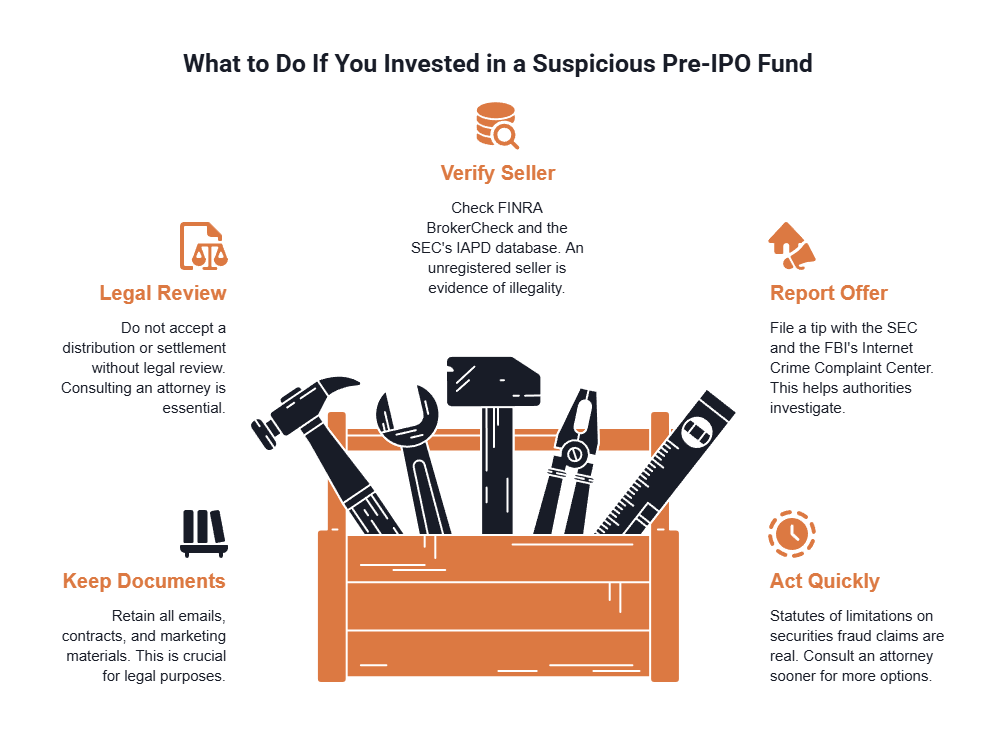
What to Do If You Invested in a Suspicious OpenAI Pre-IPO Fund
- Keep every document. Retain all emails, contracts, account statements, wire transfer records, and marketing materials.
- Do not accept a distribution or settlement without legal review. Accepting funds from a fraudulent operator without consulting an attorney can complicate future claims.
- Verify the seller’s registration. Check FINRA BrokerCheck at brokercheck.finra.org and the SEC’s IAPD database. An unregistered seller is itself evidence of potential illegality.
- Report the offer. File a tip with the SEC at sec.gov/tcr and with the FBI’s Internet Crime Complaint Center at ic3.gov.
- Act quickly. Statutes of limitations on securities fraud claims are real. The sooner you consult an attorney, the more options you are likely to have.
Meyer Wilson Werning Is Reviewing OpenAI Pre-IPO Fraud Claims
OpenAI’s name is being used right now, in active fraud schemes, to take money from real people. The victims range from first-time investors who were cold-called on social media to experienced professionals who were introduced to structured fund vehicles by people they had every reason to trust. In many cases, those investors do not realize they have viable legal claims until they speak with counsel.
With more than $350 million recovered for investors nationwide, Meyer Wilson Werning has spent over 25 years holding brokers, advisors, and financial institutions accountable for exactly this kind of misconduct. If you invested in a fund or account that claimed to offer OpenAI pre-IPO shares, particularly through a registered financial professional or broker-dealer platform, we want to hear from you. Contact us today for a free and confidential consultation. You pay nothing unless we recover for you.
Frequently Asked Questions
Has OpenAI actually gone public yet?
As of June 2026, OpenAI has confidentially filed its S-1 with the SEC but has not yet completed a public offering. Any offer you received before this filing claiming to provide OpenAI shares through an unofficial fund or unregistered seller should be treated with serious skepticism.
How do fraudsters make fake OpenAI pre-IPO pitches seem credible?
Tactics include professional-looking fund documents, fake websites mimicking investment platforms, deepfake videos of real executives like Sam Altman, references to real news about OpenAI’s IPO filing, and claims of exclusive access through personal connections to company insiders. None of these elements indicate a legitimate offering.
Can I legally buy OpenAI shares before the IPO?
OpenAI restricts share transfers without express company approval. Secondary market transactions without that approval may be voided by the company, meaning investors could lose shares they believed they had purchased. Any offer promising easy or exclusive pre-IPO access outside of an authorized process warrants independent verification before any money is transferred.
If I already sent money, is it too late to take action?
Not necessarily. Securities fraud claims are subject to statutes of limitations that vary by claim type and jurisdiction, typically ranging from two to six years. Many investors do not realize they have viable claims until well after the initial investment. Consulting a securities fraud attorney as early as possible preserves the most options.
Recovering Losses Caused by Investment Misconduct.