
SpaceX has become the most-searched name in pre-IPO investing. With its S-1 filed in May 2026 and a planned Nasdaq listing targeting a valuation of approximately $1.75 trillion, the company’s public debut is one of the most consequential financial events in decades. That historic interest has created an equally historic opportunity for fraud. Across the country, investors have been targeted by schemes falsely promising access to SpaceX shares, and they have lost real money as a result.
If a licensed financial professional, broker, or advisor facilitated your investment in a fund claiming to offer SpaceX pre-IPO shares, the attorneys at Meyer Wilson Werning are experienced in recovering losses from pre-IPO investment fraud and are reviewing claims now. Contact us today for a free and confidential consultation, and you pay nothing unless we recover for you.
Why SpaceX Has Become the Most Common Name in Pre-IPO Fraud
The formula is simple: find the company that every investor wants a piece of, and use its name to open wallets. SpaceX fits that profile better than almost any company in history. For years it remained private while growing to extraordinary scale, and as its valuation climbed, demand for pre-IPO access surged.
Fraudsters understood this dynamic early. The SEC’s Office of Investor Education and Advocacy has specifically warned that bad actors exploit trending company names to manufacture credibility, often targeting investors who fear missing out on a once-in-a-generation opportunity. The approach of a real, legitimate IPO tends to accelerate these schemes. Fraudsters lean on the real news to make fake pitches sound more credible.

We Have Recovered Over
$350 Million for Our Clients Nationwide.
The $528 Million Case That Every Investor Needs to Know About
The clearest illustration of the scale of SpaceX-adjacent pre-IPO fraud comes from an SEC enforcement action announced on December 7, 2023. The Commission charged five individuals and four companies, including Prior 2 IPO Inc. and Late Stage Asset Management, LLC, with operating a sprawling fraudulent pre-IPO scheme.
The defendants, Raymond J. Pirrello Jr., Marcello Follano, Robert Cassino, Anthony DiTucci, and Joseph Rivera, allegedly built a nationwide network of unregistered sales agents to raise at least $528 million from more than 4,000 investors around the world. Offerings involved securities of high-profile private companies, including SpaceX, that investors desperately wanted access to.
The core deception was about fees. Investors were told there were no upfront charges and that the defendants would only profit after companies went public. According to the SEC, this was false. Every investor was charged undisclosed upfront markups, some as high as 150 percent, through which the defendants pocketed more than $88 million in hidden fees.
To complicate detection, the defendants allegedly concealed the identity of Pirrello, who had been barred from associating with broker-dealers following a 2019 jury finding of insider trading liability. His involvement would have been an immediate red flag, so his name was kept out of investor-facing materials entirely.
The SEC filed its complaint in the U.S. District Court for the Eastern District of New York, seeking permanent injunctive relief, disgorgement of ill-gotten gains, civil penalties, and officer and director bars against all named individuals. More than four thousand people handed over real money, in many cases retirement savings, based on promises constructed from the ground up to deceive them.
Red Flags That a SpaceX Pre-IPO Offering May Be a Scam
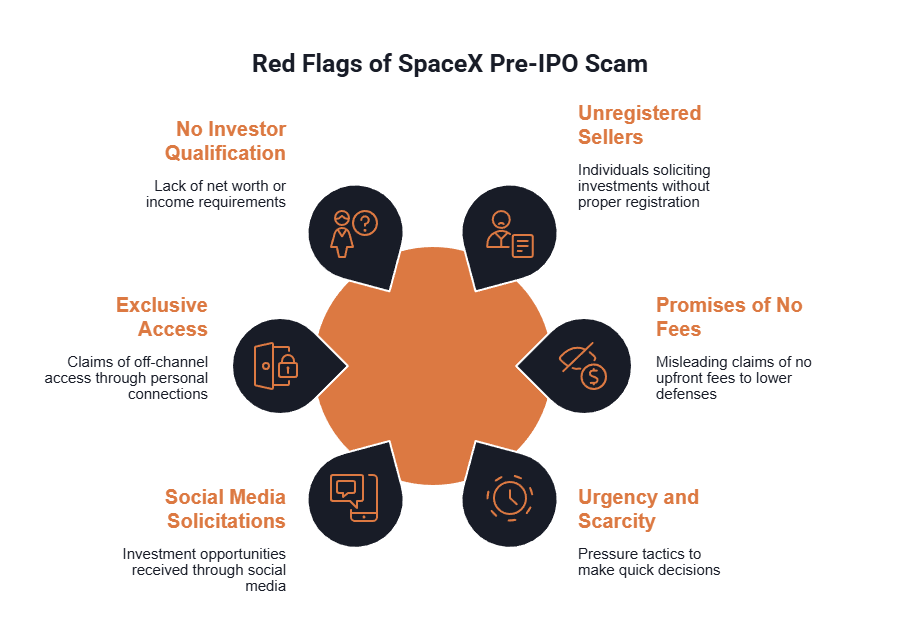
The SEC’s Investor Alert on pre-IPO investment scams identifies several specific warning signs investors should treat as immediate causes for concern:
- Unregistered sellers. Any person soliciting investments in exchange for compensation must be registered. Verify any seller through FINRA BrokerCheck or the SEC’s Investment Adviser Public Disclosure database before proceeding.
- Promises of no fees. As the Prior 2 IPO case demonstrates, “no upfront fees” can be a deliberate misrepresentation designed to lower your defenses while hidden markups drain your investment.
- Urgency and scarcity. Claims that shares are “almost gone,” that the IPO is “imminent,” or that you must decide immediately are hallmarks of pressure-based fraud.
- Social media solicitations. Fraudsters routinely use social media platforms to recruit victims. An investment opportunity that arrived through a direct message or online referral warrants extreme caution.
- Exclusive access through personal connections. Legitimate pre-IPO share access is controlled and tightly restricted. Claims of off-channel access through insider relationships should be independently verified or treated with serious skepticism.
- No investor qualification requirements. Legitimate private placements impose net worth or income standards. An offering with no such requirements may be violating federal law entirely.
Our lawyers are nationwide leaders in investment fraud cases.
When a Broker or Financial Advisor Is Involved
Not every SpaceX pre-IPO fraud involves an operator working entirely outside the regulated financial system. Some victims have been introduced to fraudulent pre-IPO funds through registered brokers and recognized financial platforms. That layer of apparent legitimacy does not eliminate the fraud, and it does not eliminate investor rights.
MWW has been investigating exactly this dynamic in connection with the Sestante Capital and NextGenTech Investments scheme, in which investors were allegedly introduced to a fraudulent pre-IPO fund through registered representatives at Forge Securities LLC. For a full account of that case, see our investigation of Forge Global and Sestante Capital and our analysis of the Giovanni Pennetta indictment.
The broader principle applies here as well. When a registered broker recommends or facilitates an investment in a private fund claiming exposure to SpaceX or any other private company, that broker assumes legal and regulatory obligations under Regulation Best Interest and FINRA’s suitability framework. When that due diligence fails, the broker and the brokerage firm may bear liability for resulting investor losses. If you were directed to a SpaceX-related pre-IPO fund by a registered financial professional, your legal options may extend well beyond the fund itself.
We Are The firm other lawyers
call for support.
What to Do If You Invested in a Suspicious SpaceX Pre-IPO Fund
- Preserve all documentation. Retain every email, contract, account statement, wire transfer record, and marketing material related to the investment.
- Do not accept a settlement without legal review. Fund operators sometimes offer below-market distributions when investors begin asking questions. Accepting without counsel can complicate future claims.
- Verify the seller’s registration. Check FINRA BrokerCheck and the SEC’s IAPD database. If the person who sold you the investment was not registered, that is evidence of potential illegality.
- Report to regulators. The SEC accepts tips at sec.gov/tcr. The FBI’s Internet Crime Complaint Center also accepts reports of investment fraud.
- Consult a securities fraud attorney promptly. Statutes of limitations and arbitration filing deadlines are real. Waiting significantly increases the risk that a valid claim will become time-barred.
Meyer Wilson Werning Is Investigating SpaceX Pre-IPO Fraud Cases
Meyer Wilson Werning has recovered more than $350 million for over 1,000 clients nationwide since 1999. Our attorneys have deep experience with investment fraud involving private funds, unregistered securities, and broker-dealer misconduct.
If you invested in a fund or account that claimed to offer SpaceX pre-IPO shares, we want to hear from you, particularly if the investment was recommended or facilitated by a registered financial advisor or broker-dealer platform. Every case is handled on a pure contingency fee basis. You pay nothing unless we recover money for you.
Contact us today for a free and confidential consultation.
Frequently Asked Questions
Is it possible to legitimately invest in SpaceX before its IPO?
Limited legitimate secondary-market transactions in SpaceX shares have occurred through regulated platforms involving accredited investors and strict controls. However, the vast majority of unsolicited offers promising SpaceX pre-IPO access, particularly those arriving via cold calls, social media, or email, are not legitimate. Any offer that arrived through an unregistered seller or unverified fund should be treated with serious skepticism regardless of the SpaceX IPO timeline.
How do I verify whether someone selling SpaceX pre-IPO shares is registered?
Use FINRA’s free BrokerCheck tool at brokercheck.finra.org and the SEC’s Investment Adviser Public Disclosure database at adviserinfo.sec.gov. If the person or entity offering the investment does not appear in either database with an active registration, that is a significant red flag.
What made the Prior 2 IPO / Late Stage Asset Management case so significant?
The case demonstrates the industrial scale at which pre-IPO fraud can operate. More than 4,000 investors worldwide were defrauded of at least $528 million through a network of unregistered agents. Investors were promised no upfront fees while being charged hidden markups of up to 150 percent. Professional-appearing operations are not inherently legitimate.
If I invested through a registered broker, can I still have a claim?
Yes. If a registered broker or brokerage firm recommended or facilitated your investment in a fraudulent pre-IPO fund without adequate due diligence, you may have claims against that broker and firm separate from any claims against the fund manager. Regulatory obligations under Regulation Best Interest and FINRA’s suitability rules attach to registered brokers regardless of whether the underlying fund is later found to be fraudulent.
Recovering Losses Caused by Investment Misconduct.