

If you invested through Forge Securities LLC and suffered significant financial losses, whether from an unsuitable recommendation, a lack of oversight, or outright misconduct, you have more legal options than you may realize. These types of investments are complex and illiquid, placing a heavy burden of responsibility on the brokerage firms that recommend them. When firms fail to protect their clients, Meyer Wilson Werning helps victims navigate the path to recovery.
We are currently investigating claims on behalf of investors who were misled or harmed through fraudulent pre-IPO investments and other private market securities. Broker-dealers have binding legal obligations to their clients. When those duties are violated, it forms the basis for a formal arbitration claim.
Contact us today for a free and confidential consultation to discuss your situation.
What Is Forge Securities LLC and Why Is It Under Scrutiny?
Forge Securities LLC (CRD #134596) is the registered broker-dealer subsidiary of Forge Global Holdings, Inc. (NYSE: FRGE), a major marketplace for private securities. The firm connects accredited investors with sellers of private company stock, often involving pre-IPO shares. Headquartered in San Francisco, California, the firm is regulated by FINRA and is licensed to operate in all 53 U.S. states and territories.
While the firm facilitates billions of dollars in transactions, its prominence in the private markets has made it a focal point for serious investor complaints. These concerns often involve questions about the due diligence performed by brokers and the accuracy of disclosures regarding high-risk, private investments.

We Have Recovered Over
$350 Million for Our Clients Nationwide.
The Charles Schwab Acquisition and Resulting Shareholder Backlash
In November 2025, Charles Schwab announced an agreement to acquire Forge Global Holdings for approximately $660 million, or $45 per share. The transaction was finalized in early 2026. However, the deal was met with significant resistance from the investment community.
Important Points Regarding the Acquisition:
- A reported 73% shareholder backlash occurred, reflecting deep concerns about the deterioration of confidence in the firm’s risk management and financial outcomes.
- Shareholder advocacy firms pursued legal action, alleging proxy deficiencies and that the acquisition process undervalued the company.
- The completion of the Schwab acquisition does not eliminate the firm’s legal liability for conduct that occurred before or during the transaction. Investors who suffered losses retain their rights to pursue claims against the original entity.
Pre-IPO Fraud and the Sestante Capital Connection
In December 2025, federal prosecutors charged the managing partner of Sestante Capital LLC with securities fraud, wire fraud, and identity theft. The allegations involve a sham pre-IPO fund that claimed to offer access to Anduril Industries shares. Prosecutors allege that investor funds were diverted into personal bank accounts rather than being used for investments.
The connection to Forge Securities LLC is critical: allegations suggest that some investors were introduced to this third-party fund through registered brokers at the firm. Under industry regulations, when a broker recommends or facilitates an investment, they carry full legal and regulatory obligations to the investor, regardless of whether the investment is a third-party fund. The individual at the center of the Sestante case pleaded guilty and is sch11eduled for sentencing in June 2026.
Our lawyers are nationwide leaders in investment fraud cases.
Did Forge Securities LLC Violate Legal Obligations?
Forge Securities LLC does not operate in a regulatory vacuum. As a FINRA-registered broker-dealer, it is bound by a comprehensive framework of federal securities law and self-regulatory rules specifically designed to protect investors. These are not suggestions, they are enforceable legal duties. When a Forge broker or the firm itself fails to meet these standards, that failure can form the direct basis of a Forge Securities complaint or arbitration claim.
The obligations that matter most in evaluating potential Forge Securities FINRA violations include the firm’s duty to act in clients’ best interests, to investigate what it recommends, and to supervise the brokers operating under its license. In the context of complex, illiquid private market products, like the pre-IPO fund interests Forge facilitated. These standards demand real diligence, not a rubber stamp:
- Regulation Best Interest (Reg BI): Effective since June 2020, Reg BI requires brokers to act in the best interest of retail customers before making any recommendation. A Forge broker who directed a client into a high-risk private fund without genuinely evaluating whether it was appropriate, or whether it was legitimate, may have violated this standard.
- FINRA Rule 2111 – Suitability: Forge brokers were required to have a reasonable basis for believing any recommendation was suitable for the investor receiving it. This includes verifying that the product being recommended actually holds what it claims to hold, a standard that goes directly to the heart of the Sestante Capital allegations.
- FINRA Rules 3110 and 3120 – Supervisory Obligations: Forge Securities LLC was independently required to maintain firm-wide supervisory systems designed to detect and prevent securities law violations. If brokers were directing investors into high-risk or fraudulent private funds without adequate compliance oversight, the firm itself may carry liability, separate from any individual broker’s conduct.
- Duty of Due Diligence: FINRA has long established that a broker-dealer recommending a security has an affirmative duty to investigate that security and its issuer. This duty is heightened for illiquid, complex, or non-public investments. Exactly the profile of the private pre-IPO products at issue in current Forge broker complaints.
We Are The firm other lawyers
call for support.
How the Arbitration Process Works for Recovery
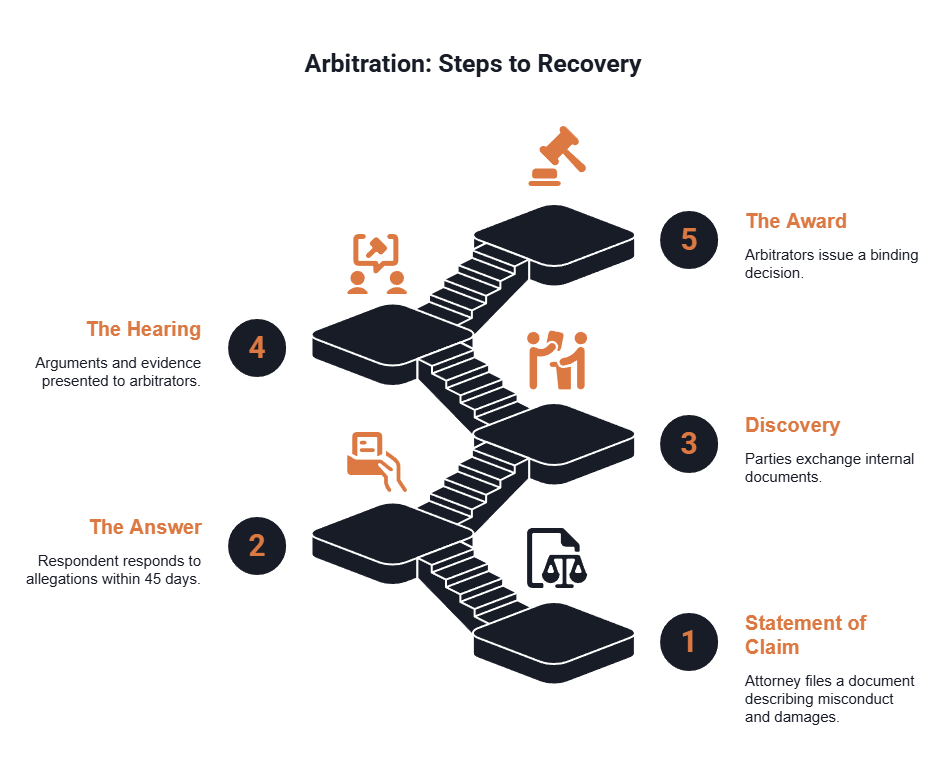
Most disputes against broker-dealers like Forge Securities LLC are resolved through arbitration rather than in court. This is often due to mandatory arbitration clauses included in investment agreements.
- Statement of Claim: An attorney files a document describing the misconduct and the damages sought.
- The Answer: The respondent has 45 days to respond to the allegations.
- Discovery: Both parties exchange internal documents, such as due diligence records and compliance files.
- The Hearing: Arguments and evidence are presented to a panel of neutral arbitrators.
- The Award: The panel issues a binding decision. If the investor prevails, the firm is required to pay the award.
Seek Professional Assistance from Meyer Wilson Werning
If you believe you were a victim of unsuitable recommendations or fraudulent schemes involving pre-IPO shares, acting quickly is vital. Meyer Wilson Werning is a nationally recognized firm that has recovered over $350 million for more than 1,000 clients since 1999. We handle these cases on a pure contingency fee basis, meaning you pay nothing unless we recover money for you.
Contact us today for a free and confidential consultation to evaluate your potential claim. Time limitations, including the six-year eligibility rule, apply to these filings. Reaching out to an attorney early can help preserve evidence and protect your rights.
Frequently Asked Questions

What are the signs that I may have a valid claim?
Common indicators include being promised “exclusive access” to shares in companies like SpaceX or OpenAI that never materialized, being pressured into illiquid investments without a clear exit strategy, or discovering your broker was involved in the Sestante Capital matter.
How long do I have to file a Forge Securities complaint?
Arbitration generally follows a six-year eligibility rule from the date of the alleged misconduct. However, specific state laws may shorten this timeframe. It is best to consult with legal counsel as soon as you suspect a loss.
What information should I gather for my case?
You should collect all account statements, emails or texts from your broker, any pitch decks or marketing materials provided, and the original account application that lists your risk tolerance and investment objectives.
Recovering Losses Caused by Investment Misconduct.