

Investors who entrusted their savings to Sean T. Sullivan may have been exposed to significant financial risks. Recent regulatory disclosures and a pending FINRA disciplinary action highlight serious allegations of unauthorized trading and unsuitable investment recommendations involving Aegis Capital Corp. These concerns primarily center on conduct involving senior investors and non-discretionary accounts, raising critical questions about broker accountability and firm-level supervision.
If you or a family member experienced losses involving Sean T. Sullivan or Aegis Capital Corp, Meyer Wilson Werning is here to help. Our attorneys handle unauthorized trading claims nationwide, and we work on a pure contingency fee, meaning you pay nothing unless we recover for you. Contact us today for a free and confidential consultation.
What Do the Allegations Reveal About Sean T. Sullivan’s Conduct at Aegis Capital Corp?
According to regulatory records, Sean T. Sullivan is the subject of a pending FINRA disciplinary action related to his tenure at Aegis Capital Corp. The allegations describe a pattern of activity where trades were placed in non-discretionary accounts for customers over age 60 without prior contact or permission. In a non-discretionary account, a broker is legally required to obtain specific client authorization for every trade. Failing to do so is a direct violation of industry standards.
The financial impact of these actions was substantial, with reports indicating that approximately $250,000 in alleged unauthorized trades occurred. Specifically, the activity involved 14 trades across four separate accounts. While Aegis Capital Corp reportedly reversed the transactions for three of these customers, a fourth client took the issue to a state regulator and transferred their assets to another firm. These Important Points highlight the potential for foreseeable harm when basic authorization protocols are ignored.

We Have Recovered Over
$350 Million for Our Clients Nationwide.
Understanding the BrokerCheck Report and Disciplinary History of Sean T. Sullivan
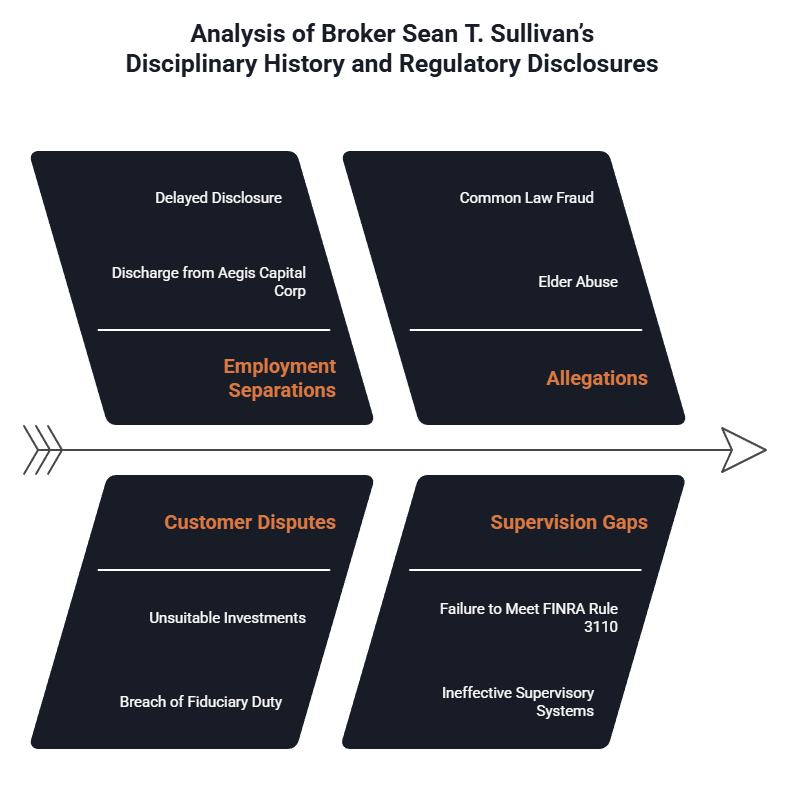
The professional history of Sean T. Sullivan (CRD# 6283466) includes multiple disclosure events and employment separations that should serve as red flags for investors. Aegis Capital Corp (CRD#: 15007) discharged Sullivan on July 8, 2022, citing alleged unauthorized trading. Interestingly, this information was not immediately transparent; a routine pre-employment review at Spartan Capital Securities (CRD#: 146251) later surfaced the issue. Sullivan’s employment history also includes stints at Sovereign Global Advisors LLC and Joseph Stone Capital L.L.C. (CRD#: 159744).
Beyond the pending FINRA matter, Sullivan’s BrokerCheck report reveals a history of significant customer disputes and settlements:
- May 25, 2025: A pending customer dispute cites earlier periods of alleged misconduct, including unsuitable investment, breach of fiduciary duty, and misrepresentation, seeking $360,000 in damages.
- Settled Claims: Past allegations involving elder abuse, common law fraud, and negligence have resulted in various outcomes, including one matter that settled for $145,000.
- Suitability and Churning: Other filings reference excessive trading and a failure to match recommendations to a client’s age, goals, or risk tolerance.
- Supervision Gaps: Several claims suggest that the firms involved failed to meet their duties under FINRA Rule 3110, which requires effective supervisory systems to address problematic trading.
How Investors Can Recover Losses Through Arbitration
When a broker exceeds client consent or recommends investments that do not fit a client’s profile, investors may have grounds for a legal claim. Recovery efforts typically proceed through arbitration, a forum designed to resolve disputes between investors and brokerage firms. These cases often hinge on demonstrating a breach of FINRA Rule 2111 (suitability) or a failure in supervision.
Success in these matters requires a detailed review of trade confirmations, account statements, and communication records. Firms have a duty to maintain accurate records under FINRA Rule 4511 and to ensure that all recommendations are in the client’s best interest. If you feel like a passenger while someone else steers your savings, these rules exist to provide you with a path toward recovery.
Our lawyers are nationwide leaders in investment fraud cases.
How Meyer Wilson Werning Supports Victims of Investment Fraud
Brokers and firms have specific duties designed to protect customers, such as FINRA Rule 2111 (suitability) and FINRA Rule 3110 (supervision). When these obligations are not met, foreseeable harm may occur. In non-discretionary accounts, authorization is non-negotiable. If you notice recommendations that do not match your age or risk tolerance, or if you see “selling away” or trading outside approved firm channels, your investment security may be at risk.
Most investor recovery efforts proceed through arbitration, a forum where disputes between clients and firms are resolved. Claims involving Sean T. Sullivan often focus on whether the firm failed to monitor for problematic trading through effective supervisory systems. By organizing documents such as trade confirmations, risk tolerance forms, and communication notes, investors can build a case to prove that the broker exceeded their authority or recommended unsuitable products.
Meyer Wilson Werning has recovered more than $350 million for investors harmed by unauthorized trading, unsuitable recommendations, and the firms that failed to supervise their brokers. If Sean T. Sullivan or Aegis Capital Corp affected your account, our attorneys will review your situation at no charge. Contact us today for a free and confidential consultation, you pay nothing unless we recover for you.
Frequently Asked Questions:
What does Sean T. Sullivan’s broker history indicate about risk to investors?
The history reflected in the BrokerCheck report for Sean T. Sullivan includes allegations of unauthorized trading and suitability concerns. If proven, these issues can lead to avoidable losses. Investors should gather statements, emails, and any written approvals to determine whether trades were discussed and authorized before execution.
What rules are brokers required to follow to protect my savings?
Key obligations include obtaining prior consent for non-discretionary trades and ensuring all recommendations are “suitable” under FINRA Rule 2111. Firms must also provide effective oversight under FINRA Rule 3110 and maintain truthful regulatory filings.
Does a pending FINRA disciplinary action affect my ability to file a claim?
No. A pending regulatory matter does not block a private claim and may actually reinforce arguments regarding a lack of supervision or authorization. However, strict time limits apply to these cases, so it is important to organize your evidence early.
How can I seek recovery for losses tied to Sean Sullivan?
Most investors seek recovery through arbitration against the responsible brokerage firm. Work with experienced counsel to organize notes, risk tolerance documents, and trade records that address consent and suitability.
Recovering Losses Caused by Investment Misconduct.