

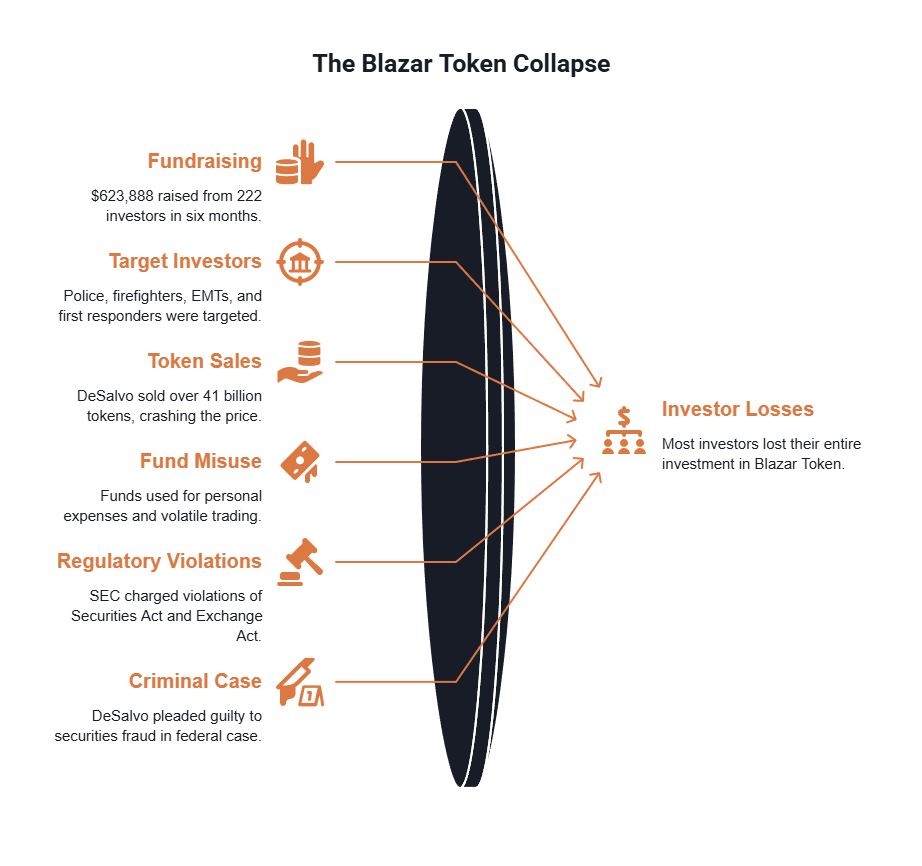
The SEC has filed a civil enforcement action alleging that former New Jersey corrections officer John A. DeSalvo raised at least $620,000 from approximately 220 investors through an unregistered crypto offering tied to a digital token called the Blazar Token. According to the complaint, DeSalvo allegedly misrepresented key facts about the token and promised high returns, targeting law enforcement and first responders.
Because DeSalvo is not a registered broker or licensed financial professional, most investors who lost money in this scheme will not have a private legal claim that Meyer Wilson Werning can pursue. MWW’s cryptocurrency fraud practice focuses on cases involving registered intermediaries, licensed advisers, and regulated platforms. If a licensed broker or adviser directed your funds into the Blazar Token, that exception may be worth exploring. For most investors here, the SEC’s enforcement action is the primary avenue.
What Does the SEC Allege About John A. DeSalvo and the Blazar Token?
The SEC’s enforcement action against DeSalvo is detailed in SEC litigation release LR-26599 in Securities and Exchange Commission v. John A. DeSalvo, which describes the civil case filed as No. 23-cv-8092-RMB-EAP in the U.S. District Court for the District of New Jersey on August 23, 2023.
According to the SEC’s complaint, DeSalvo allegedly raised at least $620,000 from about 220 investors through the Blazar Token crypto offering. The Commission alleges that DeSalvo misrepresented key facts about the token and its purported investment use, targeting retail investors who included his fellow public employees. The complaint charges DeSalvo with violations of Sections 5(a), 5(c), and 17(a) of the Securities Act of 1933, as well as Section 10(b) of the Securities Exchange Act of 1934 and Rule 10b-5.
The SEC litigation release does not identify DeSalvo as a registered broker-dealer or investment adviser. No FINRA BrokerCheck CRD number has been identified in connection with DeSalvo or the Blazar Token. The matter centers on an unregistered crypto offering rather than misconduct by a licensed brokerage professional. This means traditional BrokerCheck disclosures, customer complaint counts, and FINRA case data are unavailable for this individual.

We Have Recovered Over
$350 Million for Our Clients Nationwide.
What Remedies Does the Proposed Final Judgment Include?
On August 4, 2026, the SEC filed a consent and proposed final judgment against DeSalvo, subject to court approval. According to the litigation release, the proposed judgment would permanently enjoin DeSalvo from violating the Securities Act and Exchange Act provisions cited in the complaint. It would also impose a conduct-based injunction permanently barring him from participating in the issuance, offer, or sale of any security.
The SEC’s consent judgment ordered disgorgement of $681,105, a figure that reflects proceeds from both the Blazar Token scheme and a separate brokerage-based investment group fraud DeSalvo operated around the same time. That disgorgement obligation is deemed satisfied by the criminal restitution order entered in the parallel federal case. The SEC states that the disgorgement obligation would be deemed satisfied by a parallel criminal restitution order entered in United States v. DeSalvo, No. 24-cr-200-BRM (D.N.J.).
The DeSalvo case reflects a broader enforcement priority the SEC has formalized through its SEC Retail Fraud Working Group, an initiative announced in July 2026 specifically tasked with investigating unregistered offerings and misconduct targeting everyday investors.
Can Meyer Wilson Werning Help?
The Blazar Token scheme, as alleged by the SEC, involved an unregistered individual operating outside the licensed financial system. Because no registered broker-dealer or investment adviser has been identified as a participant in the alleged fraud, most investors who lost money in this scheme will not have an arbitration pathway available to them.
The SEC’s civil enforcement action is the government’s proceeding, not a private recovery vehicle, and it does not automatically return funds to investors. If you lost money in the Blazar Token offering, the most important first step is to confirm how you were introduced to the investment and whether any licensed financial professional played a role in directing your funds toward it.
For over 25 years, Meyer Wilson Werning has recovered more than $350 million for investors harmed by broker misconduct, investment fraud, and securities violations. In the narrow circumstances where a licensed broker or investment adviser facilitated your participation in the Blazar Token scheme, that intermediary may bear independent legal liability and MWW may be able to help.
If a licensed financial professional, broker, or advisor facilitated your investment, contact us today for a free and confidential consultation. You pay nothing unless we recover for you.
Our lawyers are nationwide leaders in investment fraud cases.
Frequently Asked Questions
What is SEC litigation release LR-26599 about?
SEC litigation release LR-26599 is a public enforcement notice describing the civil case Securities and Exchange Commission v. John A. DeSalvo, No. 23-cv-8092-RMB-EAP (D.N.J.). According to the SEC, the action alleges that DeSalvo engaged in crypto offering and investment fraud involving the Blazar Token, raising at least $620,000 from approximately 220 investors. The release describes a consent and proposed final judgment that includes permanent injunctions and $681,105 in disgorgement.
Is John A. DeSalvo a registered broker or financial adviser?
The SEC litigation release identifies DeSalvo as a former New Jersey corrections officer and does not associate him with a FINRA BrokerCheck CRD number or describe him as a registered broker or investment adviser. The case appears to center on an unregistered crypto offering rather than misconduct by a licensed securities professional.
Can I rely on SEC enforcement alone to recover my losses from a crypto scheme like the Blazar Token?
SEC enforcement actions can produce injunctions, penalties, and disgorgement orders, but they do not guarantee that each investor will recover their full losses. Affected investors often need to evaluate separate civil claims, arbitration options, or other remedies through experienced investment-fraud counsel to pursue recovery beyond what government enforcement may provide. You can find additional information on common investor FAQs on fraud and recovery.
What warning signs should investors watch for in crypto investment offerings?
Common red flags include promises of unusually high or guaranteed returns, pressure to invest quickly, a lack of SEC or state registration for the offering or the person selling it, and vague descriptions of how funds will be used. Investors should verify whether anyone soliciting an investment is properly registered before committing funds.
Recovering Losses Caused by Investment Misconduct.