

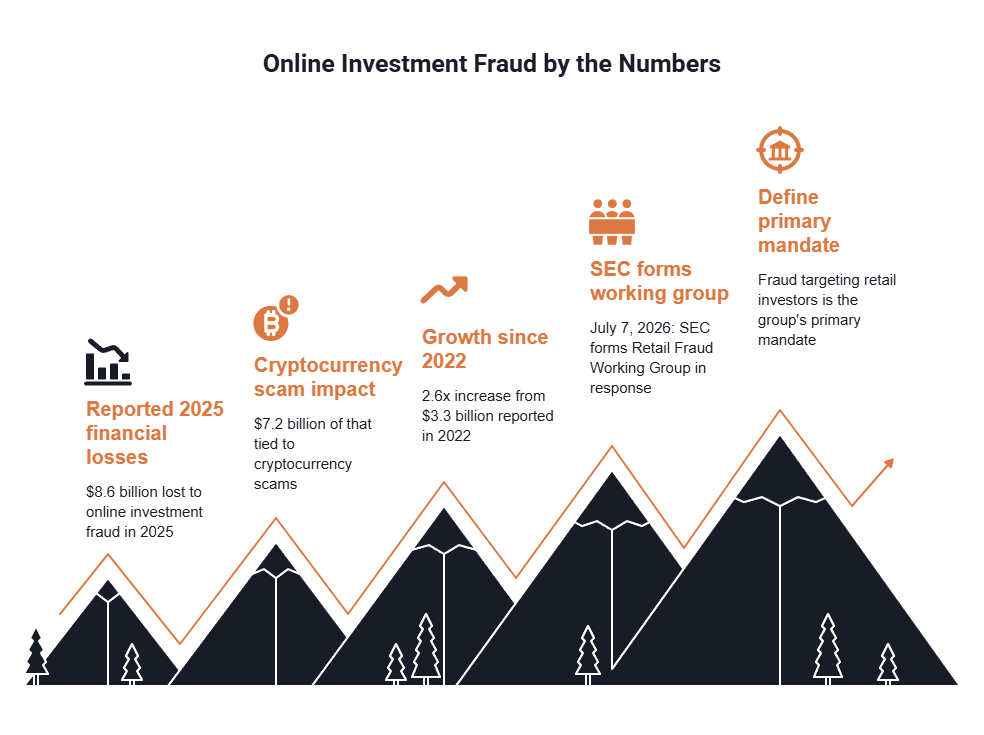
Americans lost $8.6 billion to online investment fraud last year, more than double the losses reported just three years prior. Cryptocurrency scams alone accounted for $7.2 billion of that total. The Securities and Exchange Commission has responded by forming a new internal team, the Retail Fraud Working Group, tasked with strengthening enforcement against the schemes most likely to harm everyday investors.
The formation of the group is a meaningful signal. But legal practitioners who follow SEC enforcement closely have raised an obvious question about what the agency was not already doing. And more importantly for investors who have already lost money, what does a new coordinating body actually mean for their individual recovery?
If a licensed financial professional, broker, or advisor facilitated investment losses you believe were the result of fraud or misconduct, the securities fraud attorneys at Meyer Wilson Werning can evaluate whether you have grounds for a claim. Contact us today for a free and confidential consultation, and you pay nothing unless we recover for you.
What Is the SEC Retail Fraud Working Group?
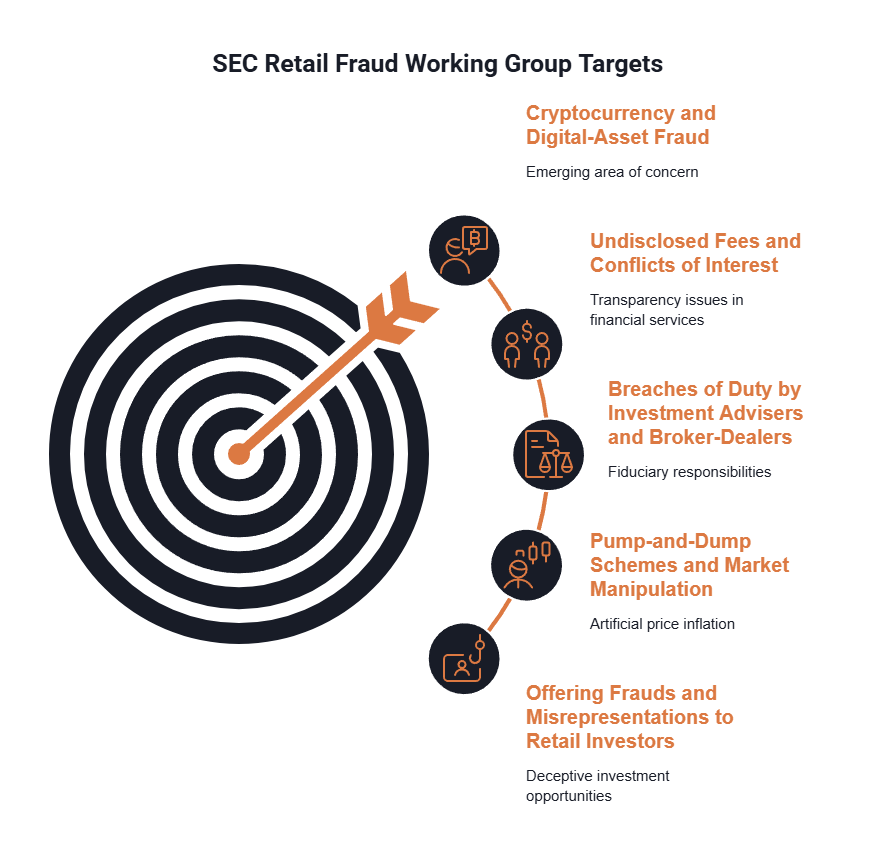
The SEC officially announced the Retail Fraud Working Group through a SEC press release announcing the Retail Fraud Working Group on July 7, 2026. According to the announcement, the group is housed within the Division of Enforcement and is tasked with identifying, investigating, and bringing enforcement actions involving fraud and misconduct directed at retail investors.
The working group is led by Kate Zoladz, Kim Frederick, and David Woodcock, according to independent commentary on the announcement. Its stated priorities include:
- Offering frauds, pump-and-dump schemes, and market manipulation targeting individual investors
- Breaches of duties by investment advisers and broker-dealers, including conflicts of interest, undisclosed fees, and unsuitable recommendations
The new group is not a separate enforcement division and does not represent a new budget allocation. It is a coordinating body that draws on existing Division of Enforcement personnel to generate proactive cases, share intelligence across SEC offices, and improve outreach to retail investors.

We Have Recovered Over
$350 Million for Our Clients Nationwide.
How Does the Retail Fraud Working Group Compare to the Retail Strategy Task Force?
The SEC previously operated an internal initiative called the Retail Strategy Task Force, launched under former Chair Jay Clayton. That task force focused on misconduct affecting retail investors and supported tools such as the SEC Action Lookup for Individuals (SALI), which allowed investors to search SEC enforcement actions by entity or individual. According to a SEC fact sheet on retail investor protection and the Retail Strategy Task Force, the earlier task force shared similar objectives around protecting retail customers from fraud.
Commentary from analysts tracking the announcement describes the Retail Fraud Working Group as structurally similar to its predecessor, with an updated mandate that places greater emphasis on adviser misconduct, private-fund fee abuses, and conflicts of interest. The practical difference may lie in the group’s explicit coordination role across the Division of Enforcement and its stated intention to proactively generate cases rather than rely solely on tips and complaints.
What the SEC Retail Fraud Working Group Can and Cannot Do for Investors
For retail investors who have experienced losses due to fraud, unsuitable advice, or undisclosed conflicts of interest, the formation of the Retail Fraud Working Group signals a renewed federal focus on the types of misconduct that most directly affect individual portfolios. But it is important to understand the limits.
SEC enforcement actions can lead to penalties, disgorgement of ill-gotten gains, and in some cases distributions to harmed investors through fair fund provisions. These actions can also generate evidentiary records, including findings of fact and administrative orders, that investors and their legal counsel may use to support private claims through arbitration or civil litigation.
The working group itself, however, does not compensate individual investors directly. Recovery of personal losses requires a separate legal claim. Investors should not assume that an SEC enforcement action alone will make them whole.
SEC Forms New Retail Fraud Working Group As Investor Losses Soar
byu/MeyerWilsonCo ininvestorclaims
Our lawyers are nationwide leaders in investment fraud cases.
What Types of Fraud Does the Working Group Cover?
Americans reported losing more than $8.6 billion to online investment fraud last year, with cryptocurrency scams accounting for $7.2 billion of that total, according to the FBI. The Retail Fraud Working Group’s mandate is broad, and the misconduct it targets takes many forms.
- Adviser and broker misconduct. Unsuitable recommendations, excessive trading, unauthorized transactions, and self-dealing by financial advisers and broker-dealers are all within the group’s scope, and all can support private recovery claims.
- Digital-asset and cryptocurrency fraud. Unregistered offerings, fake crypto exchanges, and pump-and-dump schemes driven through social media are a stated priority for the group.
- Offering frauds and Ponzi schemes. The group’s mandate covers fraudulent offerings that misrepresent returns, risks, or the use of investor funds.
In each of these categories, an SEC enforcement action may run parallel to, but does not replace, a private claim for individual losses.
We Are The firm other lawyers
call for support.
How Meyer Wilson Werning Can Help
While SEC enforcement actions can hold bad actors accountable, individual investors typically need to pursue their own claims to recover lost funds. Meyer Wilson Werning represents investors nationwide in FINRA arbitration and securities litigation involving broker misconduct claims for unsuitable or fraudulent recommendations, fiduciary breaches, and fraud schemes.
With more than 75 years of combined experience and over $350 million recovered for clients across the country for over 25 years, the experienced attorneys at Meyer Wilson Werning can evaluate whether an SEC enforcement action, regulatory finding, or pattern of misconduct supports a viable recovery claim on behalf of a harmed investor.
Contact us today for a free and confidential consultation to discuss your options.
Frequently Asked Questions
What is the SEC Retail Fraud Working Group and why was it created?
The SEC Retail Fraud Working Group is a new coordinating team within the SEC’s Division of Enforcement, formed in July 2026 to strengthen efforts against fraud targeting everyday investors. According to the SEC’s announcement, it was created to improve the agency’s ability to proactively identify and bring enforcement actions involving offering frauds, pump-and-dump schemes, market manipulation, and breaches of duty by advisers and broker-dealers.
What kinds of investment fraud will the Retail Fraud Working Group focus on?
According to the SEC, the group will target fraud and misconduct directed at retail investors, including offering frauds, pump-and-dump schemes, and market manipulation. Independent commentary suggests the group will also prioritize conflicts of interest, undisclosed fees, unsuitable recommendations, and private-fund fee abuses.
How does the Retail Fraud Working Group differ from the SEC’s earlier Retail Strategy Task Force?
The Retail Strategy Task Force was an earlier internal SEC initiative with similar goals, launched under former Chair Jay Clayton. Analysts describe the new Retail Fraud Working Group as structurally comparable but with an updated mandate that places more explicit emphasis on adviser misconduct and proactive case generation within the Division of Enforcement. It is not a new division or a new budget line.
How does the Retail Fraud Working Group affect investors who have already lost money?
The working group does not directly compensate investors. However, SEC enforcement actions it generates may lead to penalties, disgorgement, or fair-fund distributions. Enforcement findings can also create evidentiary records that investors and their attorneys may use to support private recovery claims through FINRA arbitration or civil litigation.
Recovering Losses Caused by Investment Misconduct.