


Harlan Mountain Investments LLC, a Delaware limited liability company, filed a Regulation D, Rule 506(b) equity offering with the SEC under CIK 0001751434, reporting a first-sale date of August 30, 2018. The SEC Form D and an amended Form D/A filed on October 16, 2018 state a total offering amount of $11,701,200 in the Other Real Estate sector. Investors in this private placement may face risks such as limited liquidity, limited disclosure, and the overall structure of the investment.
Investors who have questions about losses connected to a private placement like this one can learn more about alternative investment claims and the options that may be available.
What Happened With Harlan Mountain Investments LLC
SEC filings show that Harlan Mountain Investments LLC sought to raise $11,701,200 through a Regulation D, Rule 506(b) offering. The offering, which secondary sources describe as sponsored by Webb Creek Management Group, was structured as an equity private placement in the real estate sector. The SEC filing identifies Bryan Kelley as an executive officer of the company.
Key details from the SEC filings and secondary reporting include:
- The initial SEC Form D was filed with a reported first-sale date of August 30, 2018, under CIK 0001751434.
- A Form D/A amendment was filed on October 16, 2018. According to secondary sources, the amendment continued to list the offering as unsold.
- The minimum investment accepted was $119,400, according to the SEC filing.
- Secondary sources report estimated sales commissions of approximately $1,170,120.
- Those same sources report that approximately $2,685,000 was proposed for payments to executive officers and promoters.
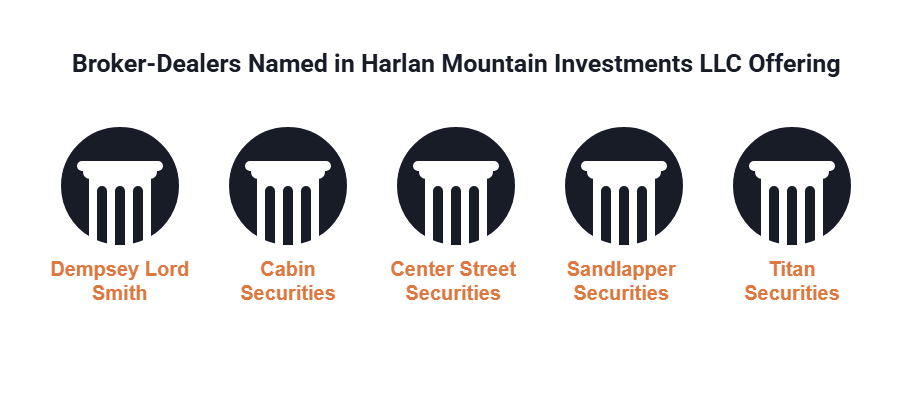
- Five broker-dealers were identified in secondary reporting as recipients of sales compensation: Dempsey Lord Smith, LLC, Cabin Securities, Inc., Center Street Securities, Inc., Sandlapper Securities, LLC, and Titan Securities, Inc.
- Despite the amendment listing the offering as unsold, secondary sources indicate that investors reportedly purchased interests in the offering.

We Have Recovered Over
$350 Million for Our Clients Nationwide.
Compensation, Disclosure, and Liquidity Issues
First, the reported compensation structure is significant. Estimated sales commissions of approximately $1,170,120 on an $11,701,200 offering amount represent roughly 10% of the total raise. An additional $2,685,000 was reportedly proposed for payments to executive officers and promoters. High upfront costs like these reduce the amount of investor capital that actually goes to work in the underlying real estate project.
Second, the discrepancy between the amendment listing the offering as unsold and reports that investors did purchase interests raises questions about the accuracy of the offering’s regulatory filings. The Form D/A does not establish how much was ultimately sold, which leaves a gap in the public record.
Third, private placements like this are typically illiquid. Unlike publicly traded stocks or bonds, there is generally no secondary market where investors can sell their interests if they need access to their capital or want to exit the investment.
How Meyer Wilson Werning Can Help
Because Harlan Mountain Investments LLC was not registered is the securities industry, Meyer Wilson Werning is unable to pursue claims directly against them. However, if investors experienced losses with Harlan Mountain Investments LLC through broker-dealers or licensed financial advisors, an experienced attorney may be able to help.
With more than 75 years of combined experience, Meyer Wilson Werning represents investors nationwide in cases involving financial advisor negligence and alternative investments. The firm works on a contingency fee basis, meaning if it is not able to recover your losses, its services are at no cost to you.
Contact us today for a free and confidential consultation to discuss your options.
Our lawyers are nationwide leaders in investment fraud cases.
Frequently Asked Questions
What is a Regulation D, Rule 506(b) private placement?
A Rule 506(b) private placement is a securities offering that is exempt from full SEC registration. Issuers can raise an unlimited amount of money but are restricted to selling to accredited investors and a limited number of non-accredited investors. Because these offerings are not registered, they typically provide less disclosure than publicly traded securities.
What obligations do broker-dealers have when recommending private placements?
Broker-dealers are required to perform a reasonable investigation of any private placement before recommending it to clients. This includes looking into the issuer, the offering terms, the compensation structure, and the risks involved. A broker-dealer that fails to conduct an adequate review or recommends an unsuitable illiquid investment may be held accountable through arbitration or other legal proceedings.
Are high sales commissions in a private placement a red flag?
High sales commissions can be a warning sign because they reduce the amount of investor capital that is deployed in the underlying investment. When a significant percentage of the offering amount goes to compensate broker-dealers, promoters, and executives, investors may receive less value for their investment. Broker-dealers are generally required to disclose these costs to their clients before recommending a purchase.
Recovering Losses Caused by Investment Misconduct.