


The SEC’s Office of Investor Education and Advocacy has formally warned that some investment newsletters are used to carry out fraudulent schemes, including touting stocks without disclosing compensation, pump and dump operations, scalping, and false performance claims.
Many investors treat newsletter recommendations as independent research, but regulators have documented how these publications can function as tools for market manipulation. Losses tied to undisclosed paid stock promotions are a recognized and persistent form of investment fraud that continues to harm individual investors across the country.
How Fraudulent Investment Newsletters Work
According to the SEC’s formal Investor Alert, several distinct schemes are commonly carried out through investment newsletters.
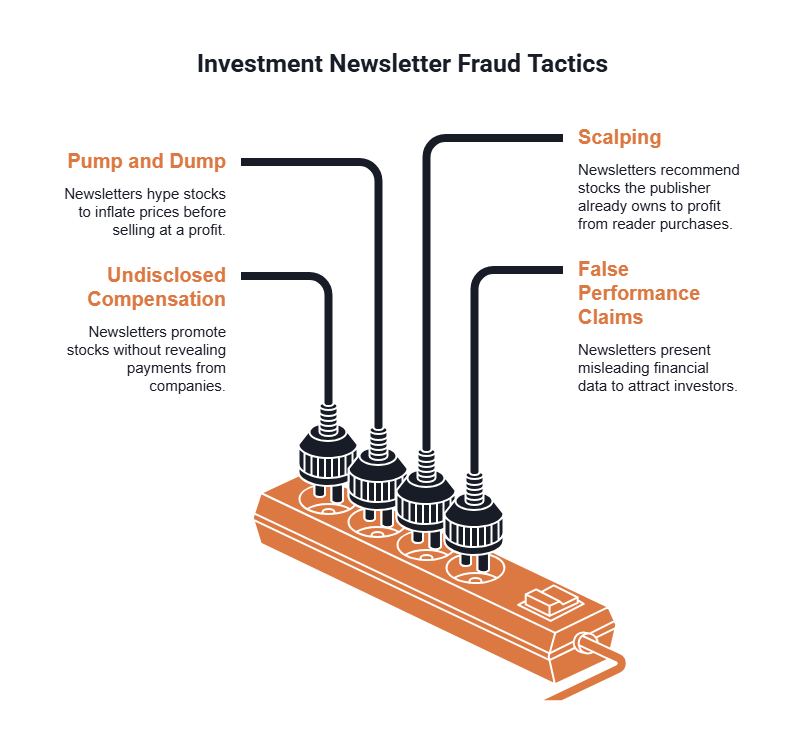
- Touting and undisclosed compensation. Some newsletters promote specific stocks without disclosing that the publisher received payment. Under federal securities laws, anyone compensated to promote a stock must disclose who paid them, how much, and in what form. SEC guidance on checking out investment newsletters and paid stock promotion advises investors to be suspicious of vague or buried compensation disclosures.
- Pump and dump schemes. Fraudsters acquire shares of a thinly traded stock, hype it through newsletters to drive up the price, then sell their shares at the inflated level before the stock collapses.
- Scalping and conflicts of interest. Some publishers recommend securities they already own, then sell for a profit once readers follow the recommendation and push the price up. The SEC Investor Alert: Investment Newsletters Used as Tools for Fraud identifies this as a recurring pattern.
- False performance claims. Warning signs include cherry-picked returns, unverifiable gain testimonials, and missing or boilerplate risk disclosures.
Investors who believe a broker acted on or relayed fraudulent newsletter recommendations may have claims based on broker misconduct.


We Have Recovered Over
$350 Million for Our Clients Nationwide.
What This Means for Investors
Fraudulent investment newsletters cause real financial harm. Investors who act on undisclosed paid promotions often buy at artificially inflated prices and face steep losses once the promotion ends. Investor.gov materials identify common warning signs such as promises of unusually high returns and pressure to buy immediately, and investors can search our broker complaint database to review the background of any broker or firm involved.
For those who have already suffered losses, recovery options depend on the facts. Claims tied to a broker who acted on fraudulent newsletter recommendations may be pursued through arbitration, while broader stock promotion schemes may call for securities litigation. Preserving newsletter communications, account statements, and any broker correspondence is an important first step toward evaluating your investment loss recovery options.
How Meyer Wilson Werning Can Help
Meyer Wilson Werning represents investors nationwide who have been harmed by investment newsletter fraud, stock promotion undisclosed compensation, and broker misconduct in stock touting. With over 25 years of experience and over $350 million recovered for clients, the experienced attorneys at Meyer Wilson Werning understand how deceptive newsletter promotions, pump and dump schemes, and related misconduct affect individual investors.
If you lost money after acting on a fraudulent investment newsletter or suspect that a licensed broker or financial professional failed to disclose compensation for stock promotion, contact us today for a free and confidential consultation to discuss your options.
Our lawyers are nationwide leaders in investment fraud cases.
Frequently Asked Questions
What is investment newsletter fraud?
Investment newsletter fraud occurs when a publication that appears to offer independent investment research is instead used to promote stocks deceptively, often without disclosing that the publisher or writer is being paid to tout particular securities. According to the SEC, these schemes can involve touting, pump and dump operations, scalping, undisclosed conflicts of interest, and false performance claims.
How can I tell if an investment newsletter is part of a pump and dump scheme?
Warning signs include promises of unusually high returns, pressure to buy immediately, vague or missing disclosures about compensation for stock promotion, and newsletter authors who appear to profit when readers follow their recommendations. The SEC warns that pump and dump schemes typically involve fraudsters hyping a stock to drive up its price and then selling their own shares at the inflated level.
What disclosures should an honest investment newsletter provide?
Regulators advise that legitimate newsletters should clearly state whether they received payment to recommend a stock, how much they received, what form the payment took, and who paid them. These disclosures should be presented prominently rather than buried in tiny print or hard-to-find sections of the publication.
What steps should I take before investing based on an investment newsletter?
The SEC recommends independently investigating any investment before acting on a newsletter’s advice. That includes searching SEC.gov for enforcement or regulatory actions, contacting your state securities regulator, and using the SEC’s IAPD and FINRA’s BrokerCheck to review the registration and disciplinary history of any person or firm associated with the newsletter.
Recovering Losses Caused by Investment Misconduct.