


People who take Suboxone are doing one of the hardest things a person can do. Treatment for opioid use disorder works, it saves lives, and the patients in this litigation followed their prescriptions exactly as directed, often for years. What they were not told is that the film dissolving under their tongue was acidic enough to destroy their teeth.
The injuries in these cases are not cavities. They are patients in their thirties losing every tooth they have, needing full extractions, implants, and reconstruction, and carrying the disfigurement and the cost of it afterward. Many had no dental problems at all before starting treatment. Indivior did not add a dental warning to the Suboxone label until June 2022, years after the risk appeared in the medical literature and months after the FDA forced the issue.
Meyer Wilson Werning is helping lead this litigation. Attorney Layne Hilton serves on the Plaintiffs’ Executive Committee in the federal Suboxone MDL, which is the body that sets strategy for the entire case. This page explains what these claims require, where the litigation genuinely stands including a trial timeline, and the single most common reason claims are being lost right now. If you are currently taking Suboxone, do not stop. We explain why below. Whether your dental records support a claim is a separate question, and a free and confidential case review will answer it.
Who May Have a Claim
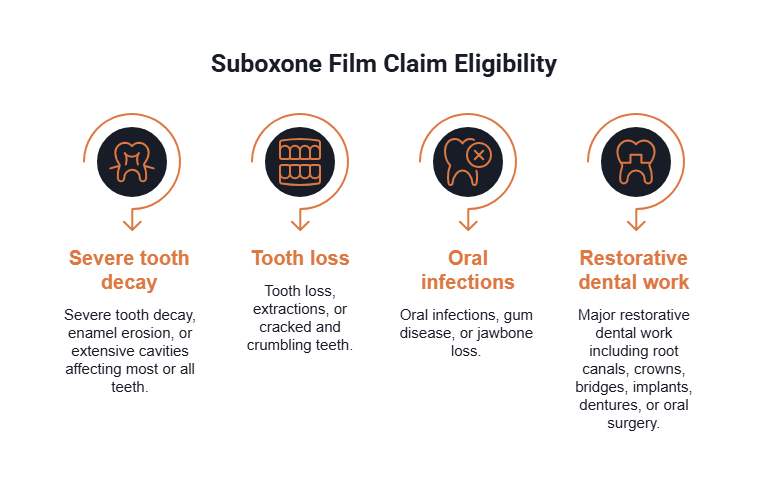
You may have a claim if you used Suboxone sublingual film or another dissolvable buprenorphine product and developed serious dental problems afterward.
-
- Severe tooth decay, enamel erosion, or extensive cavities, in some cases affecting most or all of the teeth at once.
- Tooth loss, extractions, or cracked and crumbling teeth.
- Oral infections, gum disease, or jawbone loss.
- Major restorative dental work, including root canals, crowns, bridges, implants, dentures, or oral surgery.
Two things strengthen a claim considerably. The first is that your dental health was reasonably good before you started treatment, which is what separates these injuries from the general dental problems common in people who used opioids. The second is that your use began before the June 2022 label change, when no warning existed at all. Neither is an absolute requirement, and later use can still support a claim depending on what you were told.

We Are The firm other lawyers
call for support.
Our Role in This Litigation
Layne Hilton’s appointment to the Plaintiffs’ Executive Committee in MDL No. 3092 is a court-appointed leadership position, and it is a meaningful distinction. The Executive Committee directs overall strategy, coordinates discovery across the entire litigation, shapes which cases become bellwether trials, and sits at the table in any settlement negotiation.
Most firms advertising Suboxone cases are not in that room and will refer your file to someone who is. We are already there. Practically, that means your case is handled by our attorneys, who know what the internal documents contain, what the court expects from plaintiffs, and where this litigation is actually heading rather than where advertising says it is. Layne Hilton also serves on the Plaintiffs’ Steering Committees in the Valsartan lawsuits and the rideshare sexual assault lawsuits against Uber.
Why the Film Damages Teeth
Suboxone film is placed under the tongue or against the cheek and held there for five to ten minutes while it dissolves. The dissolving film is acidic, and it sits in direct contact with tooth enamel for the entire time, every dose, often multiple times a day for years.
Buprenorphine also causes dry mouth. Saliva is what normally neutralizes acid and washes it away, so when saliva production drops, the acid stays on the teeth longer and does more damage with nothing to buffer it. Research presented to addiction medicine specialists has found that saliva could not effectively buffer the acid released as these products dissolve, with exposure falling below the pH threshold at which enamel begins to demineralize.
That combination, direct acid contact plus suppressed saliva, is why patients with good oral hygiene and no prior history still lost teeth. This was a foreseeable property of the formulation, not a mystery, which is the foundation of the claims against Indivior and Aquestive.
We Have Recovered Over
$350 Million for Our Clients Nationwide.
What the FDA Found, and When
In January 2022, the FDA issued a Drug Safety Communication warning that buprenorphine medicines dissolved in the mouth could cause serious dental problems including tooth decay, cavities, oral infections, and tooth loss. The agency had identified 305 reported cases, 131 of them classified as serious. Some patients had lost all of their teeth. The most common treatment was extraction.
The FDA emphasized the point that matters most legally: these problems occurred in patients with no prior history of dental trouble. Indivior did not update the Suboxone label until June 2022. That gap is the basis of a failure to warn claim, the same theory behind the GLP-1 drug lawsuits, the Dupixent lawsuits, and the gabapentin dementia claims involving a drug widely prescribed as an alternative to opioids.
In December 2022, a study published in JAMA examined health claims data covering roughly 33,000 patients receiving different treatments for opioid use disorder. Patients on sublingual buprenorphine and naloxone experienced dental adverse events at 21.6 per 1,000 person-years, compared with 12.2 for transdermal buprenorphine and 10.9 for oral naltrexone. For cavities and tooth loss specifically, the rate was more than double that of either comparison group. After adjustment, the authors reported a 42 percent higher risk of any dental event and a 57 percent higher risk of cavities or tooth loss relative to the transdermal form.
Our lawyers are nationwide leaders in investment fraud cases.
What Indivior Knew
Published case reports linking sublingual buprenorphine to severe dental decay date to 2012, a decade before any warning appeared on the label. The acidity of the formulation was not a discovery, it was a known characteristic of the product.
In October 2025, the court ordered Indivior and Aquestive to produce internal records including FDA filings, marketing materials, and adverse event reports. That production is where the case on corporate knowledge will be built, and it is the reason this litigation moved from allegation toward evidence.
Where the Litigation Stands
Federal cases are consolidated as MDL No. 3092 in the Northern District of Ohio before Judge J. Philip Calabrese, established in February 2024. Nearly 30 attorneys serve in court-appointed leadership roles.
The court’s docket showed roughly 1,827 cases pending as of August 2026, while attorneys involved estimate around 11,000 total claims when unfiled and tolled claims are counted. The docket figure has recently declined slightly, which is discussed in the section below.
Judge Calabrese has entered a schedule, and it puts the first bellwether trial on a path to begin in March 2028. Core discovery ran through 2026, depositions in the selected cases continue into January 2027, dispositive motions are due in March 2027, and the group narrows to four trial cases by June 2027. There is no global settlement, and serious settlement pressure typically arrives as trials approach.
Why Cases Are Being Dismissed, and How to Avoid It
This is one of the most important things on this page.
The court requires plaintiffs to produce records proving both that they used the product and that they were injured. Cases are being dismissed for failing to meet those obligations, and that is why the pending count has gone down rather than up. Some of that is not the plaintiffs’ fault. Pharmacies and third-party record custodians have refused to produce records despite repeated orders, to the point that the court has scheduled contempt proceedings. But the case gets dismissed regardless of whose fault the gap is.
What this means for you is concrete. Start gathering your own records now. Pharmacy printouts of your prescription history, dental records covering the period before and after you started treatment, and the records of every dental provider who treated the damage. If you have moved, changed pharmacies, changed dentists, or been treated at a clinic that has since closed, say so early so it can be chased down while it is still possible.
What Strengthens a Claim
- Pharmacy records showing the full prescription history, including which product, what dose, and over what period. Insurance claim histories fill gaps when pharmacy records are incomplete.
- Dental records from before you started Suboxone, which establish your baseline. This is the single most valuable document in these cases.
- Dental records documenting the damage, including x-rays, treatment notes, extraction records, and the treatment plan going forward.
- Bills and estimates, covering what you have already paid and what reconstruction will cost. Future dental costs are frequently the largest component of these claims.
- Photographs, if you have them, from before and after.
Protecting Your Teeth and Your Recovery
- Do not stop taking Suboxone because of this page. Stopping medication for opioid use disorder carries a serious risk of relapse and overdose. Your recovery matters more than any claim, and no lawsuit is worth that risk. Any change belongs to you and your prescriber.
- Rinse after each dose. The FDA advises taking a large sip of water after the film has fully dissolved, swishing it gently around the teeth and gums, then swallowing, and waiting at least an hour before brushing. This is simple, it costs nothing, and it reduces the acid sitting on your enamel.
- Tell your dentist you take Suboxone. They can monitor for early damage and may recommend protective treatments. Many patients never mention it because of the stigma attached, and that silence costs them teeth.
- See a dentist even if you expect bad news. Documented treatment is what a claim is built on, and untreated damage only gets more expensive.
- Request your records now, particularly from before you started treatment. These become harder to obtain with time.

Contact a Suboxone Dental Injury Lawyer
If you lost teeth while doing exactly what your doctor told you to do, that is worth pursuing, and it is worth pursuing with a firm that sits on the leadership committee running this litigation rather than one that will hand your file to somebody else.
Meyer Wilson Werning understands what these injuries cost beyond the dental bills, including what it does to a person to be visibly marked by a medication they took to get well. You will not be judged here for how you came to be prescribed this drug. Contact us by phone or through our online form for a free and confidential consultation.
Recovering Losses Caused by Investment Misconduct.