



Dupixent was supposed to be the answer. For people who had spent years cycling through steroid creams and light therapy for severe eczema that would not respond to anything, a biologic injection that finally calmed the inflammation was life changing, and for most patients it still is. This page is not about the people it helped.
It is about a smaller group of patients whose rash was never eczema at all, or whose eczema was hiding something else. Cutaneous T-cell lymphoma is a rare cancer of the immune system that shows up on the skin as red, scaly, itchy patches. It looks almost exactly like eczema, and it is routinely mistaken for it. Lawsuits filed against Sanofi and Regeneron allege that Dupixent can accelerate that cancer, or quiet the surface symptoms while the disease underneath keeps progressing, and that both companies had the evidence and never put a warning on the label.

Meyer Wilson Werning is evaluating claims for patients diagnosed with cutaneous T-cell lymphoma or another T-cell lymphoma after taking Dupixent, and for families who lost someone. This page explains what the research shows, including where it is disputed, what the federal litigation looks like right now, and what we would need to review. If you are currently taking Dupixent, do not stop based on anything you read here. That is a conversation for you and your physician. Whether your records support a claim is a separate question, and a free and confidential case review will answer it.
Who May Have a Dupixent Claim
You or a family member may have a claim if Dupixent was prescribed and one of the following followed.
- A diagnosis of cutaneous T-cell lymphoma. This includes mycosis fungoides and Sezary syndrome, the two most common forms, whether the diagnosis came during treatment or after stopping.
- A diagnosis of another T-cell lymphoma, including peripheral T-cell lymphoma. The panel overseeing this litigation left the door open for these cases specifically.
- A cancer diagnosis that arrived after years of treatment for something else. Many people in this litigation were treated for eczema or psoriasis for a long stretch before a biopsy found lymphoma.
- The death of a family member. Where a loved one died of T-cell lymphoma after taking Dupixent, a wrongful death claim may be available to the estate or surviving family.
Dupixent is approved for atopic dermatitis, asthma, chronic rhinosinusitis with nasal polyps, eosinophilic esophagitis, and other conditions. The claim does not depend on which condition it was prescribed for.

We Are The firm other lawyers
call for support.
What CTCL Is, and Why It Gets Missed
Cutaneous T-cell lymphoma begins in T-lymphocytes, the white blood cells that make up part of the immune system. Unlike most lymphomas, it shows up first in the skin rather than in lymph nodes, producing patches, plaques, and persistent itching that can go on for years before anyone suspects cancer. In later stages it can spread to lymph nodes, blood, and internal organs. Cutaneous T-cell lymphoma is a type of non-Hodgkin lymphoma, the same family of cancers at issue in the Camp Lejeune toxic water claims.
The diagnostic problem is real and it predates this litigation. Early CTCL and severe eczema can be nearly indistinguishable, not only to a patient but to a dermatologist, and even a skin biopsy can read as inflammation rather than malignancy in the early stages. Patients are frequently treated for eczema for years before the correct diagnosis arrives. That delay matters, because CTCL caught early is often manageable for a long time, while advanced disease is considerably harder to treat.
This is the backdrop against which these lawsuits were filed. A drug prescribed for a stubborn rash, given to a population where some portion of those rashes are undiagnosed cancer, with no instruction on the label to consider that possibility first.
What the Research Shows
Several published studies have reported an association between Dupixent and cutaneous T-cell lymphoma, and the honest summary is that the association is real but the reason for it is genuinely disputed.
- A 2024 retrospective cohort study in the Journal of the American Academy of Dermatology found roughly four times the odds of CTCL among eczema patients treated with dupilumab compared to those who were not, with most cases diagnosed more than a year after treatment began.
- A 2025 analysis of FDA adverse event reports in the Journal of Investigative Dermatology examined the CTCL reports accumulating in the federal database.
- A 2025 study in the Journal of Allergy and Clinical Immunology looked at the biological mechanism, proposing that blocking the IL-4 and IL-13 pathways may remove immune pressure that had been holding early cutaneous lymphoma in check.
- Case reports across multiple journals describe patients whose skin disease worsened or progressed after starting the drug.
Dermatologists and the manufacturers have published substantial criticism of that research, and a page that hid this from you would not be worth reading. The core objection is that the comparison groups were not equivalent. Patients who receive a biologic tend to have more severe disease, and severe eczema is itself associated with higher CTCL risk, so the drug may be a marker for severity rather than a cause. Critics also note that dupilumab can produce benign lymphoid reactions that mimic lymphoma and may have been miscoded in database studies.
We Have Recovered Over
$350 Million for Our Clients Nationwide.
Why the Scientific Dispute Does Not Resolve These Cases
The central scientific question is whether Dupixent causes cutaneous T-cell lymphoma or whether it unmasks a cancer that was already there and misdiagnosed as eczema. Both answers support a failure to warn claim, which is what most people miss about this litigation.
If the drug accelerates the disease, the companies had a duty to say so. If the drug instead unmasks a cancer that was already present, then physicians needed to be told to consider lymphoma before prescribing, to biopsy patients whose disease behaves unusually, and to reassess anyone who worsens on treatment. The failure to warn is the same failure in either scenario. The complaints in this litigation make exactly that argument: the prescribing information did not mention cutaneous T-cell lymphoma, did not advise ruling it out before starting treatment, and did not instruct physicians to monitor patients whose skin disease failed to improve. Failure to warn is the same theory at the center of other pharmaceutical litigation, including the GLP-1 drug lawsuits involving Ozempic and Mounjaro, the Suboxone lawsuits, and earlier Invokana amputation claims.
Causation will still have to be proven patient by patient, and that is genuine work involving pathology, treatment timelines, and expert testimony. It is not a reason to assume you have no case.
Our lawyers are nationwide leaders in investment fraud cases.
What the FDA Has Done, and What the Label Still Does Not Say
In March 2025, the FDA added dupilumab and cutaneous T-cell lymphoma to its Potential Signals of Serious Risks list, drawn from its adverse event reporting database. That listing is a formal acknowledgment that the agency identified a possible safety issue warranting evaluation. It is not a finding that the drug causes cancer, and the FDA has been explicit that appearing on the list does not establish a causal relationship.
What has not happened is a label change. As of this writing, the FDA-approved prescribing information for Dupixent contains no warning about cutaneous T-cell lymphoma or lymphoma risk. The label has been updated for other purposes since the signal was identified, including new approved indications. Plaintiffs argue that a manufacturer aware of a safety signal has an obligation to act on it rather than wait to be compelled, and that the absence of any warning left both patients and prescribing physicians without information they needed.
Where the Litigation Stands
On June 4, 2026, the U.S. Judicial Panel on Multidistrict Litigation created MDL No. 3180, In re: Dupixent (Dupilumab) Products Liability Litigation, and centralized the federal cases in the District of New Jersey before Judge Zahid N. Quraishi. Fifteen cases were transferred initially, with additional tag-along actions identified, and the docket has continued to grow through the summer.
This is an early stage proceeding, and being early is the point. There have been no trials, no verdicts, and no settlements. The initial case management conference is set for October 1, 2026, and the schedule that follows will determine how quickly discovery moves and when the first cases might be tried.
For families weighing whether to act now or wait, early filing has practical consequences. Cases filed before the litigation matures tend to be better positioned in bellwether selection, and more importantly, statutes of limitations run regardless of what stage the MDL is in. Some states begin the clock at diagnosis, others when the connection to a drug could reasonably have been discovered, and those differences are significant.
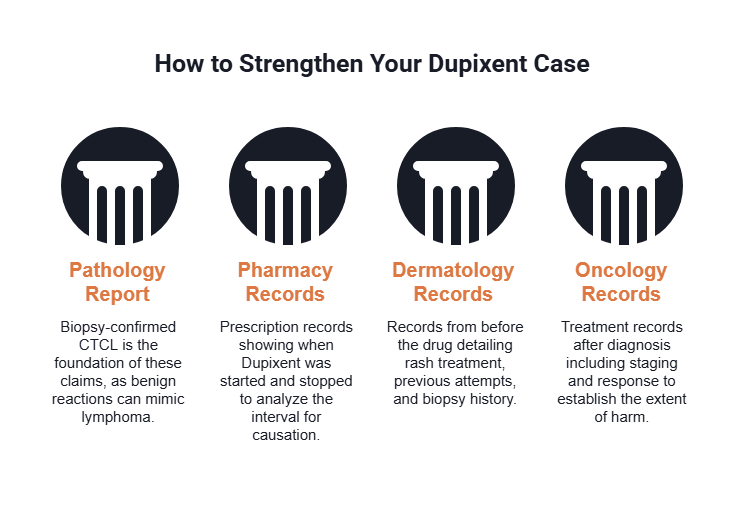
What Strengthens a Dupixent Claim
These are pharmaceutical cases, which means they are built on records rather than recollection. Most of what matters already exists in a file somewhere, and we can help obtain it.
- The pathology report confirming the diagnosis. Biopsy-confirmed CTCL is the foundation of these claims, and it matters here more than in most litigation, because benign reactions can mimic lymphoma and the defense will raise that.
- Prescription and pharmacy records showing when Dupixent was started and stopped. The interval between first injection and diagnosis is central to the causation analysis.
- Dermatology records from before the drug. How long the rash was treated as eczema, what was tried, whether biopsies were taken and what they showed.
- Oncology and treatment records after diagnosis, including staging, treatment, and response, which establish the extent of the harm.
If a family member has died, the estate can generally pursue the claim, and the records above remain obtainable by the personal representative.
What to Do If You Were Diagnosed After Taking Dupixent
- Do not stop taking a prescribed medication on your own. If you have concerns about Dupixent, raise them with the physician who prescribed it. Stopping a biologic abruptly carries its own risks, and no legal claim is worth compromising your health over.
- Ask about a biopsy if your skin disease is not behaving as expected. Persistent patches that do not respond to treatment, or that worsen on it, are worth a conversation with a dermatologist about ruling out lymphoma.
- Request your records now. Pharmacy records, dermatology charts, and pathology reports are easier to obtain the sooner you ask, and providers do not keep everything indefinitely.
- Write down the timeline while it is fresh. When symptoms started, when you were first treated for eczema, when you started Dupixent, and when the diagnosis came.
- Have someone review it. A short conversation is usually enough to tell whether the timeline and records support a claim.

Contact a Dupixent Lawyer
If you were diagnosed with cutaneous T-cell lymphoma or another T-cell lymphoma after taking Dupixent, the question worth answering is what your records show, and that is something we can determine without any commitment from you.
Meyer Wilson Werning handles complex pharmaceutical litigation against manufacturers with enormous resources and every incentive to defend a drug this commercially successful. We will tell you honestly what we think of your case, including if we do not think you have one. Contact us by phone or through our online form for a free and confidential consultation.
Recovering Losses Caused by Investment Misconduct.